

Péter Prokop: Camp Drawings (1956)
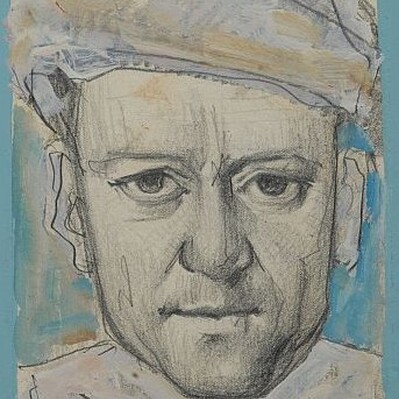
“There was an enormous number of models. They would sit down quite cheerfully and did not begrudge me their boring, idle hours. (...) My folders became full.” — writes the priest-painter in his memoir.
Péter Prokop (1919–2003), painter, spent three months from January 1957 as a refugee in Yugoslavia, being transported from one camp to another. During this time, in the drawing folder he had brought with him, he portrayed Hungarian refugees like himself. The works came to Hungary when the painter finally resettled there, and later entered the collection of the Christian Museum in Esztergom as part of his estate.
The drawings were made in pencil, chalk, or walnut stain, and are mostly frontal portraits. The artist merely indicates the neck and shoulders; for him, the most important thing was to reveal the expressive face, the gaze, the eyes — the mirror of the soul. The most expressive pieces in the series are the walnut-stain drawings, in which the forms of the head are developed more plastically than in the pencil drawings. Prokop’s gallery of refugee portraits could be called refugee art, or at least emigrant art. (György Sümegi, 2010)
References:
Péter Prokop: Autobiographical Recollections. In: Mária Prokopp, Péter Prokop. Szeged: University of Szeged, Faculty of Humanities, Department of Italian, 2003, pp. 113–136.
György Sümegi: “Elements from the Pictorial Archive of 1956.” In:
https://epa.oszk.hu/03900/03940/00175/pdf/EPA03940_mszemle_2010_09-10-146-154.pdf
György Sümegi: “Péter Prokop and the 1956 Revolution.” In: The Impact of the 1956 Revolution on the Churches of the Neighbouring Countries. Ed. István Zombori. Hungarian Ecclesiastical History Encyclopaedia Working Group (METEM), Budapest, Historia Ecclesiastica Hungarica Foundation, 2009, pp. 131–147.