

Bazsonyi, Arany (1928-2011) Graphics
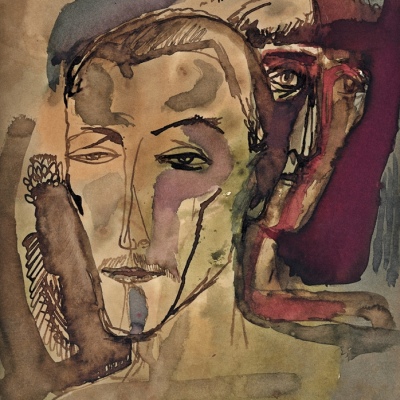
Arany Bazsonyi (1928–2011) created lasting works in several branches of art: murals, watercolours, oil paintings, drawings, and poems all came from her hand. Her visual art and poetry can often be understood and interpreted only together. Her main sources of inspiration were her childhood in Tolna, her family, the historical events she experienced, and her deep Christian faith.
Her graphic oeuvre, spanning more than half a century, is diverse both in content and aesthetics, and shows varying degrees of intensity. An important historical, social, and biographical factor in her career was her difficult beginning. After she was forced to abandon her studies at the Academy, she devoted little time to the visual arts for five years. In 1957, having given up teaching, she turned fully towards art.
Throughout her life, she maintained deep and close relationships not only with visual artists, but also with poets and writers, as she herself was a poet. Her early career was connected to the realist workshop of Hódmezővásárhely. From the second half of the 1970s, her creative method moved closer to surrealist, associative composition. Many of her graphic works are difficult to decipher at first sight; often only the title provides some help in interpretation.
Classical iconographic and motif-historical analysis can greatly assist in interpreting many of her works, especially drawings with Christian themes. However, when the title does not refer to religious content despite the visual tradition, the viewer or analyst may often become uncertain as to whether a Christian interpretation may legitimately be attributed to the work.
Among her symbols, one of the most important is the child standing in a tree, which for Bazsonyi expresses childlike innocence and freedom. Birds and flowers frequently appear in her graphic works, serving as expressions of femininity and female existence.
Bazsonyi’s graphic solutions for narrative condensation are rooted in Christian symbolism, yet she often transposed them into the context of her own age. The degree of elaboration of the figures, or the sketchiness of certain details, plays an important role in her style. A single theme might occupy her for years, and she marked the various versions with serial numbers.
By the early 1980s, her independent graphic oeuvre had fully developed, equal in importance to her painting yet partly distinct from it. Although her painting and graphic work continued to share points of connection — identical themes and common motifs — from the 1980s onward, graphic art became an independent form of expression for the artist.
Her autonomous and applied graphic works were created around the themes of family, femininity, the Christian religion, and Hungarian literature. Alongside rural genre scenes and landscapes, sacred images and depictions of family life from a female perspective dominate her oeuvre. Technological development and Cold War anxiety also left a significant mark on her works, as indicated by the titles of many of them.
Excerpts from Anna Tüskés’s volume Arany Bazsonyi (Pécs, 2022).