Medieval Hungarian, Austrian and German Painting and Sculpture
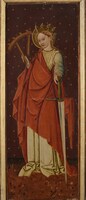
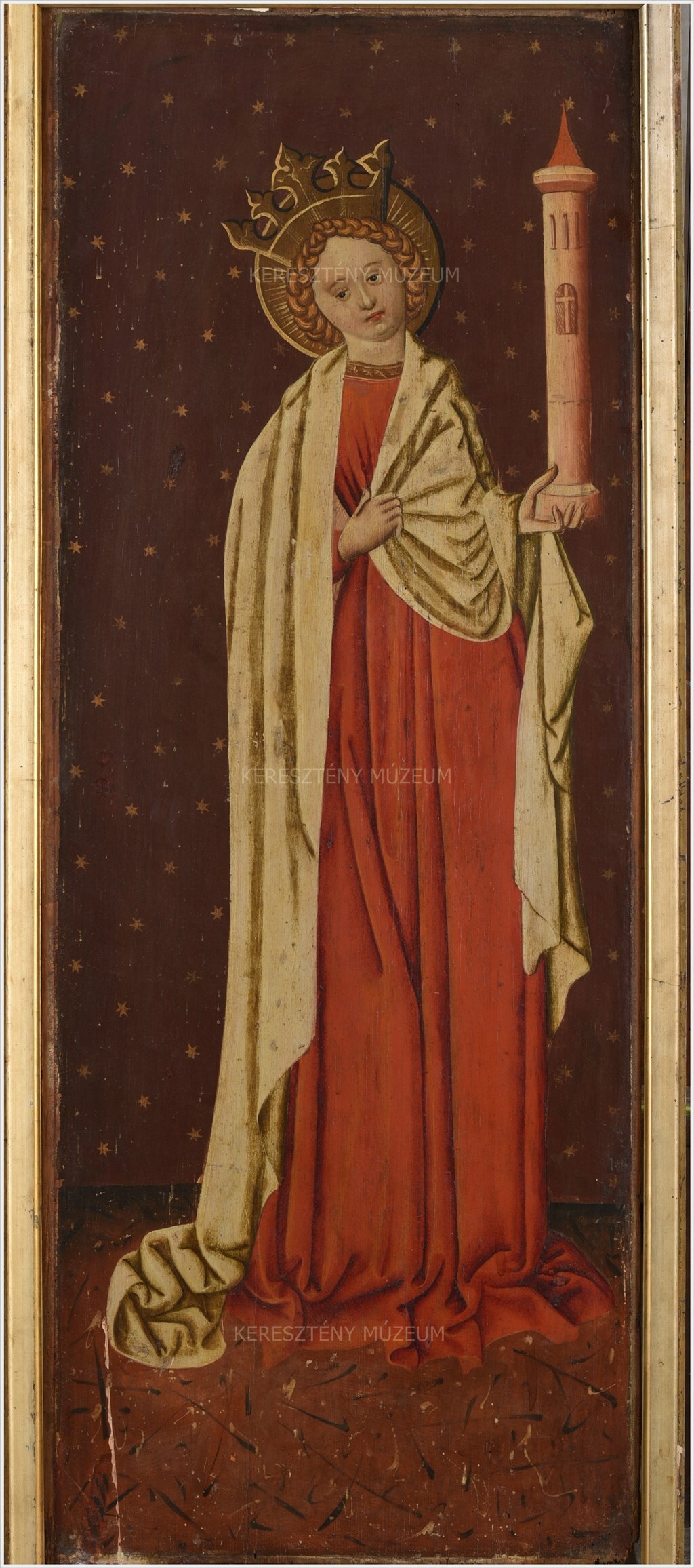
St. Barbara.
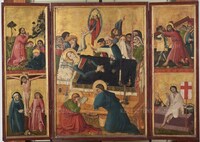
Left fix wing of a winged altarpiece. Part of the Death of the Virgin Triptych

Description and further information
130 x 50 cm (painted surface: 129 x 47 cm)
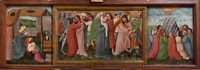
The panel painting depicting St. Barbara (55.108) originally served as the left stationary wing of the altarpiece, while its companion portraying St. Catherine of Alexandria (55.109) served as the right wing. The 1839 auction catalogue for the collection of Blasius Höfel mentions the paintings as belonging to item 17: the winged altarpiece showing the Dormition of Mary (56.492). The numerous similarities between these paintings and the images on the exterior of the movable wings (details from the Annunciation) make it very likely that the panels of the female saints were indeed originally part of the altarpiece made in Vienna or its environs and comprised its stationary wings. The differences in size can be explained by the usual discrepancies between the stationary and movable wings.
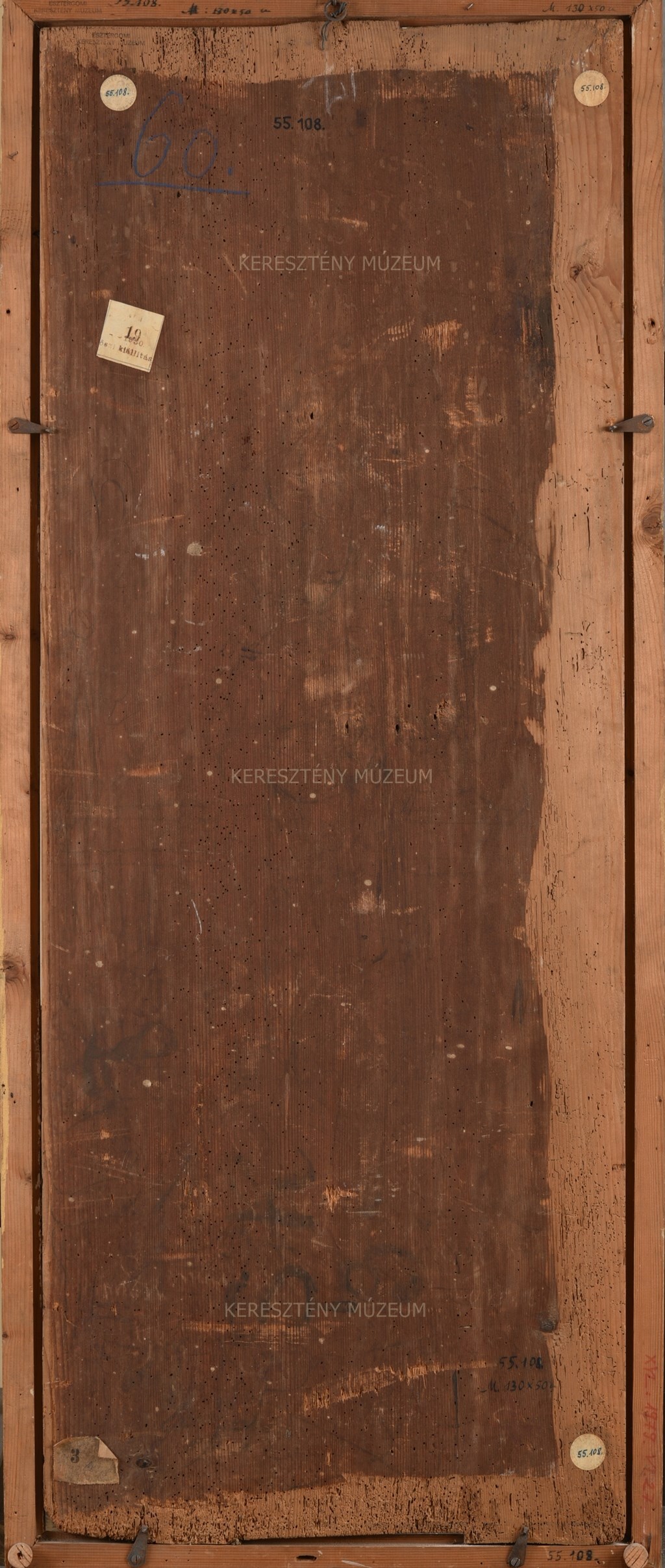
Black, charcoal (?) drawings can be discerned on the backs of the stationary wings and the altarpiece’s centre image.
The altarpiece was reassembled in the same arrangement as in Blasius Höfel’s collection, with the same predella (assigned inventory number 55.110 in the Christian Museum), which also came from the environs of Vienna. This predella, however, certainly did not belong to the Dormition of Mary altarpiece; thus the presentation of these works as one unit is incorrect.
Provenance
Acquired by Karl Lemann from Blasius Höfel in 1839 and then purchased by Arnold Ipolyi. The number 17 written with white chalk on the reverse of the two panels may be their item number in the 1839 auction catalogue.'85. és 86. Két oltárszárny; egyiken szt. katalin, a másikon szt. Borbála, arany csillagokkal behintett sötét vörös alapon. XV. sz. végéről.' / ‘85 and 86. Two altarpiece wings, on showing St. Catherine and the other St. Barbara, on a dark red ground sprinkled with gold stars. End of the 15th c.’ (Lakatos-Balla-2012, 281)
Restauration
X-rays were taken of the panels in 1979.
Bibliography
- Sarkadi Nagy Emese: Ars meditandi – Ars moriendi. Vorschläge zur Deutung des Marientod-Altars im Christlichen Museum zu Esztergom. JAHRBUCH DES KUNSTHISTORISCHEN MUSEUMS WIEN 17/18, 2022, 229-247.
- Sarkadi Nagy Emese: Ars meditandi - ars moriendi. Javaslatok a Keresztény Múzeum Mária halála-oltárának értelmezéséhez. ARS HUNGARICA 45 : 1 (2019), 429–450.
- Eörsi Anna: “Nem korhad el, nem rágják meg a férgek.” Megjegyzések Mária halála ikonográfiájához az Albert-oltár mestere hatása alatt készült esztergomi triptichon kapcsán. In: Művészettörténeti Értesítő 54 (2005),1-18.
- les vers et la poussière…” Remarques sur l’iconographie de la mort de Marie à propos du triptique d’Esztergom réalisé sous l’influence du Maître du Retable du roi Albert. In: Acta Historiae Artium 46 (2005), 5-24.
- Eörsi Anna: „Elle n’a point eu à subir […] la pourriture,
- Eörsi Anna: Puer, abige muscas! Remarks on Renaissance Flyology. In: Acta Historiae Artium 42 (2001), 9-10.
- Cséfalvay Pál, szerk.: Keresztény Múzeum, Esztergom. Budapest, 1993. Corvina, 187.
- Végh János: Zsigmond király képzőművészeti ábrázolásairól. In: Beke László, Marosi Ernő, Wehli Tünde (szerk.): Művészet Zsigmond király korában Bp. 1987. 110, 34. j.
- Koller, Manfred: Die technologischen Untersuchungen am Albrechtsaltar und ihre Beiträge zum Problem der „Werkstatt” des Albrechtsmeisters. In: Floridus Röhrig (Hg.): Der Albrechtsaltar und sein Meister, Bécs, 1981, 145-146. (A középkép és a külső Angyali üdvözlet az Albert-oltár megfelelő ábrázolásainak közvetlen másolatai, míg a Passió-jelenetek az aggsbachi oltár képeihez hasonlítanak. Az anyagminták egyezése alapján az esztergomi képeken is a bécsi műhely sablonjait alkalmazták.).
- Imago (Három késő középkori lengyel festő működésének rekonstrukciójához). Művészettörténeti Értesítő 26 (1977), 109.
- Figura
- Mojzer, Miklós: Tabula
- Mucsi András: Az esztergomi Keresztény Múzeum Régi Képtárának katalógusa. Budapest, 1975, Corvina 22.
- Mucsi 1973, 22.
- Török Gyöngyi: Die Ikonographie des letzten Gebetes Mariä. In: Acta Historiae Artium 19 (1973), 164.
- Boskovits Miklós-Mojzer Miklós-Mucsi András: Az esztergomi Keresztény Múzeum képtára (Budapest, 1964. Akadémiai Kiadó) 154.
- Dávid Katalin: Adatok a Trinitas ikonográfiájához, In: Művészettörténeti Értesítő 11 (1962), 37.
- Mojzer Miklós: Az esztergomi Keresztény Múzeum képtárának útmutatója, Budapest, 1958,, 14.
- Czobor Ágnes: Az esztergomi Keresztény Múzeum kiállításának vezetője. Esztergom 1955., 13.
- Magyarország műemléki topográfiája I. Esztergom 1. Esztergom műemlékei (összeállította: Genthon István; Budapest 1948), 126.
- Pigler Andor: “Evagationes Spiritus” (Egy képmagyarázat és adatok az esztergomi Keresztény Múzeum festményeinek történetéhez). In: Archaeologiai Értesítő 46 (1932-33), 132-134.
- Genthon István: A régi magyar festőművészet. Vác, 1932, Pestvidéki Nyomda, 28-29. (1400 körül, heiligenkreuzi mester tanítványa)
- Theodor Frimmel: Lexikon der Wiener Gemäldesammlungen, II. München 1914, 176-177.
- Verzeichniss einer Sammlung altdeutscher Gemählde...Wien 1839, 17. sz.
Related works