

Italian renaissace and baroque painting (permanent exhibition)
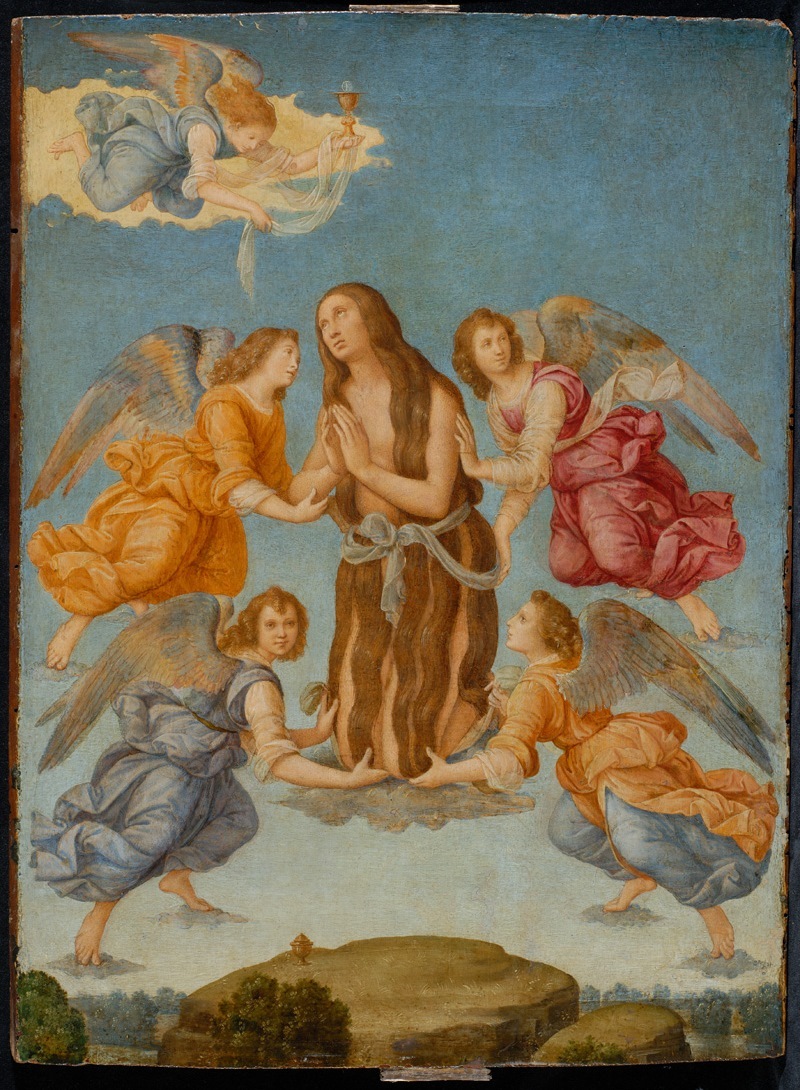
Mystic Communion of Mary Magdalene
Florence, 1456-1460 – Florence, 1537
width: 38 cm
Description and further information
The thirteenth-century Legenda Aurea recounts how the biblical sinful woman, Mary Magdalene, arrived in the harbour of Marseille on a miraculous sea voyage fourteen years after Christ’s Ascension, and from there withdrew into the wilderness. She spent the remainder of her life there in eremitic solitude and penitential self-denial. Her only sustenance was heavenly nourishment: as the angels raised her aloft, she heard celestial harmonies, which filled her so completely that she no longer needed bodily food. The model for the composition was Pollaiuolo’s painting at Staggia, although the influence of Verrocchio’s sculptural works can also be detected, for example that of the Forteguerri Tomb in Pistoia Cathedral, on whose execution Lorenzo di Credi worked as an assistant. The previously proposed provenance hypothesis, according to which the painting was brought to Hungary by Ippolito d’Este, c. 1479–1520, has not proved correct: the work was purchased by Primate Simor in Rome in 1878 from Canon Raffaele Bertinelli. A version of the painting of weaker execution is held in the Johnson Collection in Philadelphia. Dóra Sallay, 2004.
In this painting, executed around 1510, Lorenzo di Credi combined the moments of the Assumption and the Communion, as Antonio Pollaiuolo had already done in the 1460s in his altarpiece intended for the parish church of Staggia. The Florentine master trained in Verrocchio’s workshop alongside Leonardo, but he made no attempt to follow the innovations of his brilliant contemporary. Until the end of his life he remained faithful to the traditions of the Early Renaissance. His change of direction was closer to that of another of Verrocchio’s pupils, Perugino: compared with his predecessors, he made the colours lighter, the contours more fluid, the forms softer, the arrangement of the figures airier, and the religious content more sentimental. Vilmos Tátrai, 2015, in Meisterwerke ...
Provenance
Simor Collection. Purchased from the Bertinelli estate in Rome in 1878
Restauration
2015 tisztítás - Szakács Márton
Exhibitions
- London, Royal Academy of Arts, 1930
- St. Pölten, Diözesanmuseum, 2015. "Meisterwerke aus dem Keresztény Múzeum Esztergom"
- Budapest, Pesti Vigadó, 2018, "ÁTLÉNYEGÜLÉS - Az Eucharisztiáról a művészet és a csodák nyelvén"
Bibliography
- Hughes-Johnson, Samantha J.C.: The Fresco Decoration of the Oratorio dei Buonomini di San Martino: Piety and Charity in Late-Fifteenth Century Florence. Disszertáció, Birmingham City University, 2016
- Wolfgang Huber (szerk.): Meisterwerke aus dem Keresztény Múzeum; kiáll.kat; Sankt Pölten 2015. 150 (Tátrai Vilmos)
- Sallay Dóra: Raffaele Bertinelli és reneszánsz képtára. Egy műgyűjtemény útja Rómától Esztergomig. Esztergom, 2009 Sallay 2009, 58, 61, 64, 94, 155, XXXV.sz., korábbi irodalommal (Lorenzo di Credi)
- Sénéchal, Philippe: Giovan Francesco Rustici (1475-1554). Un sculpteur de la Renaissance entre Florence et Paris. Párizs, 2008
- Pfeiffer, Heinrich: L‘iconografia del mistero dell'Eucaristia. In: Mysterium. l'Eucaristia nei capolavori dell'arte europea. Milan, 2005, pp. 41-50
- Agosti, Giovanni: Su Mantegna. Milan, 2005
- De Halleux, Elisa: Iconographie de la Renaissance italienne. Párizs, 2004
- Galli, Aldo: La Maddalena di Staggia. Omaggio ad Antonio del Pollaiuolo 1498–1998. Poggibonsi, 1998
- Wilk, Sarah: The Cult of Mary Magdalen in Fifteenth Century Florence and its Iconography. In: Studi medievali Ser. 3, 26. kötet, 1985, 685-698
- Boskovits Miklós: Toskanische Frührenaissance-Tafelbilder. 2. kiadás. Budapest, 1978
- Brewer, Robert: A Study of Lorenzo di Credi. Firenze, 1970
- Boon, K.G. Een studieblad toegeschreven aan Piero di Cosimo. Bulletin van het Rijksmuseum, vol. 17, 1969, pp. 159-170
- Boskovits Miklós: Toszkán kora reneszánsz táblaképek. Budapest, 1968
- Sweeny, Barbara: Catalogue of Italian paintings. John G. Johnson Collection. Philadelphia, 1966
- Dalli Regoli, Gigetta: Lorenzo di Credi. Milano, 1966
- Berenson, Bernard: Italian Pictures of the Renaissance. A List of the Principal Artists and their Works with an Index of Places. Florentine School. 2 kötet. London, 1963
- Duveen Brothers: Duveen Pictures in Public Collections of America. New York, 1941
- Degenhart, Bernhard: Die Schüler des Lorenzo di Credi. Münchner Jahrbuch der bildende Kunst, IX 1932, 95–161
- Degenhart, B. Drawings by Lorenzo di Credi. The Burlington Magazine for Connoisseurs, 1930, Vol. 57, No. 328, pp. 10-15¬
- Exhibition of Italian Art, 1200–1900. London, Royal Academy of Arts. London, 1930
- Van Marle, Raimond: The Development of the Italian Schools of Painting. 18 kötet és index. The Hague, 1923–1938
- Colasanti, Arduino: Dipinti inediti di Lorenzo di Credi. Bolletino d’Arte, N.S. II., I. kötet, fasc. V (1922–1923), 193–200
- Colasanti, Arduino: Quadri italiani ignorati in una collezione ungherese.Bolletino d’Arte, IV, 1910, 407–408
- Rényi Rezső: Az esztergomi Prímási Kép- és Metszet-tár s annak műirodalma culturtörténeti szempontból. Budapest, 1879
- Hughes-Johnson 2016, 326, fig. 158
- Maszlaghy 1878 és 1891, 101 sz. (Lorenzo di Credi) – Rényi 1879, 15 (ua.) – Colasanti 1910a, 408 és 1910b, iii (ua.) – Gerevich 1916a, 825 (ua.) – Gerevich 1916b, 3 (ua.) – Colasanti 1922–1923, 193–195 (ua.) – Gerevich 1928, 231 (ua.) – Degenhart 1930, 15 (ua.) – Exhibition 1930, 208, 369. kat. sz. (ua.) – Van Marle 1923–1938, XIII (1931), 310–314 (Lorenzo di Credi utolsó éveiből) – Berti Toesca 1932, 954 (Lorenzo di Credi) – Degenhart 1932, 136 (a kép állapota miatt a szerzőség eldönthetetlen, talán Lorenzo di Credi közreműködésével a tanítvány, Antonio del Ceraiolo műve lehet) – Duveen Brothers 1941, 124 (ua.) – Genthon 1948, 64–66 (Lorenzo di Credi) – Mojzer 1958, 9 – Czobor 1955, 8 – Prokoppné Stengl 1960, 98 – Berenson 1963, I, 115 (ua.) – Boskovits–Mojzer–Mucsi 1964, 76 (ua., a művész életének utolsó éveiből) – Dalli Regoli 1966, 23–24, 120–121 (ua., 1485 k., talán azonos azzal a képpel, amelyet Gerolamo Casio bolognai költő küldött 1506-ban Isabella d’Estének) – Sweeny 1966, 43-44 – Boskovits 1968, 48 (ua., a 16. sz. első évtizede, esetleg a következő évtized eleje) – Boon 1969, 170, 3. jegyzet – Brewer 1970, 98 (Lorenzo di Credi) – Mucsi 1975, 47, 226 sz. (ua.) – Boskovits 1978, 48 (ua., 1510 k.) – Tátrai Vilmos, in Keresztény Múzeum 1993, 241, 127. sz. (ua., 1510 k.) – Galli 1998, 44, 60: 63–64. j. (Lorenzo di Credi vagy hozzá nagyon közel álló festő) – De Halleux 2004, 176 – Agosti 2005, 211, 249 – Pfeiffer 2005, 41 – Sénéchal 2008, 228 –