

Italian renaissace and baroque painting (permanent exhibition)
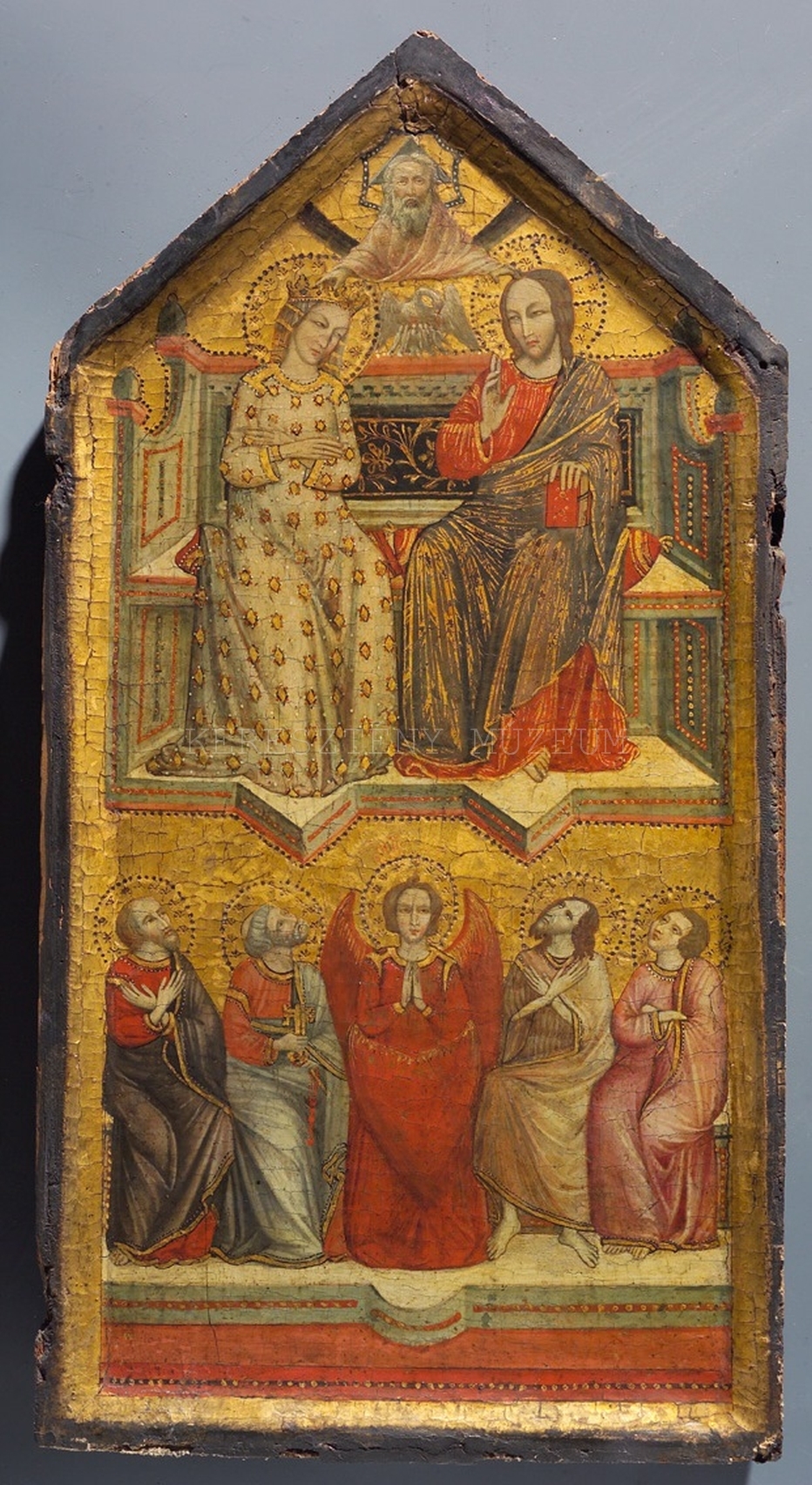
Coronation of the Virgin and Christ with a Seraphim and four Saints
active in Umbria in the early 14th century
width: 18,8 cm
thickness: 1,5 cm
Description and further information
This small painting was once the central panel of a triptych, whose two wings have been lost over time. The composition of the central panel is divided into two parts. Above, the Virgin Mary and Christ are enthroned on a stone throne with a backrest, represented in perspective. Mary, who at the end of her earthly life was assumed into heaven, enthroned and crowned, inclines humbly towards her Son with her arms crossed. Christ’s garment is still adorned with folds painted in gold, in accordance with the traditions of Byzantine painting. He raises his right hand in blessing, while in his left he holds a book, as Christ the Teacher.
In the painting’s present state, a pelican symbolizing the Redeemer appears between Mary and Jesus, and God the Father is shown above them. These elements, however, did not belong to the original composition and may have been added during a later overpainting.
Below, an angel and four male saints are seated on a marble bench decorated with inlay. The saints look up in adoration at the scene represented in the upper section. The identity of the saint seated at the far left is uncertain in the absence of an attribute, though on the basis of his facial type he is most likely Saint Paul. Beside him we see Saint Peter, holding the keys to the Kingdom of Heaven.
The angel seated in the centre, with hands joined in prayer, is distinguished by his larger scale in relation to the saints. His outspread wings are decorated with gilding, while two further wings are crossed below, in front of his body; he may therefore be a seraph, shown in red, the colour symbolizing the fiery love of God. To the right of the angel sits Saint John the Baptist. Beneath his ample mantle he wears the camel-hair garment which, according to the Gospels, he wore in the wilderness. The saint seated at the far right with folded arms is probably John the Evangelist, Christ’s youngest and most beloved disciple.
The true name of the painter is unknown. Scholars have named him the Master of the Poldi Pezzoli Diptych, after a work preserved in the Museo Poldi Pezzoli in Milan. Faces of delicate features and pale skin, widely cut eyes, and figures of fragile build are characteristic elements of his style. Dóra Sallay
Provenance
Simor collection. Purchased from the Bertinelli estate in Rome in 1878.
Restauration
1915 Endrődi Sebestyén
Bibliography
- Cristiana Pasqualetti: Pittori di confine. Nuove ricerche e scoperte sui trecentisti 'umbri' in Abruzzo. in: Paragone. Parte arte, Nº 149, 2020, 3-20. 9, 10, fig. 10.
- Sallay Dóra: Raffaele Bertinelli és reneszánsz képtára. Egy műgyűjtemény útja Rómától Esztergomig. Esztergom, 2009, 87, kat. sz. II, 122.
- Prokopp Mária, in: Cséfalvay Pál, szerk.: Keresztény Múzeum, Esztergom. Budapest, 1993. Corvina, 231, 68. sz. (umbriai festő, 1310 körül).
- Todini, Filippo: La Pittura umbra dal Duecento al primo Cinquecento. 2 kötet. Milano, 1989., I, 129 (ua.)
- Markova, Victoria: Un cofanetto della collezione del Museo di Kiev e alcuni aspetti dell’attività del „Maestro del dittico Poldi-Pezzoli”. Paragone, 34/397 (1983), 3–12., 10, 12: 15. j. (ua.)
- Boskovits Miklós: Korai olasz táblaképek. Budapest, 1966., 20 (ua.)
- tica e Moderna’, 30, 1965, pp. 113-123.
- M. Boskovits, Ipotesi su un pittore umbro del primo Trecento, in ‘Arte An
- Boskovits Miklós: Ipotesi su un pittore umbro del primo trecento. Arte antica e moderna, 30 (1965), 113–123., ( a Poldi Pizooli diptichon mestere, kevéssel 1320 után)
- Boskovits Miklós-Mojzer Miklós-Mucsi András: Az esztergomi Keresztény Múzeum képtára (Budapest, 1964. Akadémiai Kiadó), 45-46 (umbriai festő, 14. sz. eleje, ugyanettől a kéztől származik a Poldi Pezzoli múzeum diptichonja)
- Dávid Katalin: Adatok a Trinitas ikonográfiájához. Művészettörténeti Értesítő, 11 (1962), 24–39., 25 (romagnai iskola)
- Gerevich Tibor (szerk.): Magyarország műemléki topográfiája. I. Esztergom. 1. Esztergom Műemlékei. Összeállította Genthon István. Budapest, 1948., 93 (romagnai iskola, 14. sz.)
- Berti Toesca, Elena: Arte italiana a Strigonia. Dedalo, XII (1932), 933–960., 957 (rimini iskola, 14. sz. közepe)
- Maszlaghy F. Az esztergomi hercegprímási képtárban levő művek jegyzéke. II. bővített kiadás. Esztergom 1891, 78. sz. (Giottino)