

Italian renaissace and baroque painting (permanent exhibition)
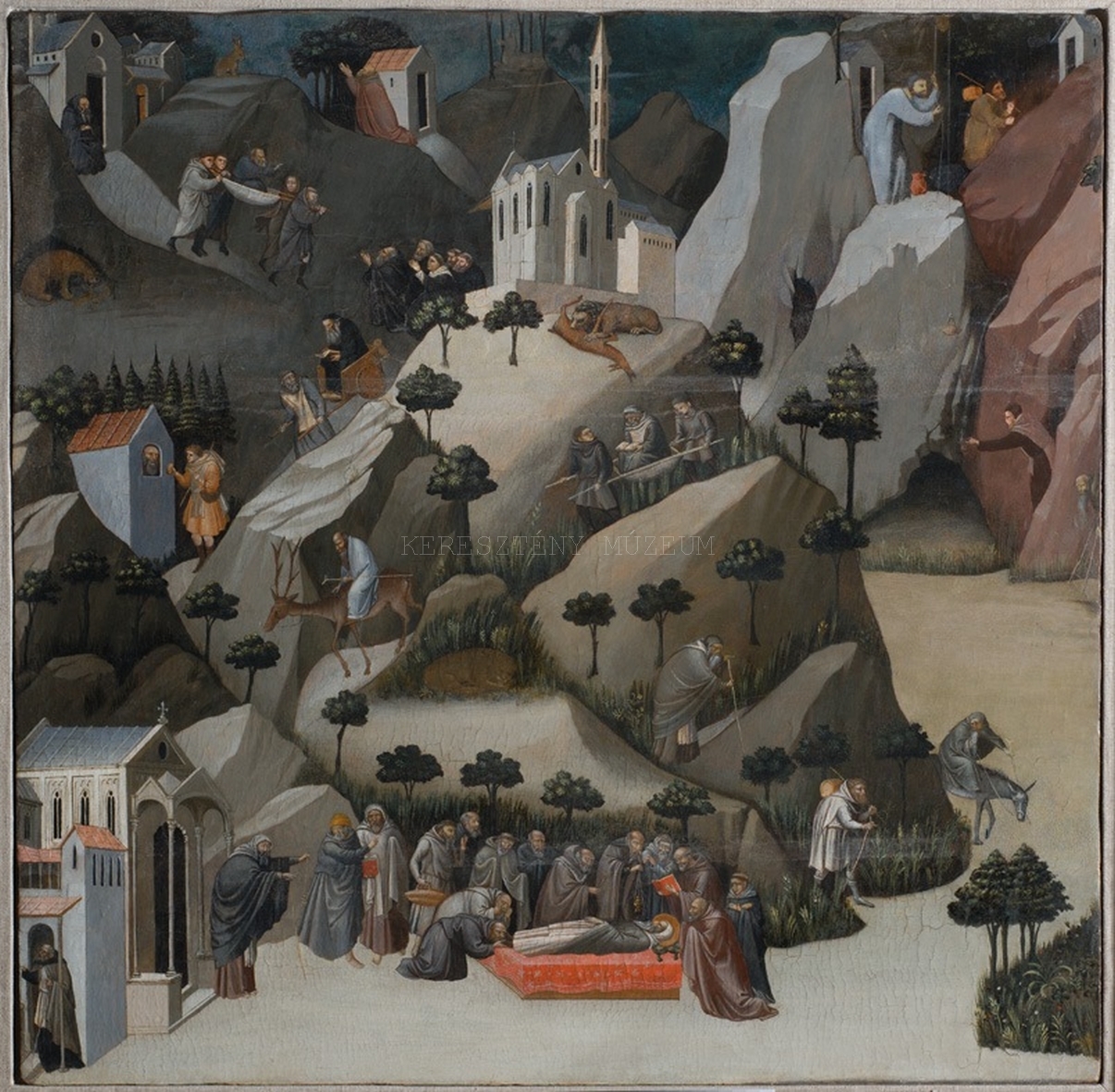
Hermits of Thebes
active in Florence 1393-1424
width: 82 cm
Description and further information
In fourteenth-century Italy, interest grew in the lives of the first monks: hermits and ascetics who had withdrawn to the deserts of Egypt, around Thebes, and to the harsh regions of Syria and Palestine. Between the fourth and the tenth centuries, numerous texts—mostly in Greek and Latin—were written to preserve the lives of these early monks, who lived either in solitude or in small communities. Compilations made from these writings and translated into the Italian vernacular in the fourteenth century became popular and widely read. As a result of the popularity of the subject, depictions of the lives of hermits appeared in many towns of central Italy, primarily in the form of frescoes. Painted versions on wooden panels were also produced in Florence. Among the latter, several monumental fifteenth-century works, surviving either intact or in fragments, are based on the same composition. The Esztergom painting once formed part of such a vast wooden panel, approximately three metres wide. It was cut out from the left-hand side of the original painting before the mid-nineteenth century, in order to make it easier to sell on the art market thanks to its smaller size. The larger, right-hand section of the former composition has also survived, in a British private collection. The Esztergom painting shows numerous episodes from the daily lives of the hermits, not directly connected with one another. Most of the scenes do not depict a specific story, but rather refer in general terms to the characteristic activities of the hermits. Contrary to the legends, the setting is not a desert, but a fairy-tale wilderness, symbolized by broken rocks and clusters of trees with high undergrowth. For the medieval Italian viewer, this conveyed more effectively the inhospitable, savage environment known from the texts. Placed within this sketchily rendered landscape are episodic scenes illustrating the lives of the Desert Fathers; many of them emphasize the figures’ harmonious coexistence and mutual assistance. Numerous groups of buildings also appear in the mountainous, rocky landscape. These buildings are not represented to scale: in keeping with the conventions of fourteenth-century painting, they appear like models in relation to the figures. The original function of the wooden panel from which the Esztergom fragment derives is unknown. According to the most widely accepted view, it may have decorated a larger room—perhaps a sacristy or chapter house—set into wall panelling, in a monastic community that attached particular importance to the exemplary lives of the ancient hermits. Such a setting may have belonged to one of the hermit orders, such as the Camaldolese or the Vallombrosans; more recently, however, the theory has also been proposed that the painting may have been commissioned by Dominican friars in Florence. Scholars are not in agreement either on the date of the work or on the identity of its master. Most believe that it was made around 1400 and may be the work of Mariotto di Nardo, while some researchers consider it even earlier. Its art-historical significance lies precisely in the fact that it formed part of the earliest known work in which this subject appears in panel painting.
(Sallay Dóra, 2002)
Provenance
Simor collection. Purchased from the Bertinelli estate in Rome in 1878.
Restauration
1991-1992 Csúcs László
Exhibitions
- 2012 Firenze, Uffizi "Bagliori dorati - Il Gotico Internazionale a Firenze 1375 - 1440"
- 2021 Budapest, Magyar Nemzeti Múzeum, "Pálosok"- rendtörténeti kiállítás
Bibliography
- Malquori, Alessandra in: “Bagliori dorati. Il Gotico Internazionale a Firenze 1375-1440”. Catalogo della mostra (19 giugno – 4 novembre 2012) a cura di Antonio Natali, Enrica Neri Lusanna e Angelo Tartuferi. Giunti Editore, Firenze, 2012, 186, kat. sz. 44.
- Malquori, Alessandra: Umanesimo e Padri del deserto. in: Bagliori dorati. Il Gotico Internazionale a Firenze 1375-1440”. Catalogo della mostra (19 giugno – 4 novembre 2012) a cura di Antonio Natali, Enrica Neri Lusanna e Angelo Tartuferi. Giunti Editore, Firenze, 2012, 83-91.
- Sallay Dóra: Raffaele Bertinelli és reneszánsz képtára. Egy műgyűjtemény útja Rómától Esztergomig. Esztergom, 2009, 88, kat. sz. V, 125
- S.Chiodo: Mariotto di Nardo, voce in Dizipnari Biografoco degli Italiani, LXX, Roma 2008, p. 588
- Fulton, Christopher B.: An earthly paradise: the Medici, their collection and the foundations of modern art. Firenze, 2006., 173, 244–245, 92. kép (ismeretlen).
- Palladino, Pia: Pilgrims and Desert Fathers: Dominican Spirituality and the Holy Land. In: Laurence Kanter – Pia Palladino: Fra Angelico. Kiáll. kat. (New York, The Metropolitan Museum of Art). New Haven etc., 2005, 36–37 (Orcagna műhelye [?], 1380 körül)
- C. B. Strehlke: The Princeton "Petient St. Jerome", the Gaddi Family, and Early Fra Angelico, Record. Princeton Univertity Art Museum. 62., 2003, pp. 18-19
- Boskovits Miklós, in Masaccio e le origini del Rinascimento. Kiáll. kat. (San Giovanni Valdarno, Casa Masaccio). Szerk. Luciano Bellosi, Laura Cavazzini és Aldo Galli közreműködésével, Genf–Milano, 2002., 171 (Mariotto di Nardo)
- Malquori, Alessandra: La „Tebaide” degli Uffizi: tradizione letterarie e figurative per l’interpretazione di un tema iconografico. In I Tatti studies, 9. Firenze, 2001, 119–137, 120: 3. j.
- Sonia Chiodo, in Dal Poggetto, Paolo (szerk.): Fioritura tardogotica nelle Marche. Kiáll. kat. (Urbino, Palazzo Ducale). Milano, 1998., 116 (Mariotto di Nardo)
- Prokopp Mária, in: Cséfalvay Pál, szerk.: Keresztény Múzeum, Esztergom. Budapest, 1993. Corvina, 223–224, 87. sz. (firenzei festő)
- De Marchi, Andrea: Una fonte senese per Ghiberti e per il giovane Angelico. Artista, 4 (1992), 130–151., 148–149: 53. j. (Mariotto di Nardo, valószínűleg egy elveszett Lorenzo Monaco prototípus után)
- Mattia, Eleonora: Le Tebaidi. In Iconografia di San Benedetto nella pittura della Toscana. Immagini e aspetti culturali fino al XVI secolo. Kiáll. kat. (Firenze, Centro d’incontro della Certosa di Firenze). Firenze, 1982, 491–502., 493, 499–500 (ismeretlen, 1380 k.)
- Brigstocke, Hugh: Panels showing the ‘Death of St Ephraim’. The Burlington Magazine, CXVIII/881 (1976), 584–589., 585, 44. kép
- Callman, Ellen: Thebaid studies. Antichità viva, XIV/3 (1975), 3–22. 7–8, 13–14 (firenzei festő, kevéssel 1400 előtt)
- Christie’s, London, 1974. június 28, 50–51, 47. tétel
- Boskovits, Miklós: Toskanische Frührenaissance-Tafelbilder. 2., átdolgozott kiadás. Budapest, 1978., 4–5 (valószínűleg Mariotto di Nardo, 14. sz. vége)
- Boskovits, Miklós: Pittura Fiorentina alla vigilia del Rinascimento 1370–1440. Firenze, 1975., 391 (Mariotto di Nardo, 1385–1390 k.)
- Bellosi, Luciano: Buffalmacco e il trionfo della morte. Torino, 1974 (idézett kiadás: Milano, 2003)., 19: 15. j. (nagyon közel Mariotto di Mardo korai műveihez)
- Boskovits, Miklós: Sull’attività giovanile di Mariotto di Nardo. Antichità viva, VII/5 (1968), 3–13., 6–7 (Mariotto di Nardo, 1385 k.)
- Boskovits Miklós: Toszkán kora reneszánsz táblaképek. Budapest, 1968., 4–5 (Niccolo Gerini köre)
- Boskovits Miklós-Mojzer Miklós-Mucsi András: Az esztergomi Keresztény Múzeum képtára (Budapest, 1964. Akadémiai Kiadó), 33–34, korábbi irodalommal (talán Niccolò Gerini műhelye)
- Richard Offner, szóbeli közlés, 1955, vö. Callman 1975, 14 (Mariotto di Nardo), 4–5 (Niccolo Gerini köre)
- Gerevich Tibor (szerk.): Magyarország műemléki topográfiája. I. Esztergom. 1. Esztergom Műemlékei. Összeállította Genthon István. Budapest, 1948, 98 (sienai festő)
- Van Marle, Raimond: The Development of the Italian Schools of Painting. 18 kötet és index. The Hague, 1923–1938, Van Marle, Raimond: The Development of the Italian Schools of Painting. 18 kötet és index. The Hague, 1923–1938.
- Rényi Rezső: Az esztergomi Prímási Kép- és Metszet-tár s annak műirodalma culturtörténeti szempontból. Budapest, 1879, 17–18 (ua.)
- Maszlaghy Ferencz: Az esztergomi Herzegprímási Képtárban lévőművek jegyzéke. Esztergom, 1878 és 1891., 99. sz. (Pietro Laureati [Pietro Lorenzetti])