

Italian renaissace and baroque painting (permanent exhibition)
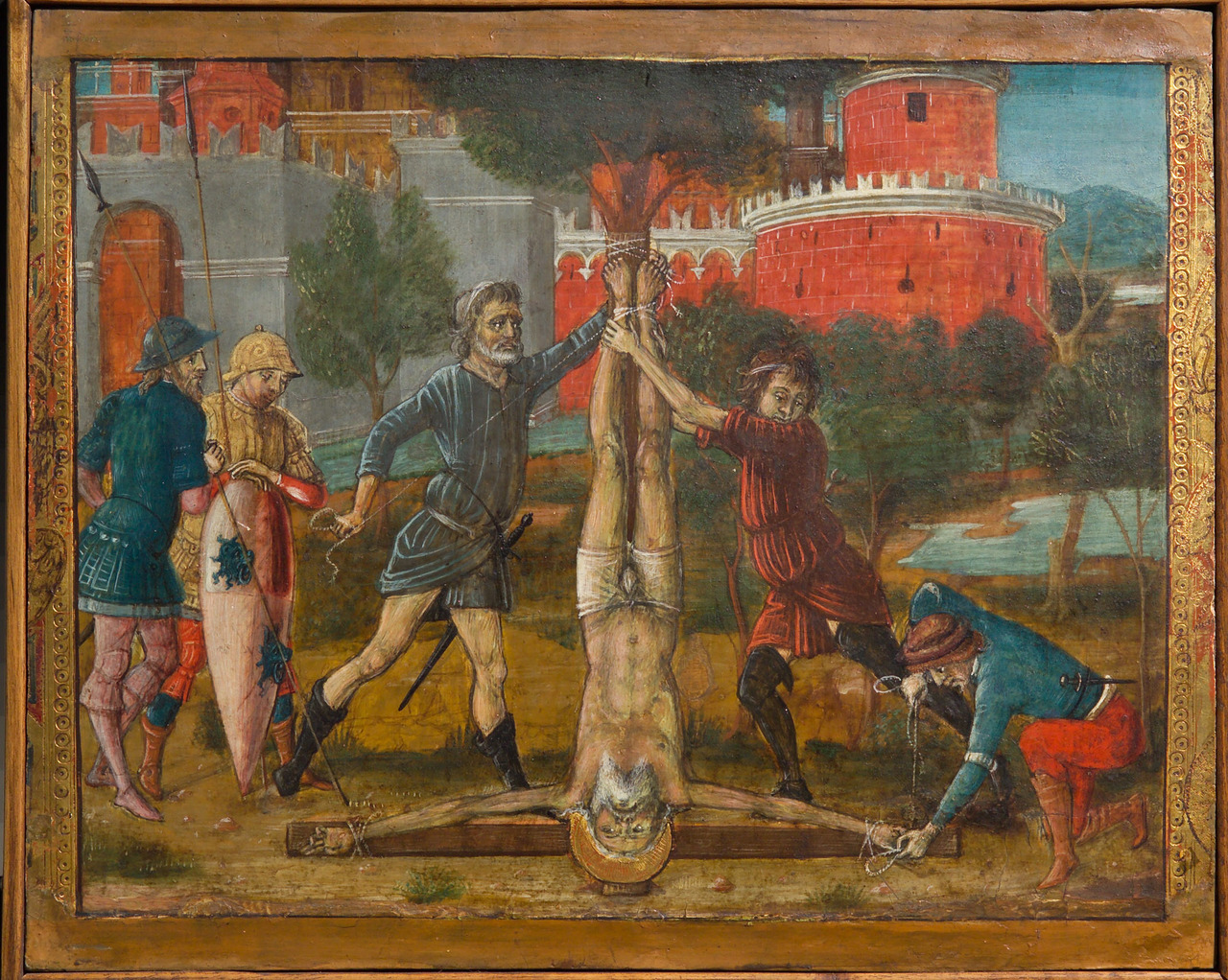
Crucifixion of Saint Peter
Borgo San Sepolcro, c. 1430 – Siena, 1495
width: 38,6 cm
Description and further information
The painting depicts the martyrdom of the Prince of the Apostles, Saint Peter, who, according to tradition, was crucified in Rome on the Janiculum Hill, rising on the western side of the Tiber. Today the site is commemorated by the church of San Pietro in Montorio. At the saint’s own request, the execution was carried out with him upside down, since he did not consider himself worthy to be crucified in the same manner as Christ. There is no evidence that the master of the predella ever visited Rome, but he could certainly have known the setting from widely disseminated representations. On the right the River Tiber winds through the landscape, and the papal fortress—formerly the mausoleum of Emperor Hadrian—Castel Sant’Angelo, appears in the distance. The painting is a fragment of a predella, of which three further scenes are known. On the basis of the remains of decorative bands with different patterns preserved on all the panels, the original order of the scenes can also be reconstructed: Saint Bernardino Raises a Child from the Dead (private collection), The Feast of Herod (Glens Falls, New York, The Hyde Collection), Calvary (Manchester, City Art Gallery), the present Crucifixion of Saint Peter, and finally a now-lost scene. The episodes, sketched with swift and practised brushwork, may best be compared with the predella of Matteo di Giovanni’s Celsi Altarpiece of 1480 (Siena, Museo dell’Opera del Duomo). (Sallay Dóra, 2002, website)
According to the account in the early Christian text The Acts of Peter, dating from the late second century, the Apostle Peter was crucified upside down at his own request, because he did not consider himself worthy to die in the same way as Jesus. The master of this Sienese predella panel, despite his more modest talent, sought to evoke the saint’s martyrdom with vivid immediacy. On the right and left, an executioner is busily fastening Peter’s feet to the wood, while a third, kneeling on one knee, secures the victim’s hand to the cross. Two armoured soldiers assist in the brutal act: one leans on his lance, the other on his shield. In the background, the place of execution is closed off by a fortified city wall; the architecture symbolizes Rome. Already the 1867 catalogue of the Ramboux Collection attributed the predella panel to the school of Matteo di Giovanni, and later it was assigned either to Matteo himself or to his workshop. According to Mojzer, the overemphasized contours, the stage-like architecture, and the puppet-like figures suggest that the work is by Guidoccio Cozzarelli, Matteo’s pupil, assistant, and most faithful follower. Mojzer also connected the present painting with the similarly sized predella fragment in the Sterling and Francine Clark Art Institute, Williamstown, Massachusetts, depicting The Calling of Saints Peter and Andrew, which has likewise been attributed in the literature either to Cozzarelli or to Matteo. Mojzer considered it possible that the two predella panels originally belonged to Matteo di Giovanni’s early altarpiece in the church of San Pietro Ovile in Siena. The 1974 catalogue of the Cleveland museum, without mentioning the Esztergom painting, related three works to one another as panels that may originally have belonged to the same predella: The Calling of Saints Peter and Andrew in Williamstown, the Feast in the House of Levi in the Koetser Gallery, Zurich, and the Crucifixion in the Cleveland Museum of Art, regarding all three as works by Matteo di Giovanni. The Esztergom panel may have belonged together with all these predella paintings, even though the drawing and modelling of its figures are undoubtedly weaker. Within a single predella, the quality of the individual panels could vary according to the lesser or greater degree of workshop participation. (Tátrai Vilmos, 1993)
Provenance
Arnold Ipolyi’s purchase from the Ramboux estate in Cologne, 1867
Restauration
2005 Varga Dezső
Exhibitions
- 1930 Budapest, Műcsarnok Őszi kiállítás
- 2005 Siena, Complesso Museale di Santa Maria della Scala, Siena e Roma: Raffaello, Caravaggio e i protagonisti di un legame antico
Bibliography
- Sallay, Dóra: Corpus of Sienese Paintings in Hungary, 1420–1510. Florence, Centro Di, 2015, kat. 24, 234-240.
- Sallay 2008, 8, 16
- Sallay 2005[a] (c. 1480–85, reconstruction);
- Sallay 2003[a], 44 n. 29 (reconstruction);
- Paardekooper 2002[a], fig. 29 on p. 47 (reconstruction sketch);
- Maria Cristina Terzaghi, in Commellato, Fiz, and Voena ed. 2001, 88–89 (Matteo di Giovanni, c. 1470);
- Dittelbach 1999, 115 (Guidoccio Cozzarelli);
- Kier and Zehnder ed. 1998, 565 (Matteo di Giovanni or Guidoccio Cozzarelli, reconstruction of the Ramboux collection);
- Cséfalvay Pál, szerk.: Keresztény Múzeum, Esztergom. Budapest, 1993. kat. sz. 108. (Tátrai Vilmos)
- Mucsi 1975 , 43. Vő.: Elizabeth de Femandez-Gimenez katalóguscímszava, In: The Cleveland Museum of Art. European Paintings before 1500. Cleveland, 1974. 97.
- Berenson 1968, 258;
- Boskovits-Mojzer-Mucsi 1964, 64;
- Mojzer 1964, 5-6;