Medieval Hungarian, Austrian and German Painting and Sculpture
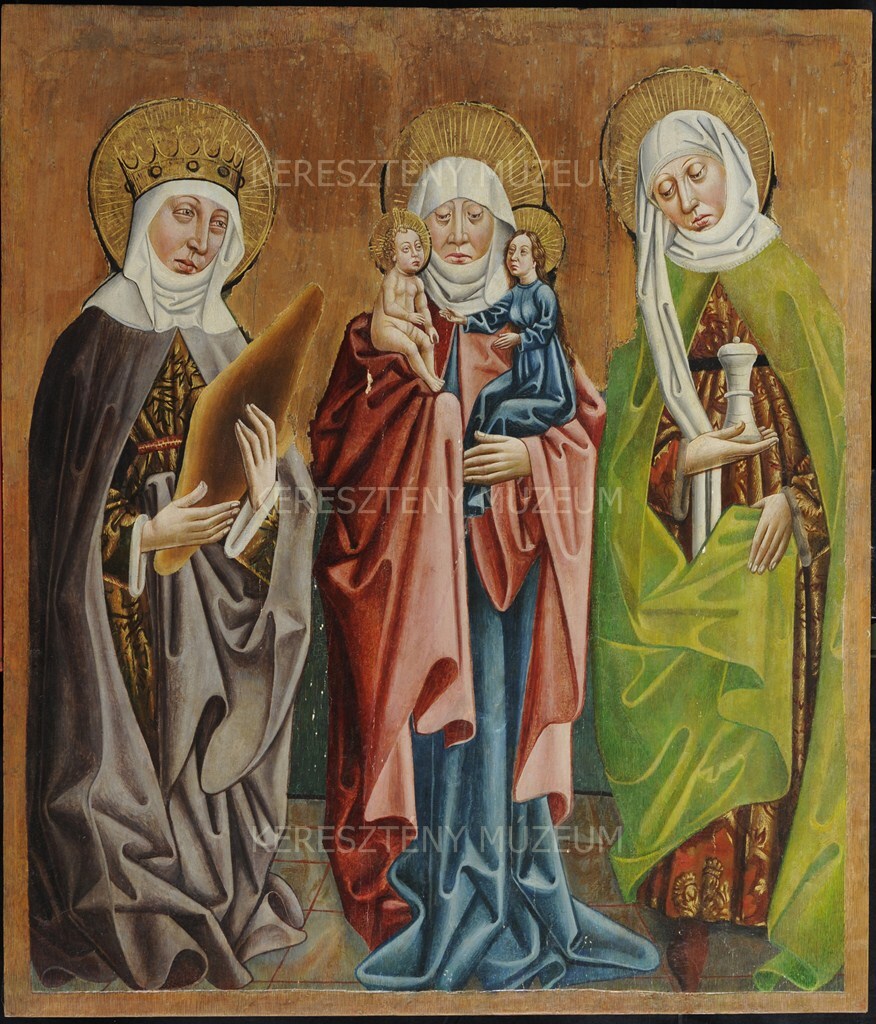
St. Elizabeth of the House of Árpád, St. Anne with the Virgin and Child, and Mary Magdalene
Detail from the movable wing of a winged altarpiece
width: 59,5 cm

Description and further information
The three saints are standing on a marble-like floor in front of a parapet that defines the space. On the left of the painting, we see Elizabeth of the House of Árpád dressed in gold brocade attire with a brown robe and a wimple and crown on her head. In her hands is her attribute, a loaf of bread. Next to her is St. Anne, with a young Mary in her left arm and the baby Jesus in her right. She wears an opulent, stiffly pleated red robe over her long blue dress and a wimple on her head. The figure of Mary Magdalene, with her head slightly bowed, is taller than the others. She is somewhat cramped in the space allotted her in the right side of the composition. Her elegant brocade dress is covered by a green robe. The loose end of her scarf spills over her right shoulder. Her left hand clutches her robe while her right holds a jar of ointment. The colour tones on the right of each saint are darker, indicating shadows. The painter modelled the blue dress of the small Mary figure using white highlights. The presentation of the saints in a line was very common in winged altarpieces of the period; moreover, this combination of Elizabeth, St. Anne with the Madonna and Child, and Mary Magdalene occurred several times in Hungary (for example in the central image of the altarpiece of St. Anne in Radács as well as in Berzenke or in one of the panels in Csíkszentlélek). The conspicuously stiff folds, the faces rendered with crisp, exacting contours as well as the composition suggest a date of execution in the 1470s-80s.
According to the earlier professional literature, the name of a member of the Kapeller family was legible on the reverse of one of the panels before it was cradled. This points to a provenance in Sáros County.
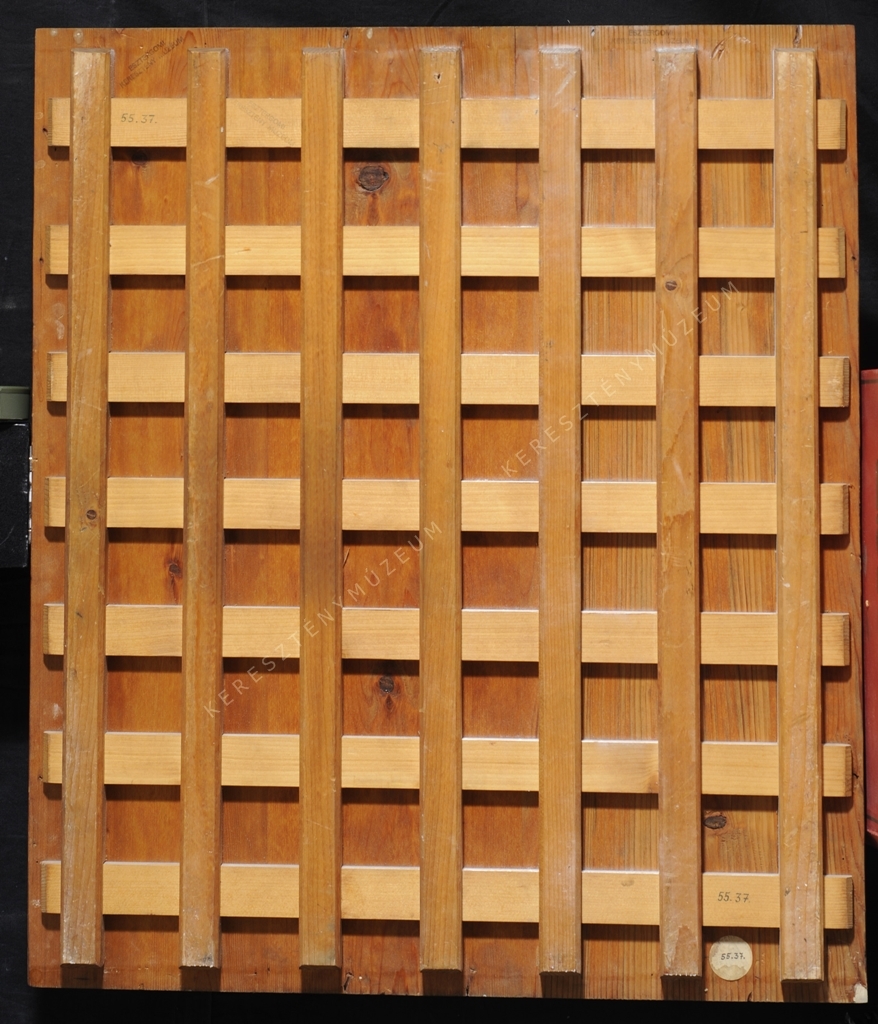
The former reverse of the painting of the three female saints was probably so badly damaged that during restoration in the 1930s the decision was made to completely remove it. The painting’s present state reveals traces of several restoration procedures including significant overpainting. The back was cradled.
Provenance
Ipolyi Collection. ("119. Szent Anna harmadmagával, mellette Szt. Erzsébet és Mária Magdolna. Tempera festmény deszkán. XV. sz. vége. Német.") - '119. St. Anne with the Madonna and Child, and beside her St. Elizabeth and Mary Magdalene. Tempera painting on a wood panel. End of the 15th c. German.’ According to tradition, Ipolyi acquired the panels from the castle of the Kapeller family. This information was probably based on a mistaken interpretation of the inscription, visible at that time, on the back of the/one panel. The error also led to the assumption that the work originated in Sáros County.)
Restauration
László Váli, 1931 (All four panels were thinned and placed on new supports, cradled.); Ilona Benkovics, 1979.
Bibliography
- Wolfgang Huber (szerk.): Meisterwerke aus dem Keresztény Múzeum; kiáll.kat; Sankt Pölten 2015., 134. (Sarkadi-Nagy)
- Cséfalvay Pál, szerk.: Keresztény Múzeum, Esztergom. Budapest, 1993. Corvina. 24, 177.– Magyar Szentek tisztelete és ereklyéi. Kiáll. Kat. Esztergom 2000, 123.
- Walicki Michal: Malarstwo polskie. Gotyk, Renesans, wezesny manieryzm; Rec. Végh János. In: Acta Historiae Artium 12 (1966), 255.
- Boskovits Miklós-Mojzer Miklós-Mucsi András: Az esztergomi Keresztény Múzeum képtára (Budapest, 1964. Akadémiai Kiadó) 126 - 128.
- Radocsay Dénes: A középkori Magyarország táblaképei. Budapest 1955, 325.- Végh János: Adatok táblaképfestészetünk ikonográfiájához. In: Művészettörténeti Értesítő 8 (1959), 148-149, 8. kép.
- Radocsay Dénes: Az esztergomi kiállítás magyar anyaga. Szabad Művészet IX. 1955. I. 1. sz. 7-13., 13.
- Magyarország műemléki topográfiája I. Esztergom 1. Esztergom műemlékei (összeállította: Genthon István; Budapest 1948), 28.
Related works