

Italian renaissace and baroque painting (permanent exhibition)
Virgin and Child Enthroned with Saints
Triptych
documented in Siena 1389-1434/35
Description and further information
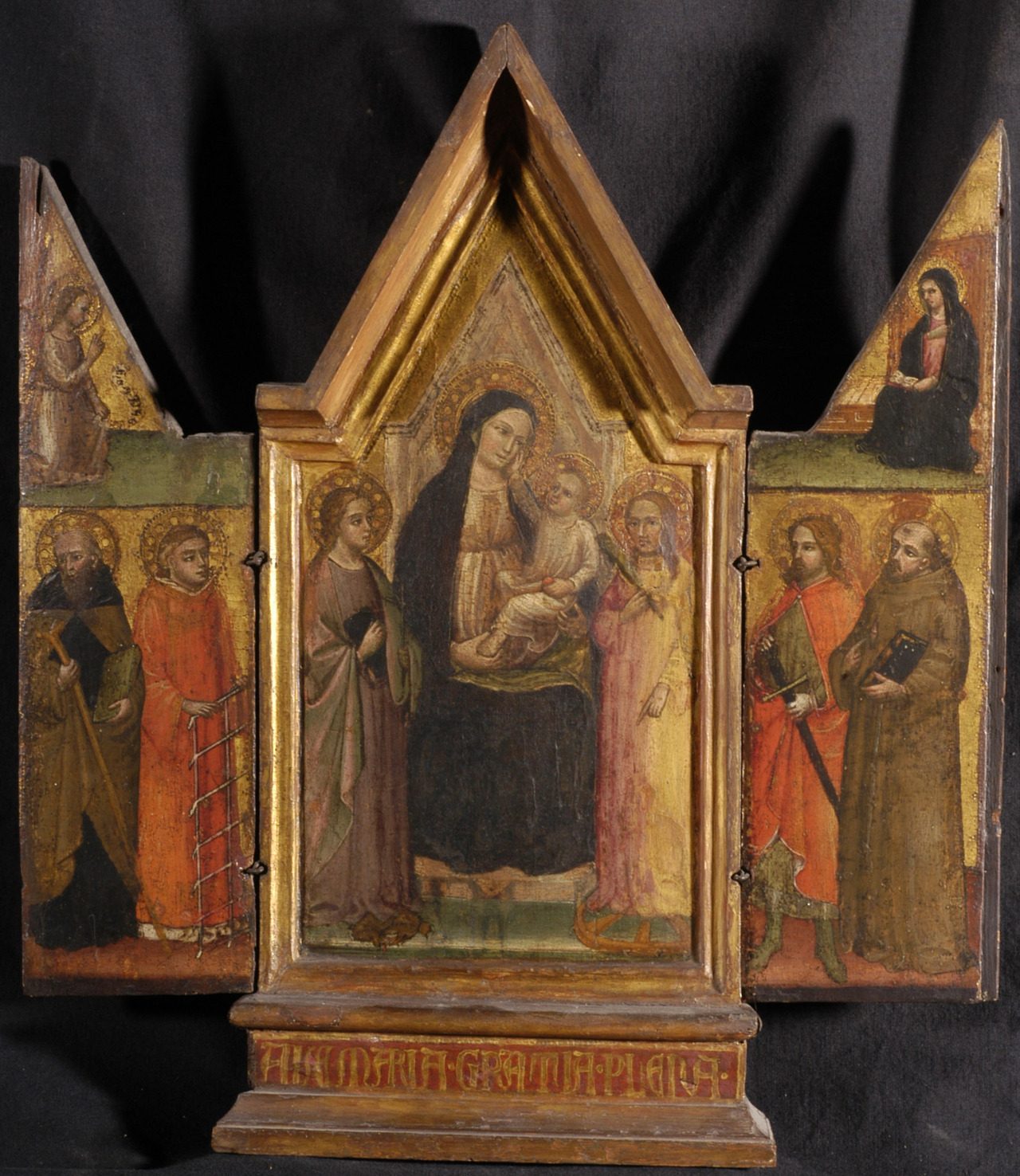
The modest tripartite domestic altarpiece dates from the years around 1400. Its iconographic programme and manner of execution preserve the Sienese traditions of the second half of the fourteenth century. In the central panel of the triptych, against a gold background, the Madonna is seated on a white marble throne, whose pointed-arch gable is echoed by the frame of the picture. The Madonna wears a white dress with ample folds, gathered by a belt, and a blue mantle. With both hands she holds the Child seated in her lap, dressed in a long white garment; with his right hand he caresses Mary’s face, while in his left he holds a red apple. The apple is the symbol of the Fall. In the hand of Jesus, it refers to the new Adam, Christ, who takes away the sins of the world. On either side of the throne, in the green foreground, stand two saints. On the left, Saint Margaret of Antioch wears a violet dress and a green mantle shaded with red; she holds a book in her right hand and a cross in her left. At her feet appears her attribute, the dragon. On the right stands Saint Catherine of Alexandria upon the wheel, wearing a long dress coloured red and yellow. In her right hand she holds a palm branch, while with her left she points to the wheel.
On the truncated wing panels, whose frames are also missing, two standing saints fill each picture field before a gold background. On the left wing, Saint Anthony the Hermit wears a brown mantle over a black cowl; he holds a book in his left hand and a pilgrim’s staff in his right. Saint Lawrence appears in a red dalmatic and holds before him the fiery gridiron, the instrument of his martyrdom. On the right wing is probably Saint Julian, the young nobleman, shown in a green garment and red mantle. In his left hand he holds the sword with which he committed his fatal deed: killing his parents, whom he failed to recognize. He was a very popular saint in Tuscany in the fourteenth century, and was venerated as the patron saint of merchants, travellers, and innkeepers. Beside him, Saint Francis of Assisi points with his right hand to the wound in his side. The Annunciation appears in the gables of the wing panels. Against the broad green horizon, on the left, the angel dressed in white kneels in greeting before Mary, who is seated on a broad marble throne on the right. The triptych’s present arrangement is the work of J. A. Ramboux, who not only made the base and the outer gable, but also cut down the wing panels so that the triptych could be closed. He also repainted certain figures, such as Saint Catherine. A more secure attribution of the master will only be possible after the painting has been cleaned. The central panel and the wings are by the same hand, to be sought in the circle of Martino di Bartolomeo, a Sienese painter who preserved the traditions of the late Trecento. The Esztergom domestic altarpiece is related to paintings nos. 105 and 160 in the Pinacoteca Nazionale, Siena. (Prokopp Mária, 1993)
Provenance
Arnold Ipolyi’s purchase from the Ramboux estate in Cologne, 1867
Restauration
1923 Endrődy Sebestyén
Bibliography
- Cséfalvay Pál, szerk.: Keresztény Múzeum, Esztergom. Budapest, 1993. (Prokopp Mária)
- Boskovits Miklós-Mojzer Miklós-Mucsi András: Az esztergomi Keresztény Múzeum képtára. Budapest, 1964., 52 "a XV. század első évtizedben Martino di Bartolomeo köre (?)"
- Magyarország műemléki topográfiája I. Esztergom 1. Esztergom műemlékei.összeállította: Genthon István, Budapest, 1948. "ismeretlen 14. századi sienai mester"
- Ramboux, 1867, "ismeretlen sienai mester"