

Italian renaissace and baroque painting (permanent exhibition)
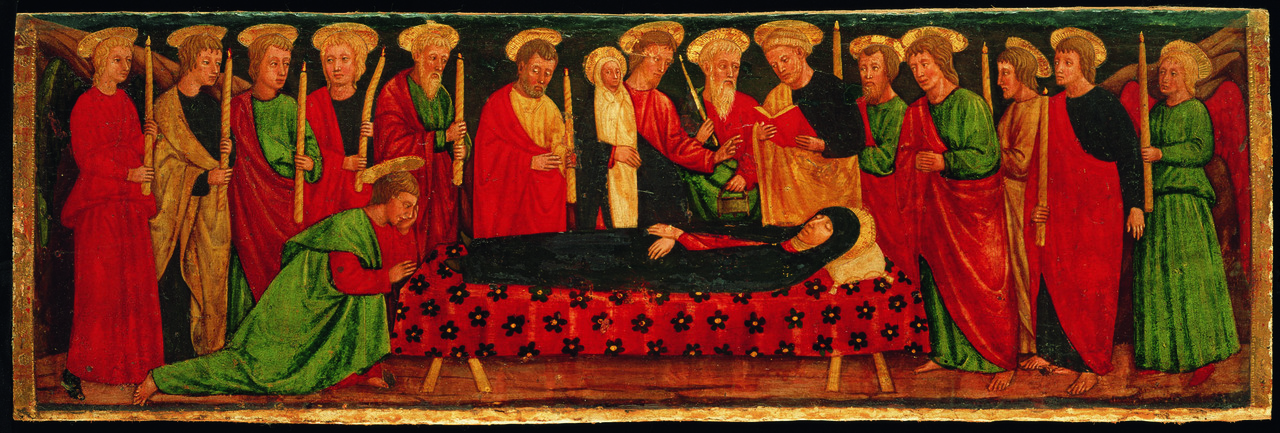
Death of Mary
Florence, 1397 - Pisa, 1478
width: 67 cm
Description and further information
For few paintings in the museum can we determine their place in time and space as precisely as in the case of this predella panel. Federico Zeri, in an oral communication, associated it with the name of Paolo Schiavo, while Miklós Mojzer established that it originally belonged to the altarpiece dated 1460 in the church of Santa Maria delle Querce at Monticelli. Another predella panel from the same altarpiece was identified by Pudelko in the Diözesanmuseum in Cologne. Paolo Schiavo probably trained in the workshop of Lorenzo Monaco, the greatest Florentine master of the Late Gothic, but his artistic formation was shaped above all by the influence of Masolino, a painter of the transition between Gothic and Renaissance. In his youth, even Masaccio’s innovations aroused his interest; from the 1440s onward, however, his art shows signs of decline and emptiness. This Death of the Virgin is such a late work, marked by weariness and schematism. In its iconography it follows the Byzantine Koimesis type: Jesus receives the soul of his dead mother in the form of a child wrapped in a white cloth. The apostles holding candles are lined up beside one another with monotonous uniformity; the only variation is provided by the alternation of clear colours—red, green, and yellow. (Tátrai Vilmos, 1993)
Provenance
Ipolyi gyűjtemény
Bibliography
- Boskovits M., Ancora su Paolo Schiavo: una scheda biografica e una proposta di catalogo, in Arte cristiana, 1995, p. 334
- Cséfalvay Pál, szerk.: Keresztény Múzeum, Esztergom. Budapest, 1993. 228, kat. 96. (Tátrai Vilmos)
- Lexikon dér Bildenden Künstler, Bd. XXX. 1936 . 46-47
- Boskovits 1978, 7. Vö. Pudelko, G.: Paolo Schiavo. In: Thieme-Becker: Allgemeines
- Mucsi 1975, 45;
- Boskovits M./ Mojzer M./ Mucsi A., Az Esztergomi Keresztény Múzeum képtára, 1964, p. 74