

Italian renaissace and baroque painting (permanent exhibition)
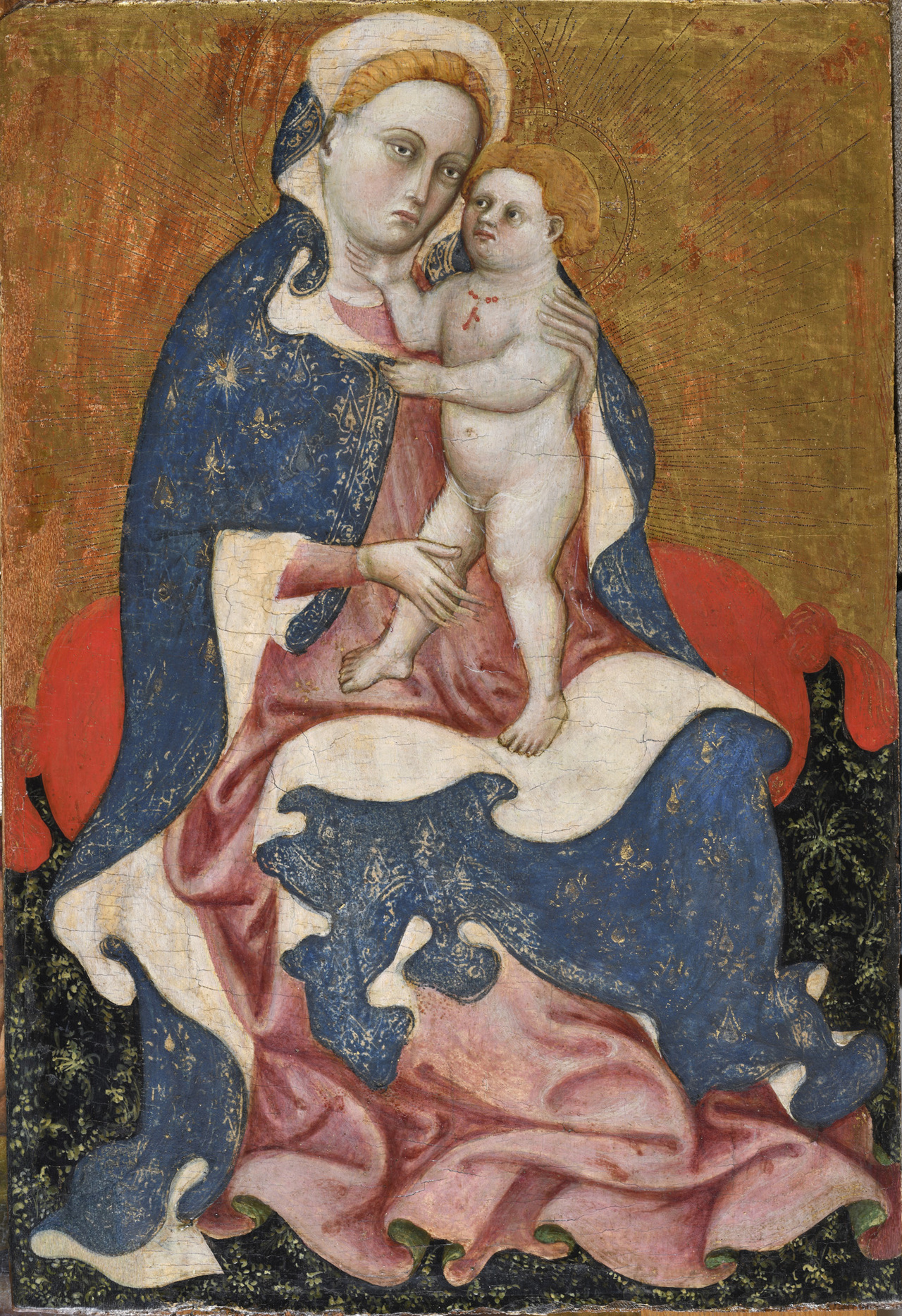
Virgin and Child
width: 41,5 cm
Description and further information
The Madonna of Humility (Madonna dell’Umiltà) was a popular and widespread pictorial type in late Gothic painting in Central and Northern Italy. In order to symbolize one of the foremost Christian virtues, Mary is shown not seated on a throne, but on the ground, or on a cushion placed on the ground. In the Middle Ages it was widely known, following Isidore of Seville’s Etymologiae, that the Latin word humilis — humble — derives from humus, meaning earth. Mary had earlier been represented seated on the ground in scenes of the Nativity of Christ, where an idea predating Christianity — the association of earth, birth, and death — also played a role. From the Nativity as a narrative scene, the Madonna dell’Umiltà became an independent devotional image, first in Siena, in the work of Simone Martini. The flowery meadow likewise has symbolic meaning: it alludes to the Garden of Paradise. While Mary is adorned with the virtue of humility more than any earthly mortal, painters also exalt her with a halo, a gold background, and a richly ornamented mantle — in other paintings, also with a crown held by angels. The naked Christ Child steps forward in his mother’s lap; with his left hand he grasps the edge of her mantle, while with his right he caresses Mary’s neck. The slightly distorted forms of his body are enclosed by a firm contour, and sharply drawn lines define the eyes, nose, and mouth of both Mary and Jesus. The Madonna’s mantle is stylized to the utmost degree. Taking the natural fall and folds of the drapery merely as a point of departure, the painter sought a rich decorative effect, giving the edge of the garment ever new breaks and turns. Vilmos Tátrai, 1993.
Provenance
Acquisition of Archbishop János Simor
Restauration
1996 Sári Gabriella
Bibliography
- Sallay Dóra: Raffaele Bertinelli és reneszánsz képtára. Egy műgyűjtemény útja Rómától Esztergomig. Esztergom, 2009, 50
- Cséfalvay Pál, szerk.: Keresztény Múzeum, Esztergom. Budapest, 1993. 225, kat. sz. 90. "Bolognai festő" (Tátrai Vilmos)
- De Marchi, Andrea: Una fonte senese per Ghiberti e per il giovane Angelico. Artista, 4 (1992), 130–151, 93: 88. j
- Mucsi András: Az esztergomi Keresztény Múzeum Régi Képtárának katalógusa. Budapest, 1975, 40.
- Boskovits Miklós-Mojzer Miklós-Mucsi András: Az esztergomi Keresztény Múzeum képtára. Budapest, 1964. , 48