

Italian renaissace and baroque painting (permanent exhibition)
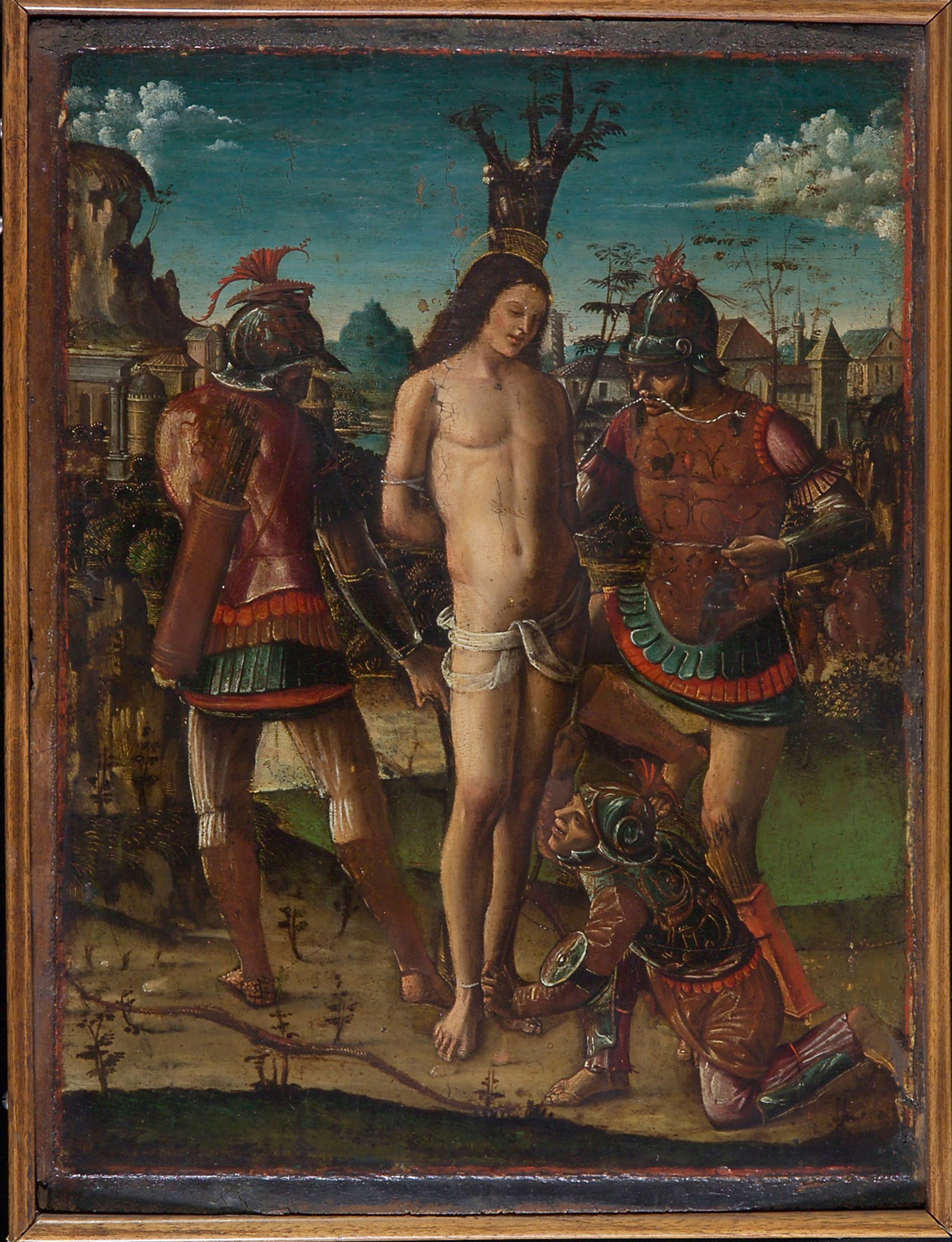
Martyrom of Saint Sebastian
Sciacca, 1443 – Palermo, 1506
width: 27,5 cm
Description and further information
According to the Legenda Aurea, Sebastian, a Roman soldier who lived in the third century, was shot with arrows by Diocletian’s soldiers because of his Christian faith until he became “like a hedgehog.” The saint, believed to be dead, was left behind, but miraculously recovered from his wounds. The painting shows the rarely depicted moment before the shooting, when the executioners bind the saint to a truncated tree trunk. The painter deliberately contrasts Sebastian’s calm, gentle face with the brutal expressions of the soldiers. Because of its style, which draws on heterogeneous elements, this small painting is difficult to define with certainty. Vilmos Tátrai tentatively attributed it to Riccardo Quartararo on the basis of its close stylistic affinity with a Saint Michael the Archangel in a private collection, which Federico Zeri considered to be by Quartararo. Quartararo worked mainly in Sicily and, over the course of his career, was exposed to a wide range of influences, above all Iberian-Flemish and North Italian — Ferrarese, Veronese, and Paduan. In 1472 he was probably in Valencia, while in 1491–92 he carried out numerous commissions in Naples. The painting’s South Italian origin is also suggested by the fact that it once belonged to the Capese Zurlo family in Naples, from where it entered the Christian Museum through the collection of the Count of San Marco.
Dóra Sallay, 2002.
Provenance
San Marco collection, 1926
Bibliography
- Fiorella Sricchia Santoro: Pittura a Napoli negli anni di Ferrante e di Alfonso duca di Calabria. Sulle tracce di Costanzo de Moysis e di Polito del Donzello. in: Prospettiva Rivista di storia dell’arte antica e moderna, Nn. 159-160, Luglio-Ottobre 2015, 25-109, 108, fig. 112.