

Italian renaissace and baroque painting (permanent exhibition)
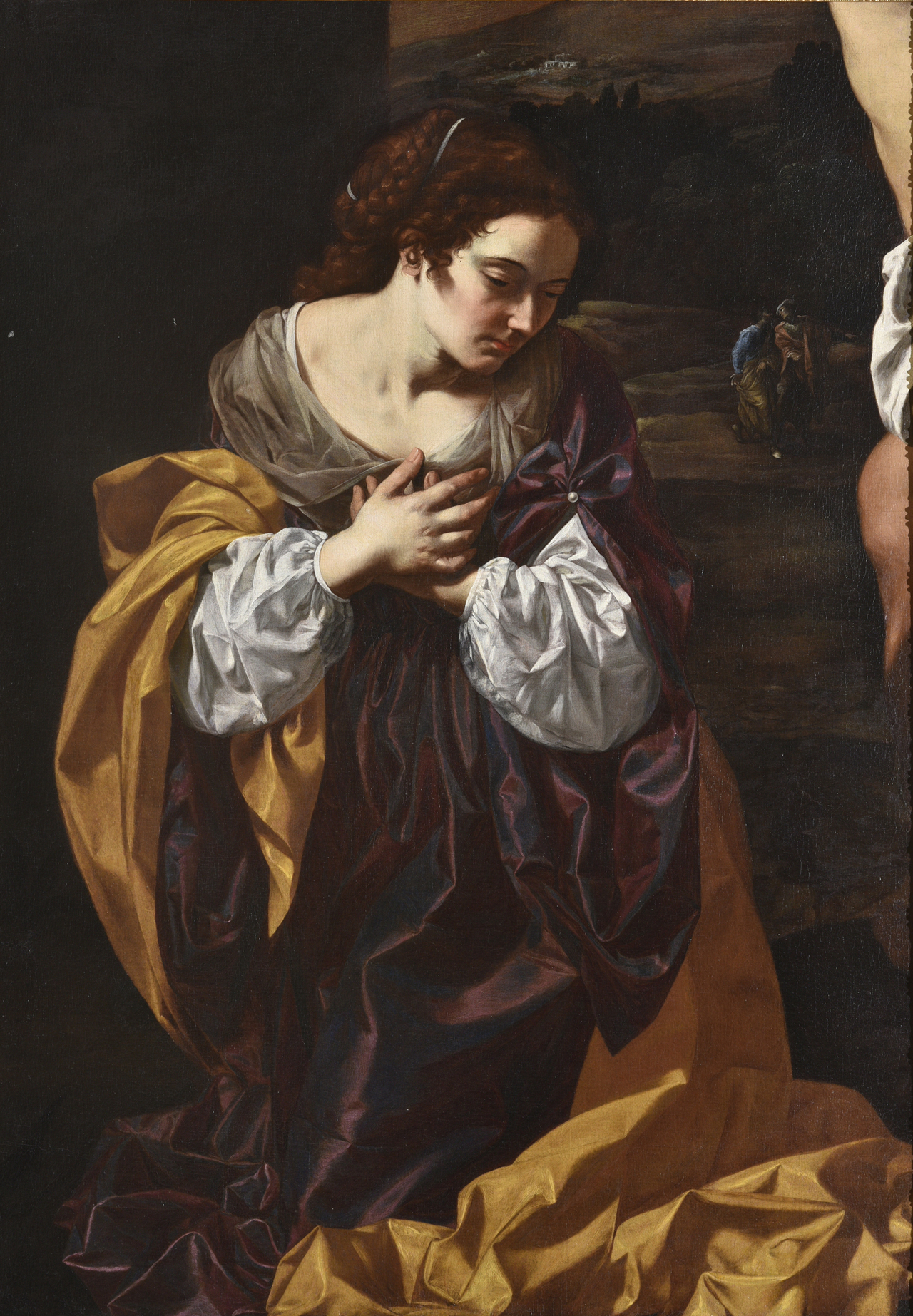
Martyrdom of a Femail Saint
earlier: Mary Magdalene
Orta di Atella or Náples, c. 1590 – Conversano, 1645
width: 92 cm
Description and further information
Paolo Finoglio was born near Naples around 1590 and died in Conversano in 1645. He belonged to the first generation of Neapolitan followers of Caravaggio. Until 1635 he was active in Naples, after which he settled in Conversano in Apulia, where, in the service of Prince Giangirolamo Acquaviva, he painted monumental ceiling frescoes, altarpieces, and a cycle illustrating Tasso’s Gerusalemme Liberata.
He was a master of large-scale figure painting, of which the lower left section of this painting, depicting the beheading of a female saint and surviving as a fragment of a larger work, offers a fine example. For a long time the work was thought to represent a Penitent Magdalene, but after its restoration, the drapery covering the executioner’s waist and a detail of his leg were revealed in the upper right corner. The painting, previously attributed to Orazio Gentileschi, was identified by Raffaello Causa.
The work comes from the Capece Zurlo di San Marco Collection in Naples, where it can be precisely identified in the inventory of 1715: “a painting of a virgin being beheaded, by Gio. Battistiello Caraccioli.” Giovanni Battista Caracciolo the Elder, 1578–1635, was a tenebrist master with whom Finoglio worked in the monastery of San Martino in Naples. The inventory also recorded the dimensions of the then still complete painting, which originally measured 210 × 158 cm.
The Esztergom painting glows with the broken, iridescent colours characteristic of the master. These are typical of Finoglio, who painted sumptuous fabrics with particular virtuosity. Éva Nyerges, 2019.
Provenance
San Marco collection
Exhibitions
- 2019 Veszprém, Érseki Palota, "Nápolytól Velencéig"