

Italian renaissace and baroque painting (permanent exhibition)
Saint Ephrem the Syrian
Naples, 1634 - Naples, 1703
width: 93 cm
Description and further information
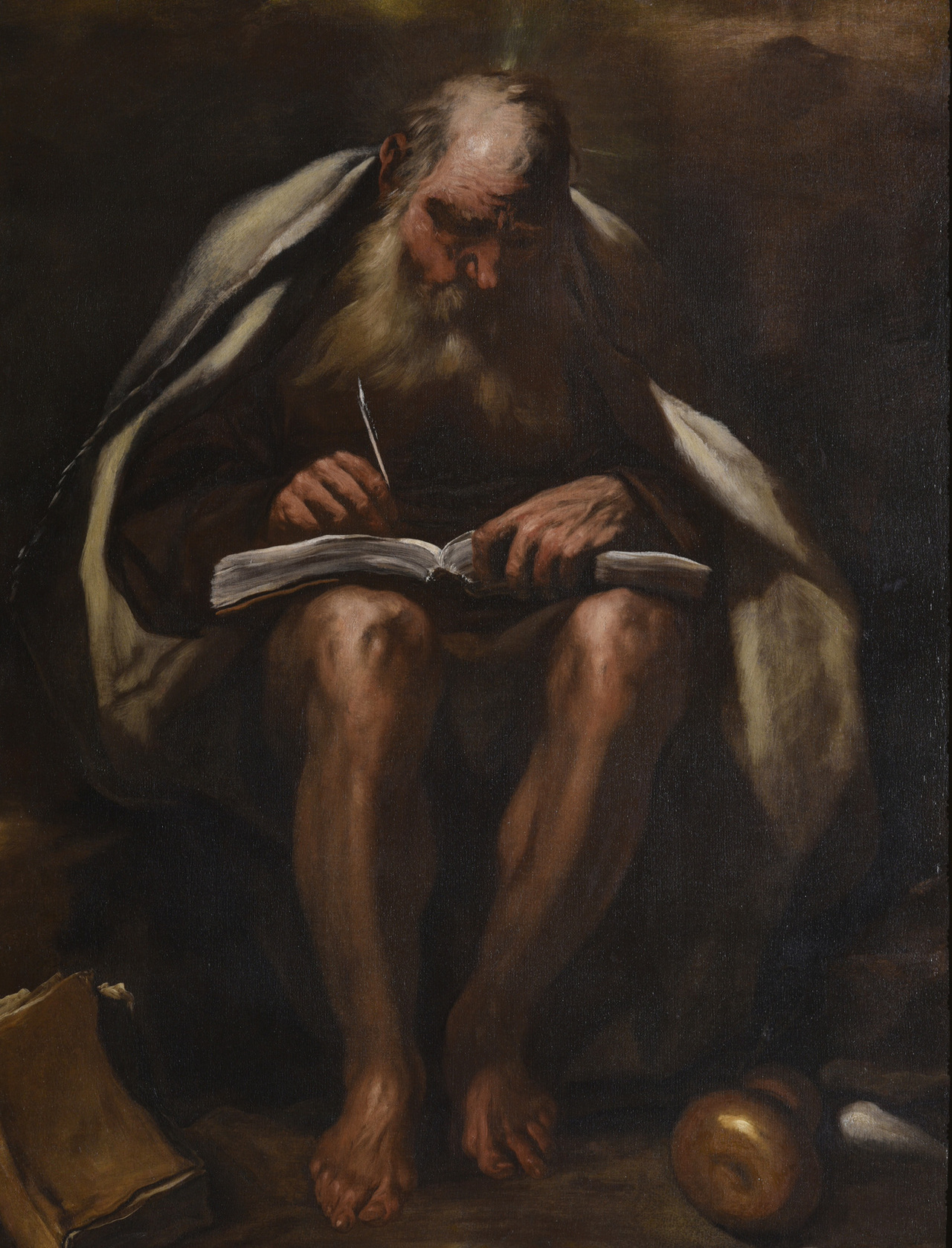
Against a dark background sits the grey-bearded hermit, with an open book on his knees; on the ground to the right lies a book, and to the left a copper vessel. The composition closely follows the sheet depicting Saint Ephrem in the series Sylva anachoretica Aegypti et Palestinae, engraved by Boetius Bolswert after a painting by Adam Bloemaert in 1612, as Pál Cséfalvay observed.
The work is by Luca Giordano, the school-forming master of mature Neapolitan Baroque painting. It demonstrates how the young master, inspired by Caravaggism and by the painting of Ribera — and later active in Florence, Venice, and, at the end of his life, Madrid — made use of models taken from northern engravers. The naturalistic rendering of the body, hair, and beard, a legacy of Ribera, is here combined with the radiant, golden light he encountered in Venetian painting. Together with its pendant, Saint Macarius of Egypt, the painting can be identified in the 1715 inventory of the Neapolitan collection of Giacomo Capece Zurlo: “two paintings, measuring 6 and 3, painted by Luca Giordano” (Ruotolo 1973, p. 150: due quadri, di misura 6 e 3, pittura di Luca Giordano).
Provenance
San Marco collection
Restauration
Varga Dezső
Exhibitions
- 2015 Sankt Pölten, Diözesanmuseum, Meisterwerke aus dem Keresztény Múzeum
Bibliography
- Wolfgang Huber (szerk.): Meisterwerke aus dem Keresztény Múzeum; kiáll.kat; Sankt Pölten 2015. 152-153. (Nyerges Éva)
- Ferrari, O.-Scavizzi, G.:Luca Giordano. Nuove ricerche e inediti. Napoli 2003, 10, 45, (A078) 1665 körül, 132, 164
- Nyerges, É.:”Le opere di Luca Giordano in Ungheria, in Ricerche sul’ 600 napoletano. Saggi e documenti 1999.Napoli 2000, 130-142, 132-, (Luca Giordano, 1665-75 között),
- Nyerges, É.in Milano,1993. L’Europa della pittura nel XVII secolo./80 capolavori dai musei ungheresi, catalogo ed. Ágnes Szigethi.(Milano, Palazzo della Permanente)