

Italian renaissace and baroque painting (permanent exhibition)
Saint Peter of Alcántara
or The Meditating Philosopher
active in Naples c. 1630-1660
width: 70 cm
Description and further information
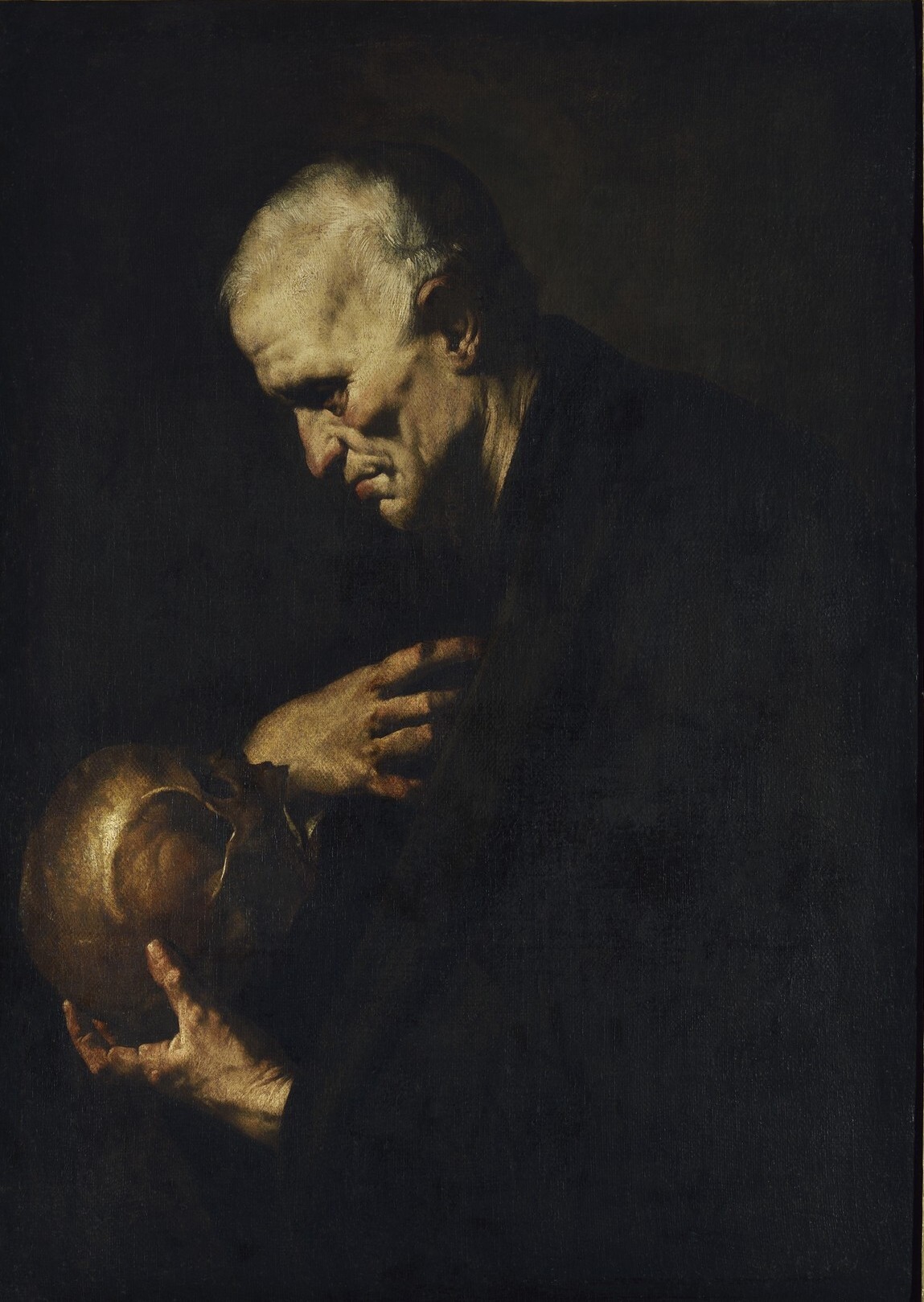
The painting was formerly identified in the literature as Saint Jerome. Its more recent identification was made in connection with the Munich version of the composition. Saint Peter of Alcántara was a Spanish-born Franciscan friar and the founder of the Alcantarine reform congregation within the Order of Friars Minor. In his reform efforts he supported the Carmelite Order and served as spiritual adviser to Saint Teresa of Ávila. He led a severe and self-mortifying life, and according to his biographer possessed an exceptional gift for meditation.
The skull, a frequent attribute in his representations, served as an aid to this profound intellectual and spiritual activity: meditation on the ultimate purpose of earthly existence. The depiction of a saint or Church Father meditating with a skull, or shown in ascetic withdrawal, was a common theme in the seventeenth century. Its popularity was connected with the deepened religious sensibility of post-Tridentine Catholicism. The Catholic Church after the Council of Trent regarded Saint Ignatius of Loyola’s book of Spiritual Exercises as a manual of meditation and Christian asceticism. Published in 1548, the work deals with the path leading to the ultimate goal of human existence: the salvation of the soul.
The painting evokes the first stage of meditation associated with this process. Since sin is the chief obstacle to the attainment of salvation, the Jesuit author prescribes, for the first week of the month-long exercises, meditation on death leading to salvation, and on the history of sin, from the sin of the first parents to our own sins. This process is expressed by the skull — symbolically the skull of Adam — which signifies both the created and mortal nature of humankind and original sin, as well as by the saint’s gesture of pointing to himself.
The colour scheme of the painting is sombre and austere. Against the dark grey background, the stooped shoulder covered by a black cloak is distinguished only by a barely visible outline. The figure is illuminated from the left by a strong light, which is not merely a natural phenomenon. It has a symbolic role, expressing the inner illumination that follows meditation. As a compositional device, the light emphasises those elements that are essential to the meaning of the work: the rough, gnarled hands, above all the expressive gesture of the right hand, and the furrowed face with its deep-set eyes, turned towards the earth-coloured skull.
The modelling of the painting is sensitively worked out. In shaping the plasticity of the face, the painter attends carefully to detail, especially around the eyes and the corners of the mouth, and on the top of the head covered with short, bristling hair.
Enikő Buzási, 1993.
Provenance
San Marco collection, 1926
Restauration
1982-83-ban a Képzőművészeti Főiskola Restaurátorképző Tanszékén
Bibliography
- Cséfalvay Pál, szerk.: Keresztény Múzeum, Esztergom. Budapest, 1993. 20-251, kat. sz. 148 (Buzás Enikő)
- La pittura napoletana dal Caravaggio a Luca Giordano (kiállítási katalógus) Torino, 1983. 126
- Spinosa, Nicola: L'opera completa del Ribera. Milano, 1978. 348, 349, 350. kat. számok (az esztergomi kép változatai);
- Dizionario Enciclopedico Bolaffi, V. i 974- 82-83 (Francesco Fracanzano címszó az analógia fotójával);
- Browm, Jonathan: Jusepe de Rihera. Prints aitd Drawings (kiállítási katalógus). Princeton-Cambridge (Mass.), 1973-1974;
- Mâle, É.: L'art religieux après le Concile de Trente. Paris, 1932. 206;
- szó);
- Kirschhaum, E.: Lexikon der christlichen lkonographie, Bd. VIII. Rom-Freiburg-Basel-Wien, 1976. 175. (Petrusvon Alcántara címszó). Vö. Künstle, K. : lkonographie dér Christlichen Kunst, II. Freihurg im Breisgau, 1926. 500-501 (Pétrus von Alcántara cím
- Mucsi 1975 , 54 (Szent Jeromosként);
- Boskovits-Mojzer-Mucsi 1964, 100. (Szent Jeromosként);
- Gemäldekataloge, Bayerische Staatsgemäldesammlungen, Alte Pinakothek, München, Bd. I. Spanische Meister. Szerk. Soehner, Halldor. München, 1963. 165-167;