

Italian renaissace and baroque painting (permanent exhibition)
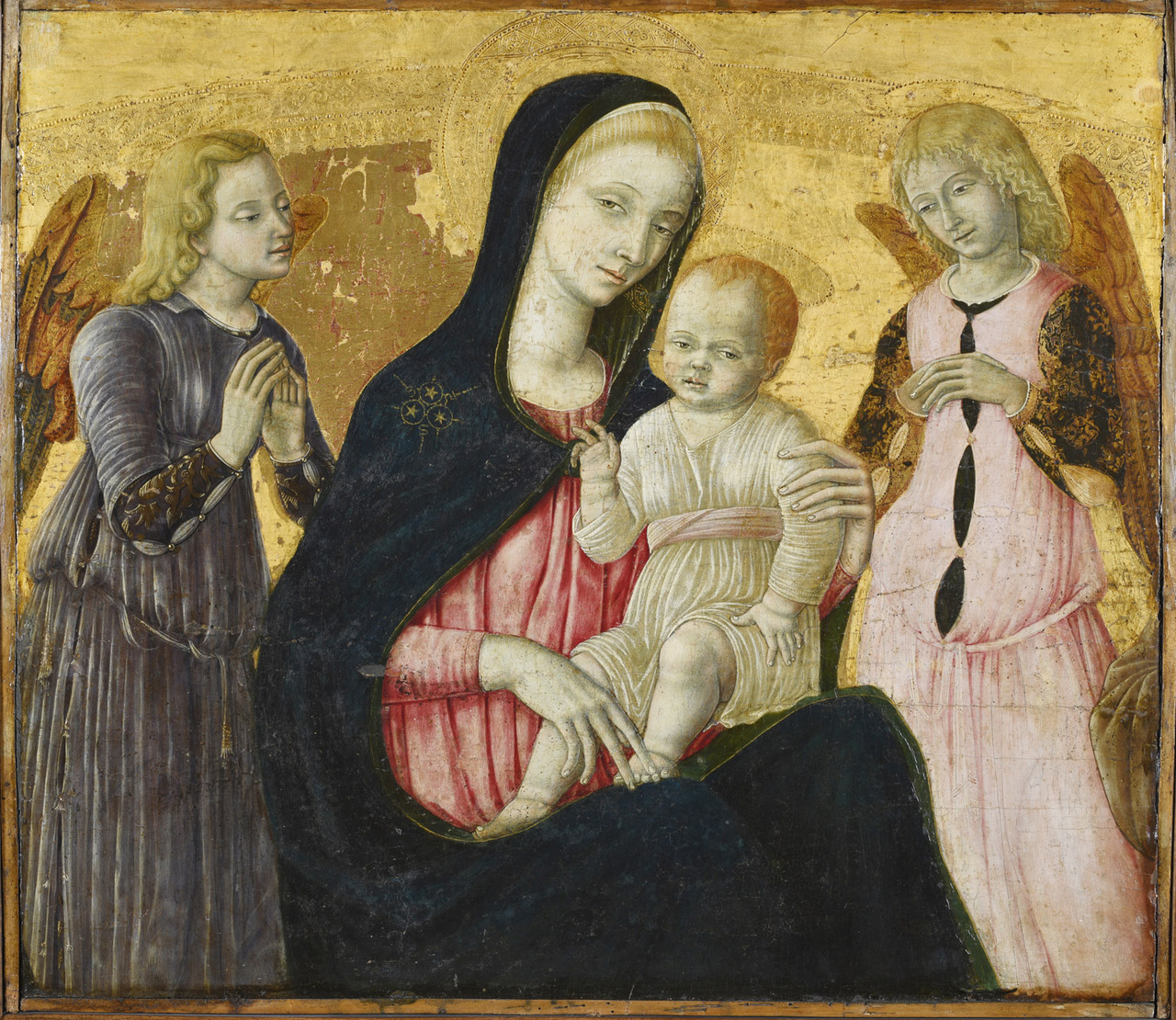
Virgin and Child with two Angels
Borgo San Sepolcro, c. 1430 – Siena, 1495
width: 76 cm
Description and further information
This painting, later extended at the top and originally terminating in an arch, was the central fragment of a lunette that once crowned the Massacre of the Innocents Altarpiece in the church of Sant’Agostino in Siena. The two sides of the composition were formerly occupied by two male saints turned towards the Madonna in prayer: Saint Augustine on the left and Saint Francis of Assisi on the right. A fragment of the latter saint’s brown habit is still visible at the right edge of the painting. In the Esztergom painting, the figures, seen from a slightly elevated viewpoint and distinguished by their ethereal beauty and pale skin, appear against a radiant gold background. The subtly modelled large surfaces, painted in a restrained colour range, are enlivened by decorative details rendered with particular care: the triple-star motif adorning Mary’s shoulder, the shimmering angels’ wings, the richly brocaded slashed sleeves, and the meticulously depicted locks of hair. The central panel of the altarpiece, depicting the Massacre of the Innocents, is today on display in the Palazzo Pubblico in Siena. The inscription along its lower edge, which also includes the date of execution, names the painter, who was a recognized and much-employed Sienese master of the second half of the fifteenth century. (Sallay Dóra, 2002, website)
Provenance
Arnold Ipolyi’s purchase from the Ramboux estate in Cologne, 1867
Restauration
1923 Endrődy Sebestyén
1937 Nikássy Lajos
1959 Varga Dezső
Exhibitions
- 1930 London, Royal Academy of Arts, "Exhibition of Italian Art 1200-1900"
- 1930 Budapest, Műcsarnok, Őszi kiállítás
Bibliography
- Sallay, Dóra: Corpus of Sienese Paintings in Hungary, 1420–1510. Florence, Centro Di, 2015. kat. 22, 226-233.
- https://www.nationalgallery.org.uk/upload/pdf/syson-billinge-campbell-sallay_matteo-di-giovannis-lost-altarpiece-for-sant-agostino-asciano_August_2013.pdf
- The Asciano Altarpiece, 1474’ in Luke Syson, ‘Renaissance Siena. Art for a City’, exh. cat., London, The National Gallery, 2007-08, pp. 124–31
- Martina De Petris, in Agosti ed. 2008, 78–87
- Sallay 2008, 8, 16;
- Sallay 2006[a], 157–63; Schmidt 2006, 710;
- Sallay 2003[b], 81–93 (reconstruction of the altarpiece);
- Paardekooper 2002[a], 46, no. 22;
- Silberger 1999, 273 99, esp. 276 (iconological analysis of altarpiece);
- Frinta 1998, 112, 274, 302, 406, 473 (repertory of punch marks);
- Cséfalvay Pál, szerk.: Keresztény Múzeum, Esztergom. Budapest, 1993. 232-233, kat.sz. 107 (Tátrai Vilmos)
- Tátrai 1983, 35. Vő. Trimpi, Erica: „Johannem Baptistam Hieronymo aequakm et non maiorem”: A predella for Matteo di Giovanni's Placidi altar-piece. The Burlington Magazine, August 1983, 457-466.
- Mucsi 1975, 42-43;
- Mucsi 1973, 16;
- Berenson 1968, 258;
- Boskovits-Mojzer-Mucsi 1967, 54;
- Boskovits-Mojzer-Mucsi 1964, 60-62;