

Medieval Hungarian, Austrian and German Painting and Sculpture
Bust of a female saint
Artist
Influenced by the workshop of Hans Multscher/environment of Jakob Kaschauer
Origin date
1435–1440
Material
linden
Sizes
height: 41 cm
width: 37 cm
depth: 21 cm
width: 37 cm
depth: 21 cm
Inventory No.
56.832.1
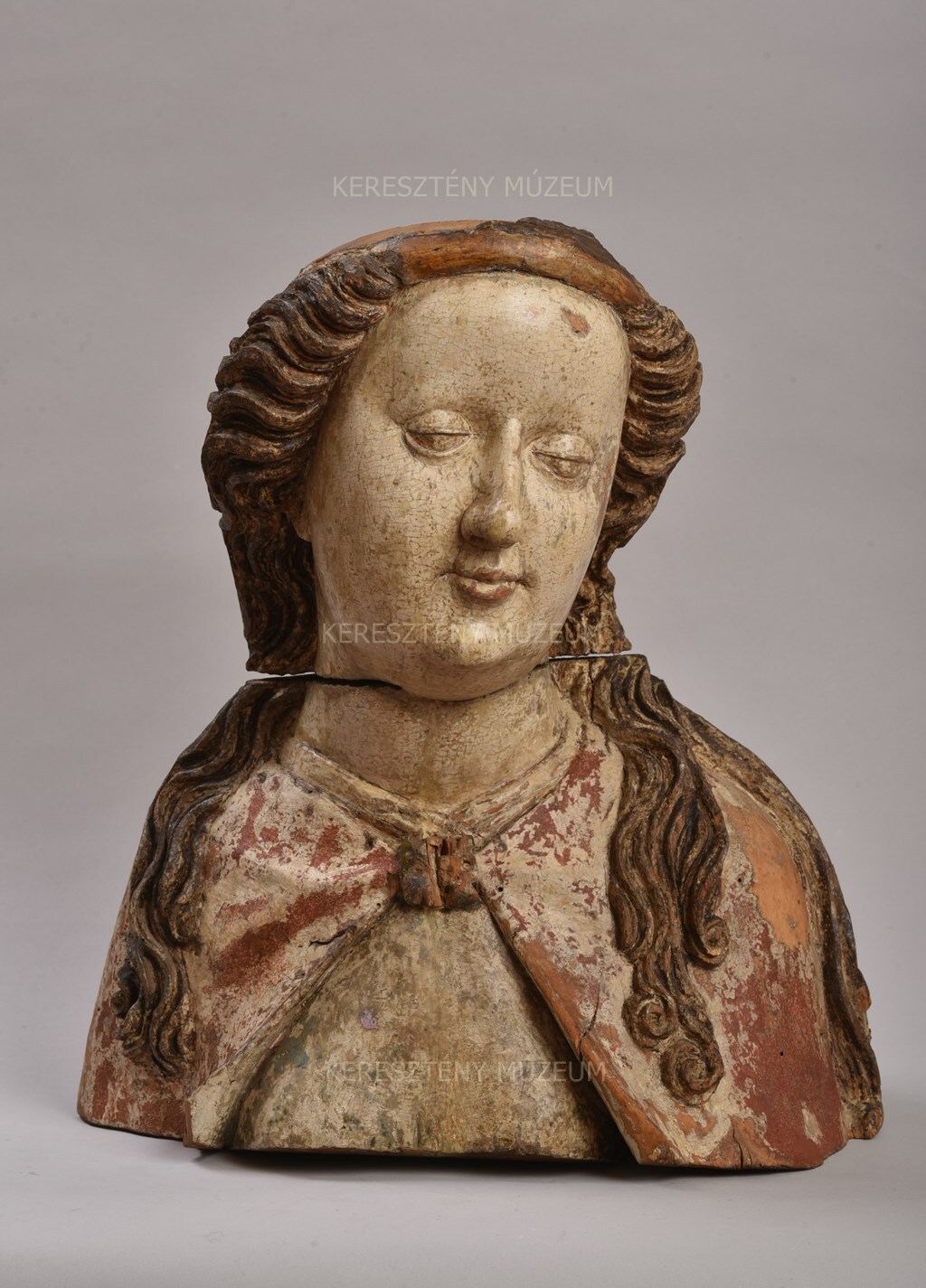
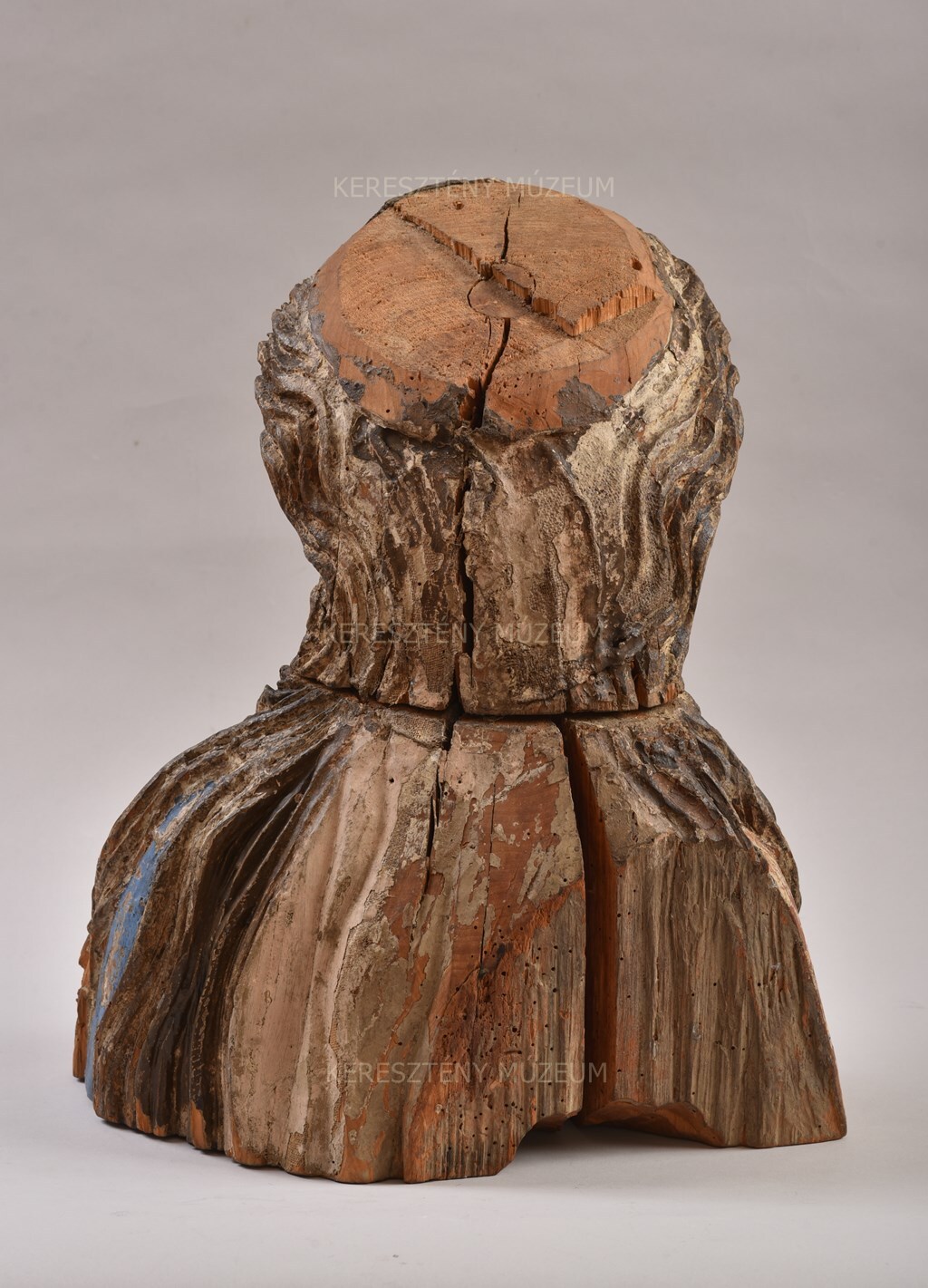
Description and further information
Presumably the statue was originally full length but was sawed into several parts during the First World War. The surviving head and chest were attached at the neck—as can still be seen clearly today. The polychrome is severely abraded, and the canvas glued to the support, beneath the grounding, is visible in several places. Some researchers have linked the statue and its companion in the Museum of Fine Arts (inv. no. 7176) to the workshop of Jakob Kaschauer. Others, however, believe the sculptor was influenced by the workshop of Hans Multscher.
Provenance:
The two, intact altarpiece statues were owned by an Austrian peasant during the First World War. Around 1918, he sawed the statues into several parts and burned the discarded parts. The remains, thus transformed into busts, were obtained by an art dealer from Wels (Upper Austria), and were then acquired by Viennese art dealer and collector Franz Kieslinger. In 1937 one statue was purchased by the Budapest Museum of Fine Arts from the collector Lajos Meller, while the other was procured by the Christian Museum in 1938.
Bibliography:
Franz Kieslinger: Mittelalterliche Bildwerke 1200-1440. In: Belvedere Bd 4 (1923),107. – Genthon István: Magyar művészek Ausztriában a mohácsi vészig. Budapest 1927, 27, 28. – Kampis Antal: A középkori magyar faszobrászat történetének vázlata 1450-ig. Budapest 1932, 62. – Franz Kieslinger: Mittelalterliche religiöse Plastik. In: Kirchenkunst 1933, 83. – Gerevich László: A kassai Szent Erzsébet-templom szobrászata a XIV - XVI. században. Budapest 1935, 72-73. – Csánky Miklós: Két későgótikus bécsi táblakép a Szépművészeti Múzeumban. In: Az Országos Magyar Szépművészeti Múzeum Évkönyvei. 9 (1937-39), 185. – Gerevich László: A felvidéki szobrászat stílusfejlődése. Budapest 1943, 8-9. – Genthon-1948 148. – Balogh Jolán: A Régi Szoborosztály. In: Pogány Ö. Gábor, Bacher Béla (szerk.): A Szépművészeti Múzeum 1906-1956. Budapest 1956, 129. – Eszláry Éva: Az esztergomi Keresztény Múzeum egyik XV. századi szobortöredékének mestere. In: Művészettörténeti Értesítő 9 (1960), 101-105. – Radocsay Dénes: Der Hochaltar von Kaschau und Gregor Erhart. In: Acta Historiae Artium 7 (1960), 23. – Boskovits-Mojzer-Mucsi: Das Christliche Museum von Esztergom (Gran). Budapest 1964, 150. – Tripps, Manfred: Eine Reihe thronender Gottesmütter und deren Verbindung zum frühen Schaffen Multschers. In: Schwäbische Heimat. Zeitschrift für Pfelge von Landschaft, Volkstum, Kultur 25 (1974) 1, 17-35, itt: 20, Abb. 8. – Balogh Jolán: Katalog der Ausländischen Bildwerke des Museums der Bildenden Künste in Budapest, I. Budapest 1975, 216. – Tripps, Manfred: Die thronende Muttergottes mit Kind in der Abegg-Stiftung. Ein Frühwerk von Hans Multscher? In: Zeitschrift für Württembergische Landesgeschichte. 48 (1989), 113-125, itt: 121, 21. kép (1435-re keltezi, Hans Multscher műhelyének tulajdonítja). – Hans Multscher : Meister der Spätgotik : Sein Werk, seine Schule, seine Zeit : Ausstellung "Hans Multscher" in Leutkirch im Allgäu anläßlich des Jubiläums "700 Jahre Reichsstadt, 1200 Jahre Leutekirche”. Leutkirch im Allgäu 1993, 89.
Provenance
A két, teljes épségben megmaradt oltárszobor az első világháború idején egy osztrák paraszt tulajdonában volt. A tulajdonos 1918 körül több darabra fűrészelte őket, a levágott részeket pedig eltüzelte. A mellszobrokká alakított töredékek egy welsi (Felső-Ausztria) kereskedő tulajdonába jutottak, tőle pedig Kieslinger bécsi műkereskedőhöz és gyűjtőhöz, majd az 1933-as bécsi középkori szobrászati kiállításon együtt szerepeltek. 1937-ben az egyik fej Meller Lajostól a Szépművészeti Múzeumba, a másik 1938-ban a Keresztény Múzeumba került.
Restauration
1991 Budai Sándor
Exhibitions
- Leutkirch im Allgäu 1993
- "Gótikus szobrok", Budapest, Szépművészeti Múzeum, 1999
Bibliography
- Hans Multscher : Meister der Spätgotik : Sein Werk, seine Schule, seine Zeit : Ausstellung "Hans Multscher" in Leutkirch im Allgäu anläßlich des Jubiläums "700 Jahre Reichsstadt, 1200 Jahre Leutekirche”. Leutkirch im Allgäu 1993, 89.
- Tripps, Manfred: Die thronende Muttergottes mit Kind in der Abegg-Stiftung. Ein Frühwerk von Hans Multscher? In: Zeitschrift für Württembergische Landesgeschichte. 48 (1989), 113-125, itt: 121, 21. kép (1435-re keltezi, Hans Multscher műhelyének tulajdonítja).
- Balogh Jolán: Katalog der Ausländischen Bildwerke des Museums der Bildenden Künste in Budapest, I. Budapest 1975, 216.
- Tripps, Manfred: Eine Reihe thronender Gottesmütter und deren Verbindung zum frühen Schaffen Multschers. In: Schwäbische Heimat. Zeitschrift für Pfelge von Landschaft, Volkstum, Kultur 25 (1974) 1, 17-35, itt: 20, Abb. 8.
- Boskovits-Mojzer-Mucsi: Das Christliche Museum von Esztergom (Gran). Budapest 1964, 150.
- Radocsay Dénes: Der Hochaltar von Kaschau und Gregor Erhart. In: Acta Historiae Artium 7 (1960), 23.
- Eszláry Éva: Az esztergomi Keresztény Múzeum egyik XV. századi szobortöredékének mestere. In: Művészettörténeti Értesítő 9 (1960), 101-105.
- Balogh Jolán: A Régi Szoborosztály. In: Pogány Ö. Gábor, Bacher Béla (szerk.): A Szépművészeti Múzeum 1906-1956. Budapest 1956, 129.
- Magyarország műemléki topográfiája I. Esztergom 1. Esztergom műemlékei (összeállította: Genthon István; Budapest 1948) 148.
- Gerevich László: A felvidéki szobrászat stílusfejlődése. Budapest 1943, 8-9.
- Csánky Miklós: Két későgótikus bécsi táblakép a Szépművészeti Múzeumban. In: Az Országos Magyar Szépművészeti Múzeum Évkönyvei. 9 (1937-39), 185.
- Gerevich László: A kassai Szent Erzsébet-templom szobrászata a XIV - XVI. században. Budapest 1935, 72-73.
- Franz Kieslinger: Mittelalterliche religiöse Plastik. In: Kirchenkunst 1933, 83.
- Kampis Antal: A középkori magyar faszobrászat történetének vázlata 1450-ig. Budapest 1932, 62.
- Genthon István: Magyar művészek Ausztriában a mohácsi vészig. Budapest 1927, 27, 28.
- Franz Kieslinger: Mittelalterliche Bildwerke 1200-1440. In: Belvedere Bd 4 (1923),107.