

Medieval Hungarian, Austrian and German Painting and Sculpture
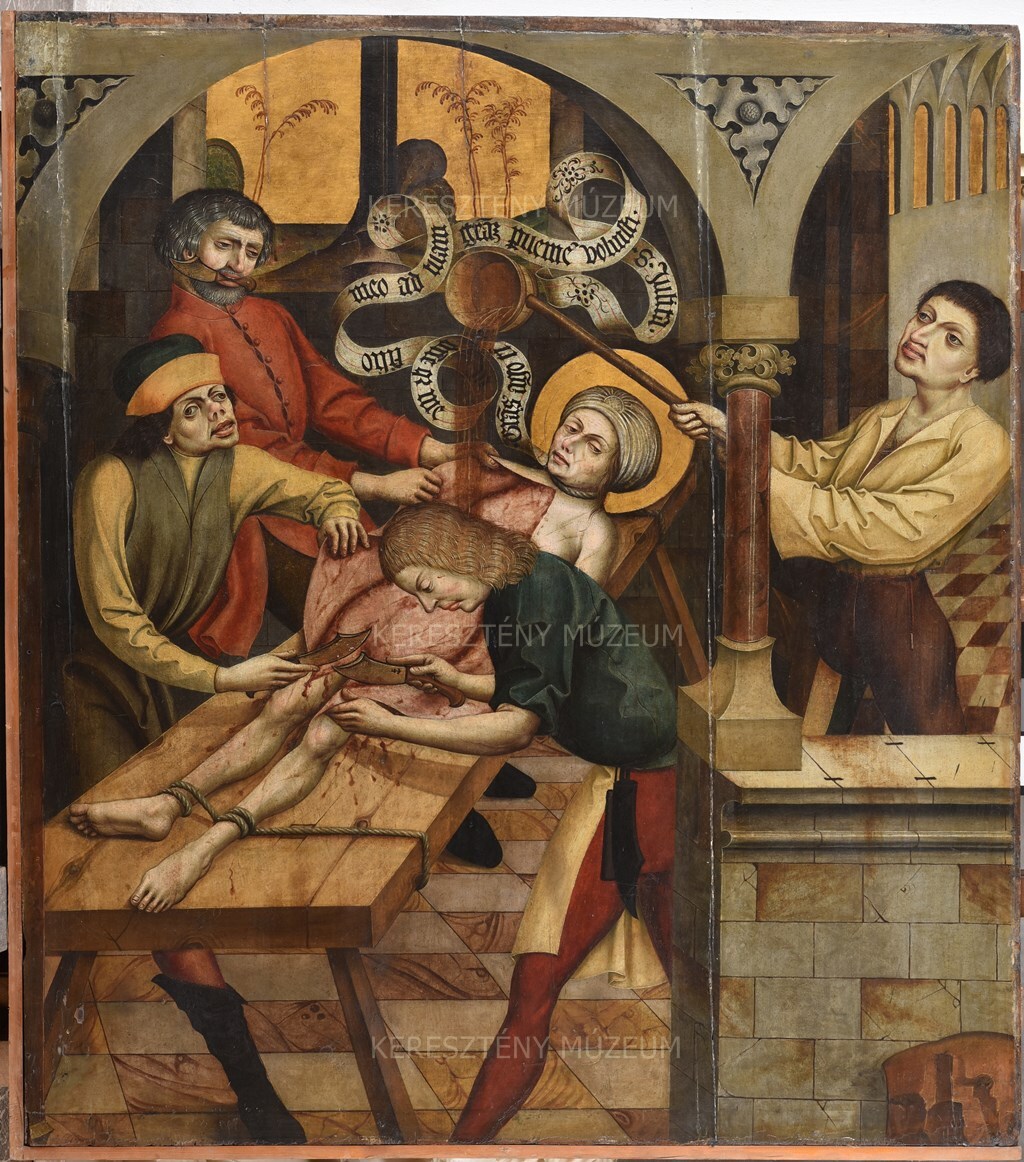
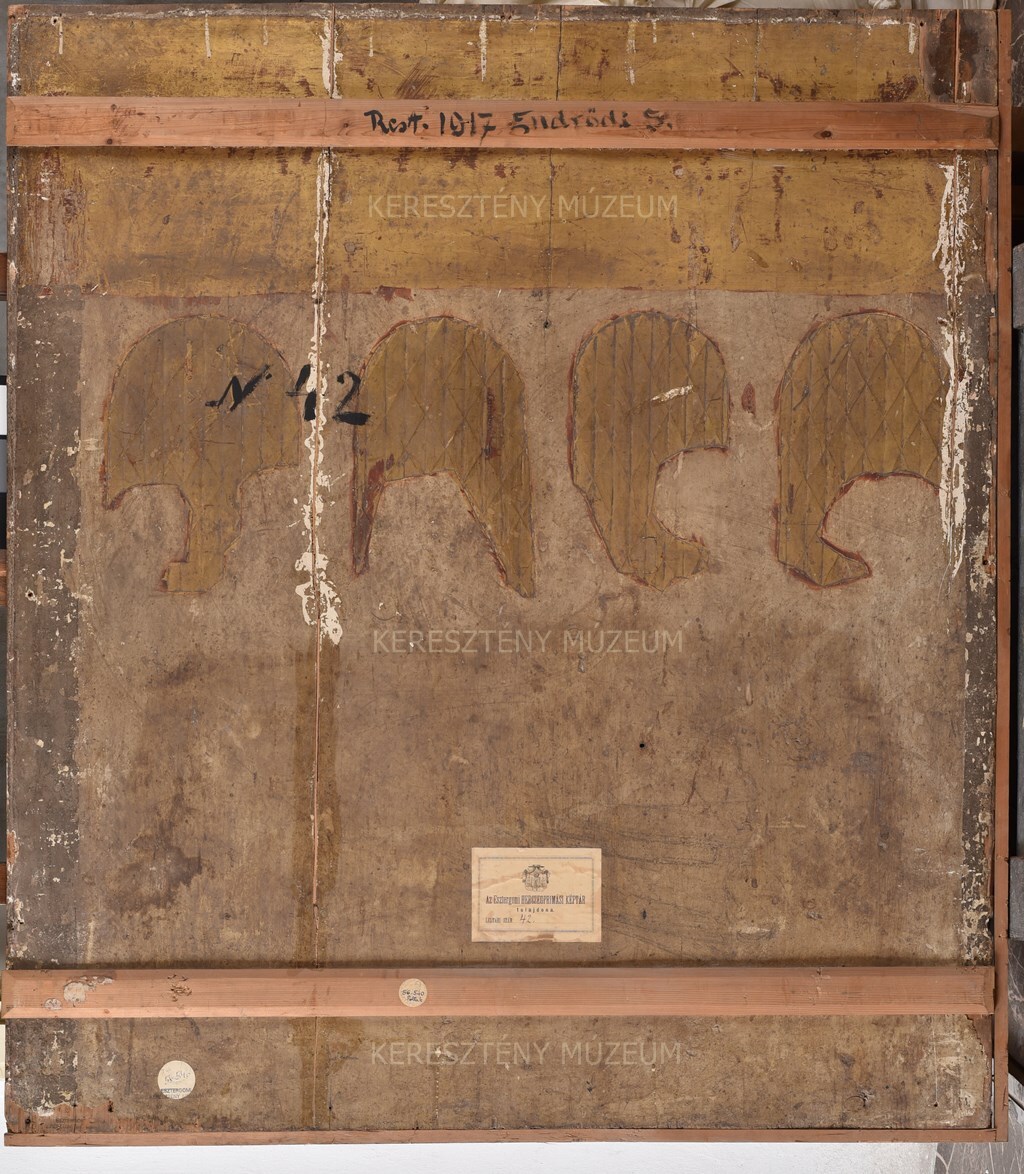
The Martyrdom of St. Julitta; the front presumably was a relief work depicting five figures
Detail from the movable wing of a winged altarpiece
width: 107 cm
Description and further information
Inscription (on the banderol emerging from the saint’s mouth):
Gra(tia)s ago ti[bi] / D(omi)ne q[uod] me / [cum] / filio / meo ad tuam / gra(tia)m p(er)veni(r)e voluisti • /
• S(ancta) Julita •
As part of her martyrdom, Julitta witnessed the murder of her little son, Cyricus, and later she was flayed, sprayed with hot oil, and finally beheaded. The depiction of her torture was presented originally on the workday side of a winged altarpiece.
The former inner side was adorned with a relief comprising five figures, the impression of which can be seen on the surface of the panel. The upper third was gilt and presumably had carved appliqué decoration. The rounded arches of the background architecture of the relief are filled with gilt rhombus-patterned decoration.
The left side and bottom of the painting of Julitta were truncated. The original edge can be seen all along the right side and top of the work.
Provenance:
Perhaps prior to 1879, the work entered János Simor’s collection; however, it has not been identified with any certainty in the early records of the Prince Primate’s Gallery.
Restoration:
According to the inscription on the upper cross brace affixed to the feast-day side, it was restored in 1917 by Sebestyén Endrődi.
Bibliography
Hercegprímási Képtár-1879, 19. sz. – Magyar Sion-1885, 674; – Maszlaghy-1891, 42. sz. – Lepold-Homor-1924, 94. – Gerevich-1928, 244. (Meister des Hausbuchs). – Genthon-1948, 132 (Jan Pollack). – Czobor-1955, 13. – Mojzer-1958, 14-15. – Boskovits-Mojzer-Mucsi-1964, 160. – Végh János: XV. századi német és cseh táblaképek. Budapest 1967, 33. tábla. – Mucsi-1973, 27. –Cséfalvay-1993, 198 (Végh J) (Mair von Landshut)
Provenance
Talán 1879 előtt kerül Simor János gyűjteményébe, azonosítása azonban a Hercegprímási Képtár korai jegyzékeiben teljesen bizonytalan.
Restauration
1917 Endrődy Sebestyén. Az egykori ünnepi oldalra erősített merevítőkön olvasható felirat szerint.
Bibliography
- Cséfalvay Pál, szerk.: Keresztény Múzeum, Esztergom. Budapest, 1993. Corvina, 198 (Végh J) (Mair von Landshut)
- Mucsi 1973, 27.
- Végh János: XV. századi német és cseh táblaképek. Budapest 1967, 33. tábla.
- Boskovits Miklós-Mojzer Miklós-Mucsi András: Az esztergomi Keresztény Múzeum képtára (Budapest, 1964. Akadémiai Kiadó), 160. (Stange szóbeli véleményét idézi - aki szerint magyar festő).
- Mojzer Miklós: Az esztergomi Keresztény Múzeum képtárának útmutatója, Budapest, 1958,, 14-15.
- Czobor Ágnes: Az esztergomi Keresztény Múzeum kiállításának vezetője. Esztergom 1955., 13.
- Magyarország műemléki topográfiája I. Esztergom 1. Esztergom műemlékei (összeállította: Genthon István; Budapest 1948), 132 (Jan Pollack).
- Gerevich Tibor: Esztergomi Műkincsek, in Prímás Album, Budapest 1928,179-263., 244. (Meister des Hausbuchs).
- Lepold A.-Homor I.: Esztergomi Kalauz II. Kiadás, Esztergom 1924, 94.
- II. bővített kiadás. Esztergom 1891, 42. sz. (? azonosítása bizonytalan)
- Maszlaghy F. Az esztergomi hercegprímási képtárban levő művek jegyzéke.
- -Z.: Az esztergomi érseki képtár leírása. Új Magyar Sion XVI (1885), 674 (Wolgemutnak tulajdonítja);
- –-ó: Az esztergomi hercegprímási képtár. Magyar Korona III (1879), 19. sz.