Medieval Hungarian, Austrian and German Painting and Sculpture
The Crucifixion
Calvary Altar from Garamszentbenedek - central image
width: 177 cm

Description and further information
242 x 177 cm
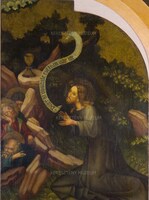
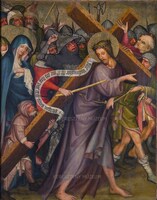
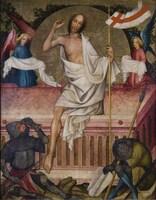
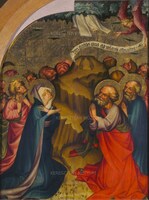
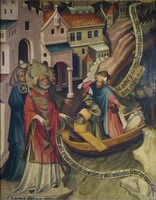
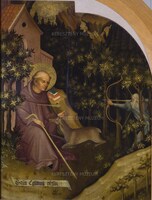
Eight panel paintings have survived from the former Calvary Altar in Garamszentbenedek. The central image showed the Crucifixion of Christ. On the inner side of the movable wings were four scenes from the Passion, while on the workday side miraculous episodes from the lives of saints were originally presented. The missing lower painting on the outer left wing may have depicted a scene from the legend of St. Peter. The removal of the workday sides from the feast-days sides was probably commissioned by János Simor and was carried out in Vienna. At that time neo-Gothic frames were made for the paintings. Éva Galambos has posited that the missing panel was destroyed when the works were sawed apart, a view supported by the serious damage suffered by the surviving paintings of the left altarpiece wing. The predella of the altar was destroyed in the fire in the Primate’s Palace in Esztergom in 1905. Ferenc Storno’s copy of the predella inscription, which provided the name of the painter and the patron, the year it was made and a lot of other information, was published by Nándor Knauz. According to recent art historical research, the altarpiece did not belong to the furnishings of the Benedictine abbey of Garamszentbenedek but rather to that of the village’s parish church of St. Giles.
Provenance
Acquired by Prince Primate János Simor from Garamszentbenedek around 1870, and later, in 1875, housed in the newly opened Primate’s Gallery.
Restauration
The historicizing modifications added in the last decades of the 19th century, probably in Vienna, were painted over in 1915 by Sebestyén Endrődy. Around 1930-1940, this overpainting was removed by Lajos Nikássy. In 1958-59 and 1962 Dezső Varga cradled the backs of the panels, stabilized the blistering paint layers, and filled in and retouched the paint in several places. In 1972-72, new frames were made for the paintings as a part of preparations for the new permanent exhibition.
Bibliography
- Zsombor Jékely: “Painting at the Court of Emperor Sigismund: The Nuremberg Conncetions of the Painter Thomas de Coloswar”. In: Acta Historiae Artium 58 (2017), 57-83.
- Ivan Gerat: Legendary Scenes. An Essay on Medieval Pictorial Hagiography. Bratislava, 2013, 227-228.
- Sigismundus rex et imperator : művészet és kultúra Luxemburgi Zsigmond korában, 1387-1437. (kiállítási katalógus) Szerk.: Takács Imre. Budapest, 2006., 518-527, 580-586, 7.19 (Poszler Gy.).
- Galambos Éva: The Calvary Altarpiece by Thomas de Coloswar: Some Technical Observations. In: Sigismund von Luxembourg. Ein Kaiser in Europa. Tagungsband des internationalen historischen und kunsthistorischen Kongresses in Luxembourg, 8-10. Juni 2005. Luxembourg 2005.
- Barbara Drake-Boehm - Jiri Fajt (eds.): Prague. The Crown of Bohemia. 1347-1437. Kat. Metropolitan Museum. New York 2005, 308-310, 146. kat. sz (W. Franzen).
- Dušan Buran (ed.): Gotika. Dejiny slovenského vy ́tvar-ného umenia. (Gótika. A szlovák képzőmûvészet története). Slovenská národná galéria v Bratislave. Bratislava, 2003. Kiállítási katalógus., 698-699 (M. Bartlová).
- Milena Bartlová: Poctivé obrazy. Deskové malíøství v Èechách a na Moravì 1400-1460. Praha 2001, 152 - 153.
- Takács Imre: Garamszentbenedek temploma és liturgikus felszerelése. In: Pannonhalma 2001: Paradisum Plantavit. Bencés Monostorok a Középkori Magyarországon. Szerk. Takács Imre. Pannonhalma 2001. Kiállítási Katalógus., 175-180.
- Papp Júlia: Kolozsvári Tamás garamszentbenedeki oltára feliratának 19. század eleji említéséről. In: Ars Hungarica 27 (1999), 419-422.
- Tóth Sándor: Képesség és Képtelenség. Tudományos kíntorna a XX: század végén. In: BUKSZ 1998/1, 74.
- Mojmir Frinta: Some Thought-provoking Musing: Angevino –Luxemburgian –Corvinian. In: Ars 29 (1996):1 /3, 83-85.
- Cséfalvay Pál, szerk.: Keresztény Múzeum, Esztergom. Budapest, 1993. Corvina, 172 - 174 (Török Gy.).
- Gyöngyi Török: Zur Frage der Internationalität in der gotischen Buch- und Tafelmalerei. In: Pochat, G. - Wagner, B. (Hg.): Internationale Gotik in Mitteleuropa. Internationale Tagung in Graz 1989. Kunsthistorsches Jahrbuch Graz 24 (1990), 50-61.
- Gyöngyi Török: Problems of Central European Art, c. 1400. The Thomas de Coloswar Altarpiece in Hungary. In: Lavin, I. (ed.): World Art, Themes of Unity in Diversity. Acts of the XXVIth International Congress of the History of Art, I., 1986. Washington 1989, I., 133-136.
- Művészet Zsigmond király korában 1387 - 1437. kiáll. kat. Budapest 1987, II. 315-318 (Török Gy.).
- Magyarországi művészet 1300-1470 körül (szerk. Marosi Ernő). 1987, I. 619-623 (Végh J.).
- Mucsi András: Kolozsvári Tamás Kálvária-oltára, 1978.
- Török Gyöngyi: Táblakép festészetünk korai szakasza és európai kapcsolatai. Ars Hungarica 6 (1978), 7-27.
- Lukács Zsuzsanna: Kolozsvári Tamás Passió-sorozatának burgundiai kapcsolatai. In: Építés- és Építészettudomány 5, 1973 3/4, 331-339.
- Jan Bialostocki (Hg.): Spätmittelalter und beginnende Neuzeit. Propylaen Kunstgeschichte, VII. Berlin 1972, 203-204.
- Gerhard Schmidt: Malerei bis 1450. Tafelmalerei –Wandmalerei–Buchmalerei. In: Swoboda, K.M. (Hg.): Gotik in Böhmen. München 1969, 318.
- Mojmir Frinta: The Master of the Gerona Martyrology and Bohemian Illumantion. In: The Art Bulletin 46, 1964, 301.
- Boskovits Miklós-Mojzer Miklós-Mucsi András: Az esztergomi Keresztény Múzeum képtára (Budapest, 1964. Akadémiai Kiadó), 116-121.
- Radocsay Dénes: Gótikus festmények Magyarországon. Budapest 1963, 1 - 7 . kat. sz.
- Radocsay Dénes: A középkori Magyarország táblaképei. Budapest 1955, 50-59, 307-310.
- Gerevich Tibor: Kolozsvári Tamás, az első magyar táblaképfestő. Budapest 1923.
- (válogatás):
Related works