

Woven Tapestries
Not a Bulletproof Mantle
In Commemoration of the Assassination Attempt on Pope John Paul II
Budapest, 1931 - Budapest, 2015
width: 185 cm
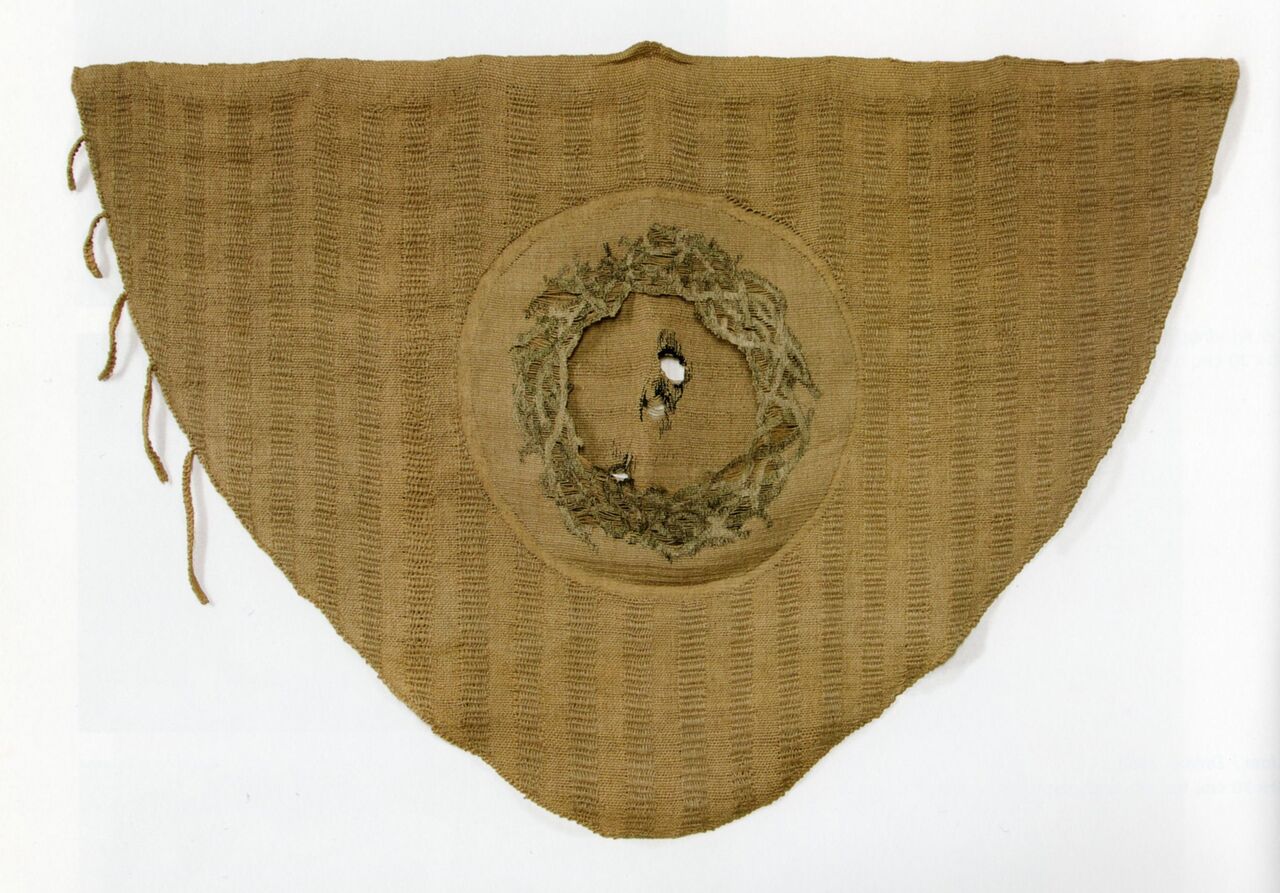
Description and further information
Gizella Solti studied under Noémi Ferenczy at the Hungarian College of Applied Arts between 1950 and 1955. “The Not Bulletproof Mantle, made of linen and hemp and shaped like a liturgical cope, is a timeless, sensuous and technically masterful work. Its trompe-l’œil effect is evident, as is the artist’s characteristic emphasis on the contour and outline of the object. Through its double warp and two-layered weave, this ‘timeless’ and multivalent work creates a biconvex visual effect. …
From the natural, sand- and sack-coloured central field, a darker crown of thorns projects in relief. The timelessness and contemporaneity of this tapestry-object are compelling. A circle, or rondel, together with the sculptural crown of thorns, surrounds the bullet hole and the damaged area. The perforation in the mantle is strongly accentuated by the dark goat’s wool. The circle, the rondel and the wreath are fundamental symbols. The vertical striping … resembles the patterning of a sacred vestment. It is fluted like an ancient column. The solution is precise, masterful and archaic in character. Small ribbon-like ties also hang down at the sides, reinforcing the garment-like quality of the mantle. The mantle, a flowing garment, is made of a finely textured material. In the Bible, the mantle is also described as a seamless tunic: ‘When the soldiers had crucified Jesus, they took his clothes and divided them into four parts, one for each soldier. They also took his tunic; now the tunic was seamless, woven in one piece from the top’ (John 19:23).
Crown of Thorns … The hole visible in the Mantle—the mark of the bullet—which also forms a wreath, echoes the Crown of Thorns. The ground is structured vertically, with strongly pronounced vertical stripes. Once again, the technical virtuosity of the double warp is apparent. The thorns of the wreath are made from the gleditsia plant, commonly known in Hungarian folk terminology as ‘Christ’s thorn.’” Judit Jóry, “Serenissima” (excerpts, 2005), in Gizella Solti: Arguments, Budapest–Cluj-Napoca, 2016, pp. 21–23.
Provenance
Vásárlás a művésztől 2015-ben (NKA támogatással)
Bibliography
- Solti Gizella Argumentumok. Budapest-Kolozsvár, 2016, 5, 21-23.
- Solti Gizella: Emlékek. In: Kárpitok 2014, 38-39, 73. -
- Kárpitművészet Magyarországon, Budapest, 2004. -