

Italian renaissace and baroque painting (permanent exhibition)
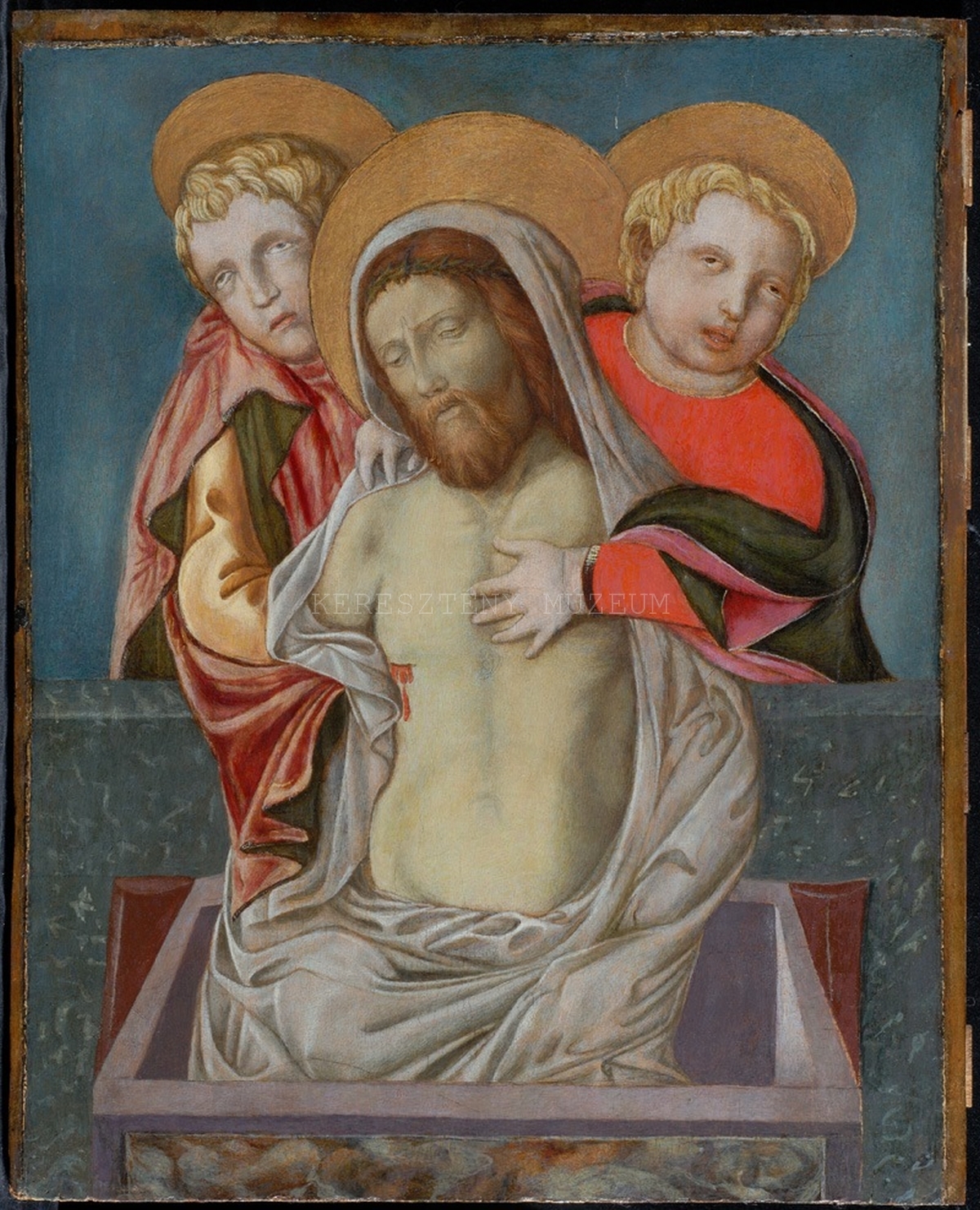
Dead Christ with two angels
width: 34,5 cm
Description and further information
The fourteenth and fifteenth centuries were a flourishing period for the veneration of the Eucharist and the cults associated with it. As a result, the so-called Pietà image, presenting the dead Christ as a sacrifice, became a frequent subject in Italian painting. In the various formulations of this pictorial type, the helpless body of the Redeemer is supported by accompanying figures: usually the Virgin Mary and Saint John the Apostle, Joseph of Arimathea and Nicodemus, or, as in the present painting, two angels. The angels, their faces distorted by grief, both support and present to the devout viewer of the painting the lifeless body, masterfully wrapped in a burial shroud, which rises from a marble sarcophagus shown in foreshortening. The emotionally charged representation invites contemplation of Christ’s sacrifice, alluding to the parallel between his body and the Host offered in the sacrifice of the Mass. The origin of the painting long remained uncertain, and scholars sought its author among the Venetian, Veronese, and Paduan schools. Only more recently, in 1996, was the name of the great Florentine painter Filippo Lippi proposed. According to Andrea De Marchi’s well-founded hypothesis, the painting may have been made during Lippi’s stay in Padua, in 1433, and may originally have formed the central panel of a triptych whose wings depicted the mourning Virgin and Saint John the Apostle. The painterly conception is indeed related to Lippi’s early works, although the condition of the painting makes the assessment of authorship difficult. Dóra Sallay.
Provenance
Simor collection. Purchased from the Bertinelli estate in Rome in 1878.
Restauration
1997 körül Varga Dezső
Bibliography
- Sallay Dóra: Raffaele Bertinelli és reneszánsz képtára. Egy műgyűjtemény útja Rómától Esztergomig. Esztergom, 2009, 89, kat.sz. VIII.,128.
- Giorgia Mancini, in Banzato, Davide – Alberta De Nicolò Salmazo – Anna Maria Spiazzi (szerk.): Mantegna e Padova: 1445–1460. Kiáll. kat. (Padova, Musei Civici). Milano, 2006., 216 (ua.)
- Tátrai Vilmos, in Jékely Zsombor (szerk.): Verrocchio Krisztusa = Verrocchio’s Christ. Kiáll. kat. (Budapest, Szépművészeti Múzeum). Budapest, 2003., 70–71, 118–119, kat. 11 (ua., 1433–34)
- Andrea De Marchi, in Masaccio e le origini del Rinascimento. Kiáll. kat. (San Giovanni Valdarno, Casa Masaccio). Szerk. Luciano Bellosi, Laura Cavazzini és Aldo Galli közreműködésével, Genf–Milano, 2002., 190 (ua.)
- Casu, Stefano G.: Giorgio Schiavone e Carlo Crivelli nella bottega dello Squarcione. Proporzioni, N.S., 1 (2000), 37–54., 44 (ua.)
- De Marchi, Andrea: Un raggio di luce su Filippo Lippi a Padova. Nuovi Studi, I/1 (1996), 5–23., (Filippo Lippi, 1433?)
- De Marchi, Andrea: Una fonte senese per Ghiberti e per il giovane Angelico. Artista, 4 (1992), 130–151., 146: 14. j. (Filippo Lippi)
- Romano, Giovanni: Il coro di San Lorenzo. Alba, 1969., 30: 26. j. (Foppa iskolája)
- Heinemann, Fritz: Giovanni Bellini e i Belliniani. 3 kötet. Velence (I-II) és Hildesheim – Zürich – New York (III), 1962–1991., I (1962), 304, MB.126. kat. sz., III (1991), 99, MB.126. kat. sz. (1962: fotó alapján inkább Pier Maria Pennacchi modora; 1991: a késői Vincenzo Foppa iskolája)
- Mojzer Miklós: Tanulmányok a Keresztény Múzeumban, I Művészettörténeti Értesítő, XIII/3 (1964), 214–226., 217 (Gregorio Schiavone után)
- Boskovits Miklós-Mojzer Miklós-Mucsi András: Az esztergomi Keresztény Múzeum képtára (Budapest, 1964. Akadémiai Kiadó), 91 (Gregorio Schiavone után, feltehetőleg Marco Basaiti köre, 16. sz. eleje)
- Gerevich Tibor (szerk.): Magyarország műemléki topográfiája. I. Esztergom. 1. Esztergom Műemlékei. Összeállította Genthon István. Budapest, 1948., 61, korábbi irodalommal (Marco Basaiti iskolája)
- Van Marle, Raimond: The Development of the Italian Schools of Painting. 18 kötet és index. The Hague, 1923–1938., XVII (1935), 511: 6. j. (Marco Basaitinak attr.; tévesen Angyalként említi)
- Berti Toesca, Elena: Arte italiana a Strigonia. Dedalo, XII (1932), 933–960., 956–957 (talán Liberale da Verona korai műve)
- Gerevich Tibor: Esztergomi műkincsek. In Prímás Album. Dr. Serédi Jusztinián Magyarország Bibornok Hercegprímása tiszteletére. Budapest, 1928, 179–263., 238 (Basaiti köre)
- Maszlaghy Ferencz: Az esztergomi Herzegprímási Képtárban lévő művek jegyzéke. 2., bővített kiadás. Esztergom, 1891., 54. sz. (ismeretlen festő)
- Maszlaghy Ferencz: Az esztergomi Herzegprímási Képtárban lévő művek jegyzéke. Esztergom, 1878., 54. sz. (ismeretlen festő)