

Italian renaissace and baroque painting (permanent exhibition)
Virgin and Child
Florence, c. 1422 - 1457
width: 36,6 cm
thickness: 3 - 3,1 cm
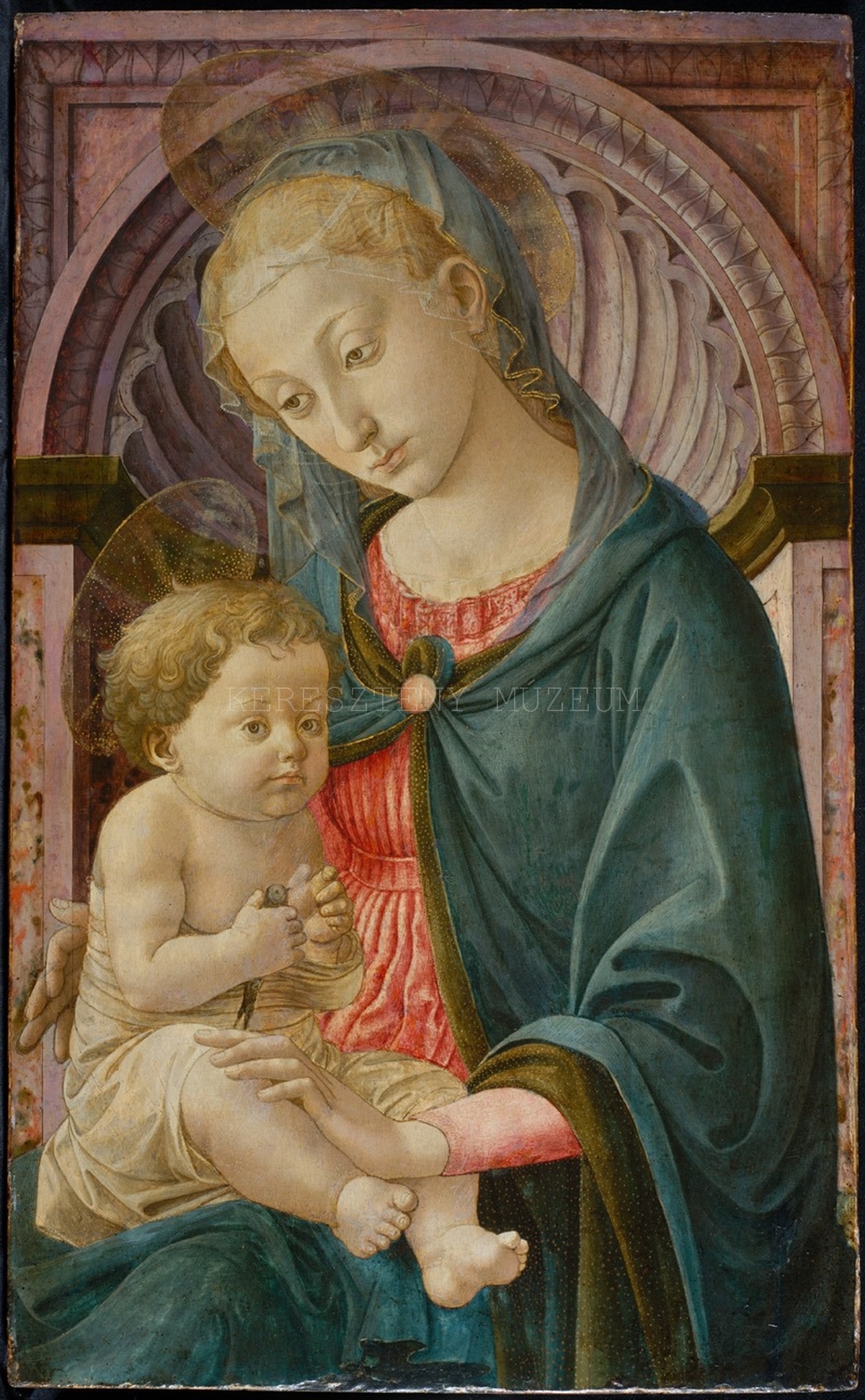
Description and further information
This Madonna belongs among Pesellino’s late works and was painted shortly before his death. The artist placed the group of Mother and Child before an ambitiously rendered Renaissance niche of red marble. The strong light entering from the left emphasises the spatial depth of the background architecture and highlights the bodies, depicted with anatomical precision. The refined elegance of the representation, as well as several of its motifs — such as the extremely delicate veils and the haloes rendered as translucent crystal discs adorned with golden dots — derive from the art of Filippo Lippi. Pesellino’s Madonnas with their sorrowful gaze were already highly popular in his own time. An autograph version of this painting is preserved in the Isabella Stewart Gardner Museum in Boston, and numerous copies were also made. In Florence, an entire workshop specialised in imitating the Madonnas of Lippi and Pesellino, copying them for several decades with the aid of transfer cartoons. Dóra Sallay, 2002 — website
Provenance
Simor Collection. Purchased from the Bertinelli estate in Rome in 1878.
Restauration
1916 Endrődi Sebestyén
Bibliography
- ''Pseudo Pier Francesco Fiorentino: Cristo di dolori" (p. 42), by Andrea de Marchi, Davide Civettini and Christopher Daly (2022), 30. https://flore.unifi.it/retrieve/bba79e67-19ef-41c9-abdc-21220ac4d15e/Libro%20Pseudo.pdf (említi a szövegben Pesellinoként a bostoni változattal együtt)
- Sonnevend Margit: Pesellino esztergomi Madonnája : adalékok egy népszerű kompozíció eredetéhez . - In: Művészettörténeti értesítő, 2011. (60. évf.), 1. sz., 63-72. p. (további irodalommal)
- Sallay Dóra: Raffaele Bertinelli és reneszánsz képtára. Egy műgyűjtemény útja Rómától Esztergomig. Esztergom, 2009 (Címlapkép), 89, kat. sz. XI., 131
- Staderini, Andrea: „Gentile, et in compositione di chose piccole eccellente”: Francesco di Stefano detto il Pesellino (1422–57). Doktori disszertáció, Istituto di Studi Umanistici, Università di Firenze, 2008., 106–107, 273–274 (Pesellino, késői mű, a bostoni Madonna az esztergomiról készült sajátkezű replika)
- Holmes, Megan: Copying practices and marketing strategies in a fifteenth-century Florentine painter’s workshop. In Artistic exchange and cultural translation in the Italian Renaissance City. Szerk. Stephen John Campbell. Cambridge etc., 2004, 213–223., 72–73, 67. j. (másolat a bostoni képről; inkább egy korai Lippi és Pesellino követő műve, mint sajátkezű Pesellino)
- Miklós Boskovits, in Boskovits, Miklós – David Alan Brown, et al.: Italian Paintings of the Fifteenth Century. The Collections of the National Gallery of Art. Systematic Catalogue. National Gallery of Art, Washington. New York and Oxford, 2003., 573: 11. j. (Pesellino vagy Jacopo d’Antonio szerzősége közül az előbbi valószínűbb)
- Gretchen A. Hirschauer, Boskovits, Miklós – David Alan Brown, et al.: Italian Paintings of the Fifteenth Century. The Collections of the National Gallery of Art. Systematic Catalogue. National Gallery of Art, Washington. New York and Oxford, 2003., 418 (Pesellino)
- Tátrai Vilmos, in Keresztény Múzeum, 1993, 229–230, 100. sz. (Pesellino, 1450-es évek, korábbi, mint bostoni és müncheni verzió)
- Zeri, Federico: Italian Paintings in the Walters Art Gallery. 2 kötet. Baltimore, 1976., 81 (Pesellino sajátkezű műve)
- Boskovits, Miklós: Toskanische Frührenaissance-Tafelbilder. 2., átdolgozott kiadás. Budapest, 1978., 29–30 (Pesellino, utolsó éveiből való, korábbi, mint bostoni verzió)
- Boskovits Miklós: Toszkán kora reneszánsz táblaképek. Budapest, 1968., 29–30 (Pesellino, utolsó éveiből való, korábbi, mint bostoni verzió)
- Boskovits Miklós-Mojzer Miklós-Mucsi András: Az esztergomi Keresztény Múzeum képtára (Budapest, 1964. Akadémiai Kiadó), 72 (Pesellino műhelye, 1460–70 körül, felsorolja a kép változatait)
- Berenson, Bernard: Italian Pictures of the Renaissance. A List of the Principal Artists and their Works with an Index of Places. Florentine School. 2 kötet. London, 1963., I, 167 (Pesellino, a bostoni kép változata)
- Friedmann, Herbert: The symbolic goldfinch. Its history and significance in European devotional art. The Bollingen series, VII. Washington, 1946., 149
- Berenson, Bernard: Pitture italiane del Rinascimento. Milano, 1936., 380 (ua.)
- Berenson, Bernard: Italian Pictures of the Renaissance. A list of the principal artists and their works with an index of places. Oxford, 1932., 442 (Pesellino)
- Berti Toesca, Elena: Arte italiana a Strigonia. Dedalo, XII (1932), 933–960., 950–951 (Compagno di Pesellino)
- Van Marle, Raimond: The Development of the Italian Schools of Painting. 18 kötet és index. The Hague, 1923–1938., X (1928), 434 (ua.)
- Gerevich Tibor: Esztergomi műkincsek. In Prímás Album. Dr. Serédi Jusztinián Magyarország Bibornok Hercegprímása tiszteletére. Budapest, 1928, 179–263., 227, 230 (Filippo Lippi)
- Gerevich Tibor: A külföldi és az ujabb magyar mesterek a primási képtárban. Az Ujság, XIV. évf., 200. sz. (1916. július 20.), 3–4., 3 (Filippo Lippi tanítványa, valószínűleg Lorenzo da Viterbo)
- Maszlaghy Ferencz: Az esztergomi Herzegprímási Képtárban lévő művek jegyzéke. 2., bővített kiadás. Esztergom, 1891., 100. sz. (Filippo Lippi)
- Maszlaghy Ferencz: Az esztergomi Herzegprímási Képtárban lévő művek jegyzéke. Esztergom, 1878., 100. sz. (Filippo Lippi)