

Italian renaissace and baroque painting (permanent exhibition)
Archangel Raphael with Tobias and Saint Jerome
Florence, 1419 - Florence, 1492
width: 25,7 cm
thickness: 0,9 - 1 cm
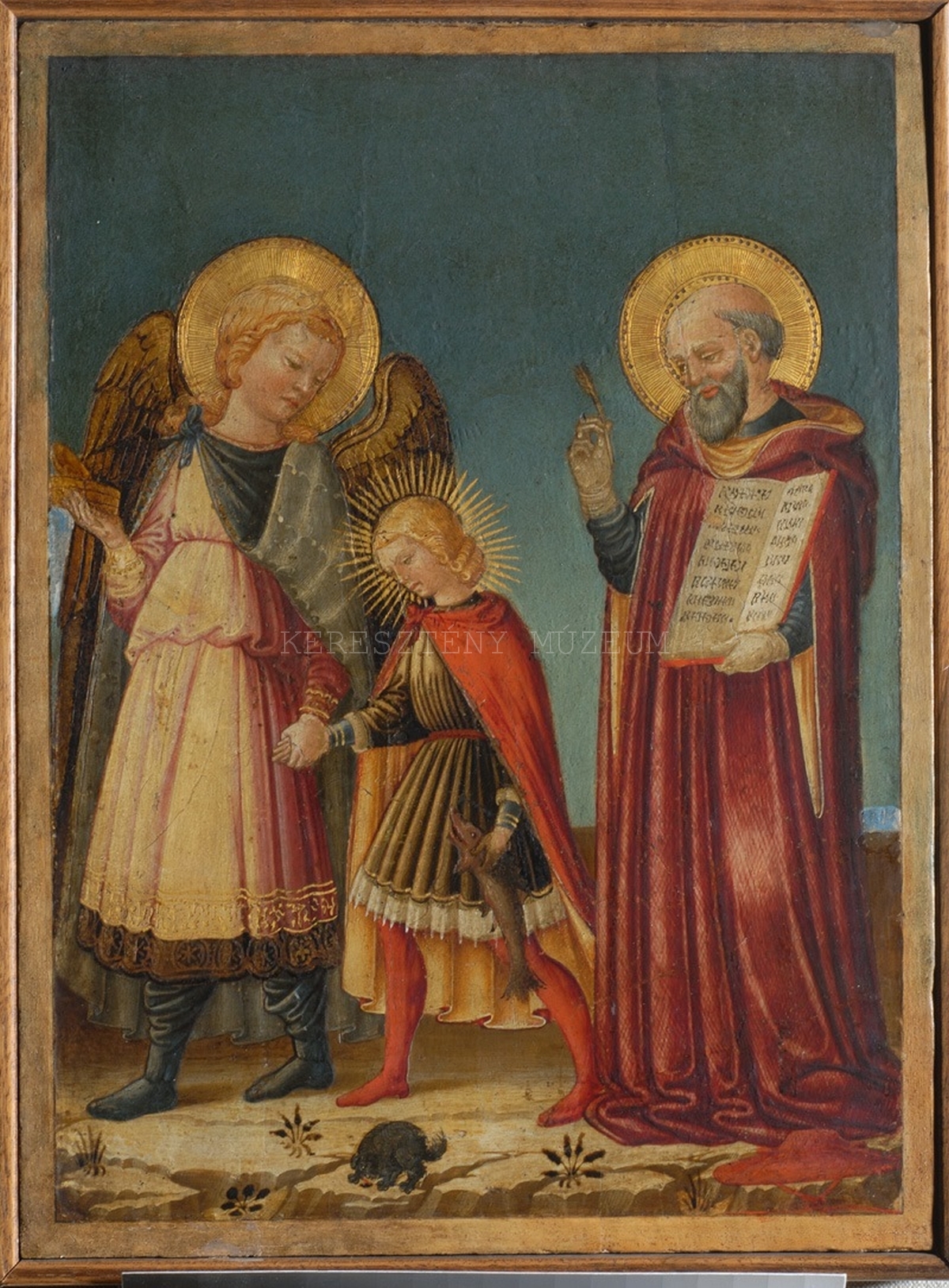
Description and further information
Neri di Bicci was a popular and exceptionally prolific minor master of fifteenth-century Florentine painting. As the head of a family workshop active for several generations, he produced conservative paintings over many decades, showing little stylistic change. This small panel painting, which survives in several versions and in one almost identical copy as well (Florence, Museo Horne), recounts the biblical story in which Tobias sets out on a long journey under the protection of the Archangel Raphael in order to recover the family wealth deposited elsewhere, while also finding a cure for his father’s blindness in the gall of a miraculous fish. Raphael enjoyed great veneration in the fifteenth-century mercantile city on the banks of the Arno; a religious confraternity also bore his name. According to the most widely accepted view, these small paintings were created for votive purposes: wealthy merchant families may have commissioned them for their sons setting out on distant business journeys, whom they thus commended to the angel’s protection. This interpretation is also supported by the inscription preserved on a painting of the same subject: Raphael medicinalis mecum sis perpetualis et sicut fuisti cum Thobia semper mecum sis in via — “Healing Raphael, be with me forever, and as you were with Tobias, be always with me on the road!” (painting by Giovanni da Piamonte, San Giovanni Valdarno, Museo della Basilica). In these paintings, the pair of Raphael and Tobias is often accompanied by another saint—here Saint Jerome—who may appear as the personal patron saint of the travelling youth. (Sallay Dóra)
Provenance
Simor collection. Purchased from the Bertinelli estate in Rome in 1878
Restauration
1916 Endrődi Sebestyén
Bibliography
- Sallay Dóra: Raffaele Bertinelli és reneszánsz képtára. Egy műgyűjtemény útja Rómától Esztergomig. Esztergom, 2009, 90, kat.sz. XV., 135.
- Tátrai Vilmos, in: Cséfalvay Pál, szerk.: Keresztény Múzeum, Esztergom. Budapest, 1993. Corvina, 231, 103. sz., korábbi irodalommal (ua.)
- Boskovits Miklós-Mojzer Miklós-Mucsi András: Az esztergomi Keresztény Múzeum képtára (Budapest, 1964. Akadémiai Kiadó), 74, korábbi irodalommal (ua., valószínűleg az 1460-as évekből)
- Berenson, Bernard: Italian Pictures of the Renaissance. A List of the Principal Artists and their Works with an Index of Places. Florentine School. 2 kötet. London, 1963., I, 153 (ua.)
- Gerevich Tibor (szerk.): Magyarország műemléki topográfiája. I. Esztergom. 1. Esztergom Műemlékei. Összeállította Genthon István. Budapest, 1948., 81 (ua.)
- Berenson, Bernard: Pitture italiane del Rinascimento. Milano, 1936., 332 (ua.)
- Berti Toesca, Elena: Arte italiana a Strigonia. Dedalo, XII (1932), 933–960., 952 (ua.)
- Van Marle, Raimond: The Development of the Italian Schools of Painting. 18 kötet és index. The Hague, 1923–1938., X (1928), 542 (ua.)
- Gerevich Tibor: Esztergomi műkincsek. In Prímás Album. Dr. Serédi Jusztinián Magyarország Bibornok Hercegprímása tiszteletére. Budapest, 1928, 179–263., 230 (Neri di Bicci)
- Maszlaghy Ferencz: Az esztergomi Herzegprímási Képtárban lévő művek jegyzéke. 2., bővített kiadás. Esztergom, 1891., 83. sz. (Vittore Pisanello)
- Maszlaghy Ferencz: Az esztergomi Herzegprímási Képtárban lévő művek jegyzéke. Esztergom, 1878., 83. sz. (Vittore Pisanello)