

Woven Tapestries
Roman Triumph
width: 360 cm
Description and further information
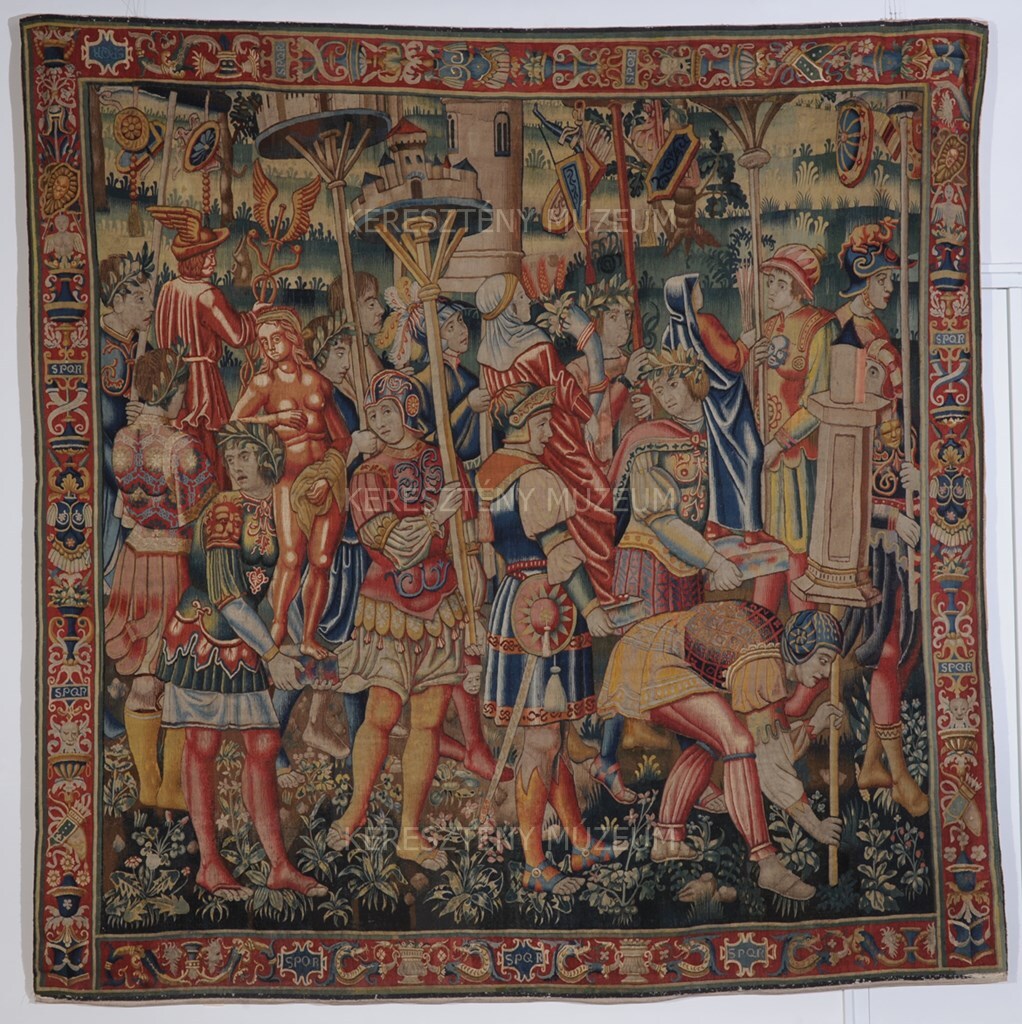
This vividly coloured tapestry depicts a Roman triumphal procession. In the crowded scene, fourteen figures clad in armour proceed from left to right. The Roman soldiers, arranged across a field strewn with flowers, wear armour and, in some cases, laurel wreaths. They carry triumphal standards mounted on poles, as well as statues of deities. The city models raised high on poles symbolize conquered and vanquished cities. Among the gods, Mercury appears on the left, wearing his winged helmet and holding a caduceus, the herald’s staff entwined with serpents. The female figure in the foreground is a statue of Venus. The third statue represents the goddess Ceres, holding a cornucopia. The fourth divine figure holds a bundle resembling arrows and may therefore be identified as Diana.
Among the colours of the tapestry, red predominates, with blue also playing a dominant role. The Renaissance border, sharply distinguished from the central field, has a red ground. Within the border are arranged vases, cuirasses, shields, weapons, masks, and small tablets inscribed with the letters S.P.Q.R. The cartoon may have been made using Andrea Mantegna’s nine-part painting series The Triumphs of Julius Caesar (1485–1490; now at Hampton Court Palace), for which a contemporary print series was also produced; see Mathias F. Müller and Anne Röver-Kann, Künstler und Kaiser: Albrecht Dürer und Kaiser Maximilian I., exhibition catalogue, Kunsthalle Bremen, Bremen, 2003, pp. 73–75.
Another possible prototype is the large woodcut series The Triumph of Caesar, made in Venice in 1504 by Jacobus Argentoratensis after Benedetto Bordone. According to written documents, in 1510 a set of eight tapestries on the theme of the Triumph of Julius Caesar was exhibited in Brussels. A comparable example is currently preserved at Haarzuilens, Kasteel de Haar.
Provenance
Ipolyi Arnold gyűjteménye
Restauration
1966 Szőnyegjavító Szövetkezet Budapest
Exhibitions
- 2002, Bremen, Kunsthalle, Albrecht Dürer und Kaiser Maximilian I.
Bibliography
- Mathias F. Müller, Anne Röver-Kann: Künstler und Kaiser: Albrecht Dürer und Kaiser Maximilian I. Ausstellung in der Kunsthalle Bremen. Bremen, 2003, 73, 94-96 (előképekkel, további irodalommal és a vélt keletkezéstörténettel)
- Jean Michel Massing: Arnould Poissonier of Tournai and his "...Hiut Pieces du Triophe de César" for Margaret of Austria. in: Artes Textiles XI. 1986, 69-74.
- Kunst der Refomationszeit. Staatliche Museen zu Berlin, 1983, 302, 303, E. 14.
- Ipolyi Arnold Emlékkönyve. Halálának századik évfordulója alkalmából az Esztergomi Keresztény Múzeumban 1986. december 12-én rendezett emlékülés anyaga. Szent István Társulat, Budapest, 1989. 154, 42. kép
- László Emőke: Flamand és francia kárpitok Magyarországon. Corvina. Budapest, 1980 37-38, 75, 19. kép II. tábla
- (benedek): Dr. Gobelin in: Ország Világ XII. évf. 1. sz, 1968. január 3, 20 oldal (beszámoló a szövetkezet javításairól)
- Magyarország műemléki topográfiája I. Esztergom 1. Esztergom műemlékei (összeállította: Genthon István; Budapest 1948)
- Dutka Mária: Az esztergomi Keresztény Múzeum gobelinjei. Budapest, 1936. 27-35, 2. kép