

Italian renaissace and baroque painting (permanent exhibition)
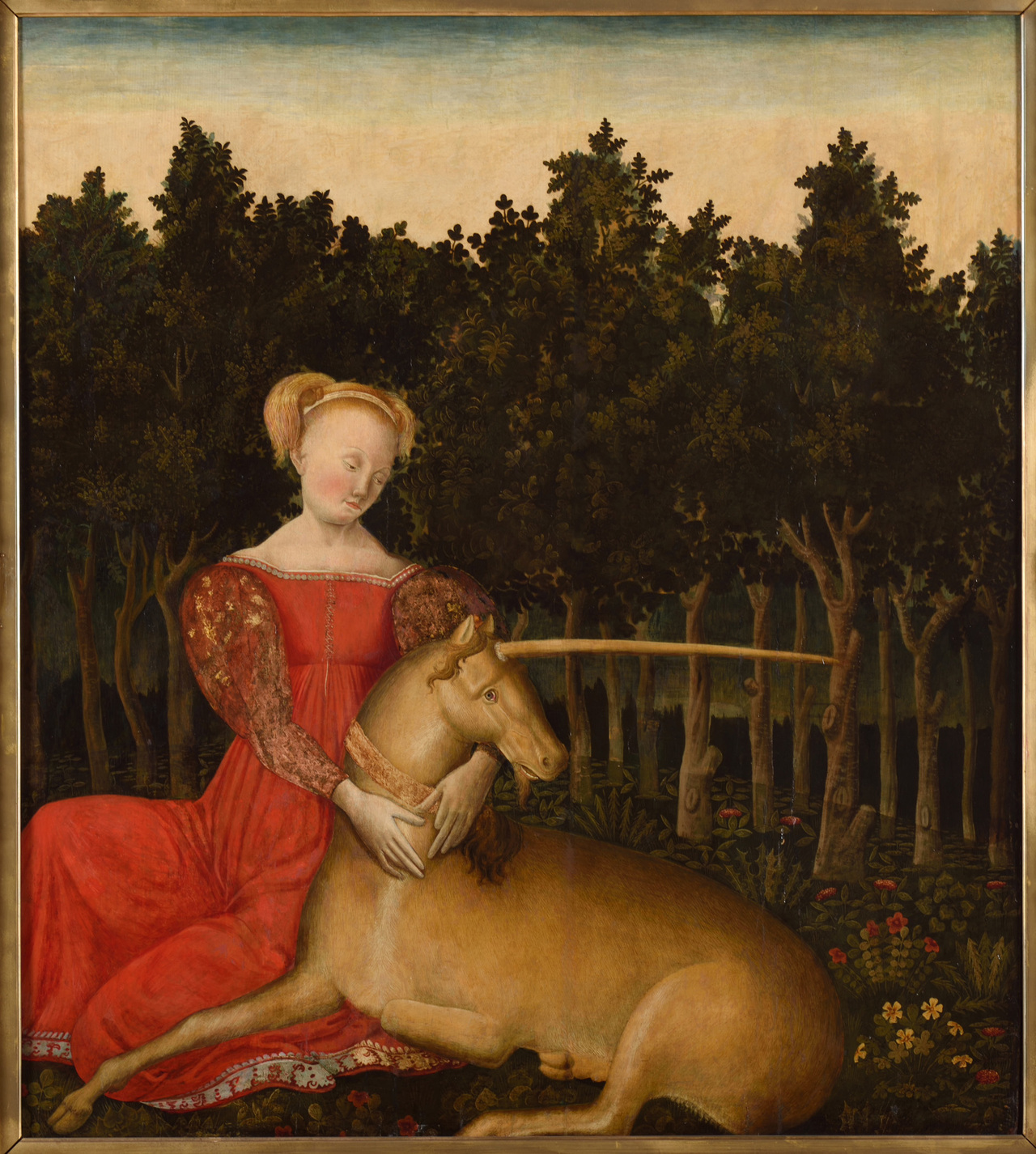
The Maid with the Unicorn
Caterina Corner as Chastity
Pordenone, 1420 - Conegliano,1495
width: 90 cm
Description and further information
„It is now thought to be a work by Dario di Giovanni, who for a long time was known only as the Master of the Judgment of Paris or the Master of the Stories of Helen—the latter after a series of three large panel paintings (Walters Art Museum, Baltimore). […] In keeping with tradition, the virgin is sitting in the forest, which stands out in the background. […] The virgin has pulled her hair back with a headband; her dress with brocade sleeves gleams bright red. With a rigid facial expression, she looks with narrow eyes at the unicorn lying beside her and has placed her hands around its neck. […] The woman portrayed is Caterina Corner (1455/56–1510) of Venice, who is depicted as an allegory of chastity. She married the king of Cyprus in 1468 and reigned as queen of that island realm for several years after his death.” Michael Philipp: “Intimate Companionship: The Unicorn and the Virgin.” In: Béatrice de Chancel-Bardelot et al. (eds.): Unicorn: The Mythical Beast in Art. Munich–London–New York: Prestel, 2025, p. 250.
Provenance
Collection of Arnold Ipolyi,
Exhibitions
- 2015 St. Pölten
- 2025 Potsdam
Bibliography
- Michael Philipp: „Intimate Companionship: The Unicorn and the Virgin”. In: Béatrice de Chancel-Bardelot et al. (szerk.): Unicorn: The Mythical Beast in Art. München–London–New York, Prestel, 2025,248-250.
- Joaneath Spicer, “The Abduction of Helen: A Monumental Series Celebrating the Wedding of Caterina Corner in 1468,” The Journal of the Walters Art Museum 74 (2019), https://journal.thewalters.org/volume/74/essay/the-abduction-of-helen-venetian-spalliere-celebrating-the-wedding-of-catarina-corner-1468/.
- Wolfgang Huber (szerk.): Meisterwerke aus dem Keresztény Múzeum; kiáll.kat; Sankt Pölten 2015., 146 (Tátrai Vilmos)
- Petr Přibyl in Olga Pujmanová in cooperation with Petr Přibyl : National Gallery in Prague. Italian Painting c. 1330-1550. National Gallery in Prague, 2008, 49, 9. kat.sz.
- Einhorn, Jürgen W.: Spiritalis unicornis - Das Einhorn als Bedeutungsträger in Literatur und Kunst des Mittelalters. Fink Verlag, München, 1998, 438. D182
- Keresztény Múzeum, Esztergom. Szerk. Cséfalvay Pál. Budapest, 1993, 226, 92.sz. (Tátrai Vilmos)
- Mauro Lucco in La pittura nel Veneto. Il Quattrocento. Milano, 1990, II., 400;
- László Mravik: Oberitalienische Quattrocento-Gemälde. Zweite, überarbeitete Auflage, Budapest, 1983, 28.sz.;
- Christiane L. Joost-Gaugier: A Rediscovered Series of Uomini Famosi from Quattrocento Venice. The Art Bulletin, LVIII, 1976, Nr.2., 192-194;
- Federico Zeri: Italian Paintings in the Walters Art Gallery, Baltimore, 1976, I., 237, 240;
- Ursula Hoff: European Paintings before Eighteen Hundred. National Gallery of Victoria. Melbourne, 1967, 138-139;
- Boskovits Miklós-Mojzer Miklós-Mucsi András: Az esztergomi Keresztény Múzeum képtára (Budapest, 1964. Akadémiai Kiadó, 82.
- Magyarország műemléki topográfiája I. Esztergom 1. Esztergom műemlékei (összeállította: Genthon István; Budapest 1948)