

Italian renaissace and baroque painting (permanent exhibition)
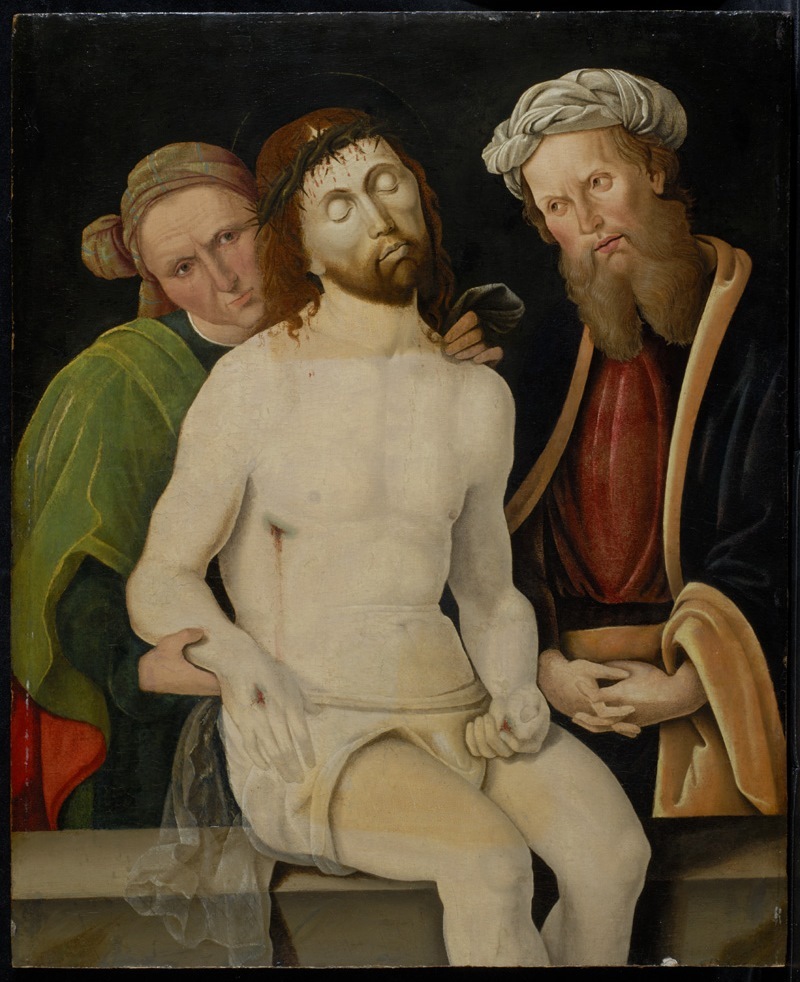
Dead Christ with Nicodemus and Joseph of Arimathea
Ferrara, c. 1470? – Ferrara, before 1513
width: 49,5 cm
Description and further information
The fourteenth and fifteenth centuries were a flourishing period for the veneration of the Eucharist and the cults associated with it. As a consequence, the so-called Pietà image, presenting the dead Christ as a sacrifice, became a frequent subject in Italian painting. In the various formulations of this pictorial type, the helpless body of the Redeemer is supported by accompanying figures: usually the Virgin Mary and Saint John the Apostle, Joseph of Arimathea and Nicodemus, or, as in the present painting, two angels.
The angels, their faces distorted by grief, both support and present to the devout viewer of the painting the lifeless body, masterfully wrapped in a burial shroud, which rises from a marble sarcophagus shown in foreshortening. The emotionally charged representation invites contemplation of Christ’s sacrifice, alluding to the parallel between his body and the Host offered in the sacrifice of the Mass.
The origin of the painting long remained uncertain, and scholars sought its author among the Venetian, Veronese, and Paduan schools. Only more recently, in 1996, was the name of the great Florentine painter Filippo Lippi proposed. According to Andrea De Marchi’s well-founded hypothesis, the painting may have been made during Lippi’s stay in Padua, in 1433, and may originally have formed the central panel of a triptych whose wings depicted the mourning Virgin and Saint John the Apostle. The painterly conception is indeed related to Lippi’s early works, although the condition of the painting makes the assessment of authorship difficult. Dóra Sallay, 2002, museum website.
Copy after Pietro Perugino (Williamstown, The Clark Art Institute, c. 1494–1498, 92.6 × 71.8 cm, inv. no. 1955.947). In style, the painting is extremely close to an altarpiece in Hanover (Hanover, Landesmuseum, 118.5 × 82.5 cm, inv. no. 266; see Tátrai 1993). That painting is attributed to Domenico Panetti, although the names of Lazzaro Grimaldi and Geminiano Benzoni have also recently been proposed in connection with it (Toffanello, Marcello: “Domenico Panetti,” in Dizionario Biografico degli Italiani, vol. 80, 2014).
Csenge Béres, 2022.
Provenance
Simor collection. Purchased from the Bertinelli estate in Rome in 1878.
Bibliography
- Sallay Dóra: Raffaele Bertinelli és reneszánsz képtára. Egy műgyűjtemény útja Rómától Esztergomig. Esztergom, 2009, 58, 61, 63, 66-67, 94, 152, XXXII. sz., korábbi irodalommal (közép-itáliai festő, 16.sz. eleje)
- Brown, David Alan: Andrea Solario. L’opera completa. Milánó, 1987
- Mojzer Miklós: Tanulmányok a Keresztény Múzeumban, I. Művészettörténeti Értesítő, XIII/3, 1964, 214–226
- Tátrai Vilmos, in Keresztény Múzeum 1993, 239, 122. sz. (Domenico Panetti?, 16. sz. eleje)
- Brown 1987, 131, 12. jegyzet (ua.)
- Mucsi 1975, 49, 238. sz. (ua.)
- Mojzer 1964, 217 (ua., Perugino után)
- Boskovits–Mojzer–Mucsi 1964, 93–94 (ua.)
- Prokoppné Stengl 1960, 98
- Mojzer 1958, 9 (Domenico Panetti
- Berti Toesca 1932, 959 (ua.) – Genthon 1948, 61 (ua.)
- Gerevich 1928, 232 (Domenico Panetti)
- Maszlaghy 1878 és 1891, 92. sz. (Mantegna iskolája)