

Italian renaissace and baroque painting (permanent exhibition)
Saint Anthony of Padua, Saint Bernardino of Siena, Saint Dominic
Venice, 1430/35 – Marche, 1494/95
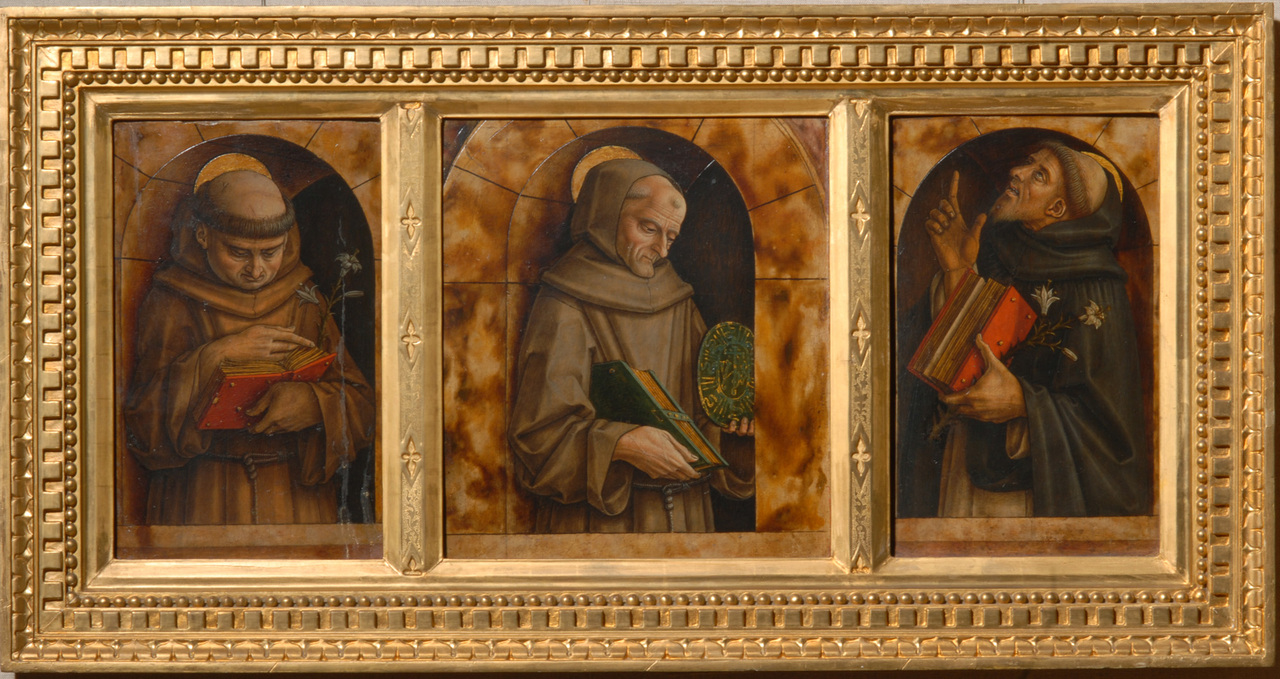
Description and further information
The three small panels depicting three mendicant friars — two Franciscan saints and the eponymous saint of the Dominican Order, who was also venerated by the Franciscans — are fragments of the former predella of an altarpiece from the church of San Francesco in Fabriano. The other parts of the altarpiece are also known: the main panel, the Coronation of the Virgin, and the lunette, the Pietà, belong to the Brera Gallery in Milan; the fragment with the Blessing Christ, which once occupied the centre of the predella, and a fragment depicting Saint Onuphrius are preserved in the Castel Sant’Angelo in Rome; while two further sections, each representing three saints, entered the Musée Jacquemart-André in Paris.
According to the inscription on the main panel, the altarpiece is a work by Carlo Crivelli dated 1493 — thus his last known dated work. Carlo trained in Padua and in his native Venice, but after a moral scandal he was forced to flee his home city. Thereafter, until the end of his life, he painted in Dalmatia and in the Marches, producing works of extraordinary refinement, often seasoning his sophisticatedly decorative, dry style with gentle irony. He adapted his paintings to the conservative taste of his patrons, while also remaining attentive to the achievements of his contemporaries: here, for example, the figures appear within the space of an illusionistically painted Renaissance architecture.
Dóra Sallay, 2002, website.
Crivelli, trained in the Paduan-Venetian school, spent most of his life in the small principalities of the Marches, adapting his highly original, consciously archaizing art to the conservative tastes of his patrons. In creating his magnificent multi-compartment altarpieces, he painted figures, garments, and still-life accessories in such a way that every detail possesses, simultaneously and to a high degree, naturalistic, illusionistic, decorative, and expressive value.
Although he never painted portraits, few of his contemporaries could rival his ability to render character. The jovial Saint Anthony is absorbed in reading; with a delicate gesture he is about to turn the page, pressing the book almost tenderly to himself. His plump, wrinkled face, seen in foreshortening as he bends over the book, recalls the impact that Mantegna’s art in Padua had on the young Crivelli. The features of Saint Bernardino, familiar from so many images, are repeated in caricatured form in the predella panel. The Sienese preacher appears within a frame imitating a monastery window as a bitter old man turned away from the world. The unctuous Saint Dominic turns his face, wearied by self-mortification, towards heaven, pointing upwards with his finger as well. Crivelli paints saints who are more pitiably frail than awe-inspiring.
Vilmos Tátrai, 1993.
Provenance
Simor collection. Purchased from the Bertinelli estate in Rome in 1878.
Bibliography
- Sallay Dóra: Raffaele Bertinelli és reneszánsz képtára. Egy műgyűjtemény útja Rómától Esztergomig. Esztergom, 2009, 93, kat. sz. XXVI.
- Marina Massa, in Costanzi szerk. 2005, 117–118, 42. kat. sz. (ua.)
- Lightbown 2004, 455–461 (ua.)
- Giorgio Fossaluzza, in Di Lorenzo szerk. 2002, 82–85 (ua.)
- Montironi 2000 (ua.)
- Chastel 1993, 60. sz., 196–197, 278–279 (ua.)
- Tátrai Vilmos, in Keresztény Múzeum 1993, 234–235, 111. sz., korábbi irodalommal (ua.)
- Zampetti 1986, 299–301 (ua.)
- Mravik 1978 (2. kiad. 1983), 31 (ua.)
- Bovero 1975, 101 (ua.)
- Boskovits–Mojzer–Mucsi 1964, 94–98, korábbi irodalommal (Carlo Crivelli)
- Zampetti szerk. 1961, 132–133 (Carlo Crivelli késôi mûvei)
- Zampetti 1961, 62, 97 (Carlo Crivelli)
- Zeri 1961a, 174–176 (Carlo Crivelli, 1493, predella rekonstrukciója)
- Berenson 1957, I, 71 (Vittorio Crivelli)
- Gerevich szerk. 1948, 66 (Carlo Crivelli)
- Berenson 1936, 140 (Vittorio Crivelli)
- Van Marle 1923–1938, XVIII (1936), 60 (Carlo Crivelli)
- Colasanti 1932, 72–73 (Carlo Crivelli követôje)
- Berti Toesca 1932, 956 (Carlo Crivelli)
- Berenson 1932, 163 (Vittorio Crivelli)
- Gerevich 1928, 238 (Carlo Crivelli)
- Colasanti 1910a, 407 és 1910b, iii (Vittore Crivelli)
- Rényi 1879, 15 (ua.)
- Maszlaghy 1878 és 1891, 93. sz. (Carlo Crivelli)