

Italian renaissace and baroque painting (permanent exhibition)
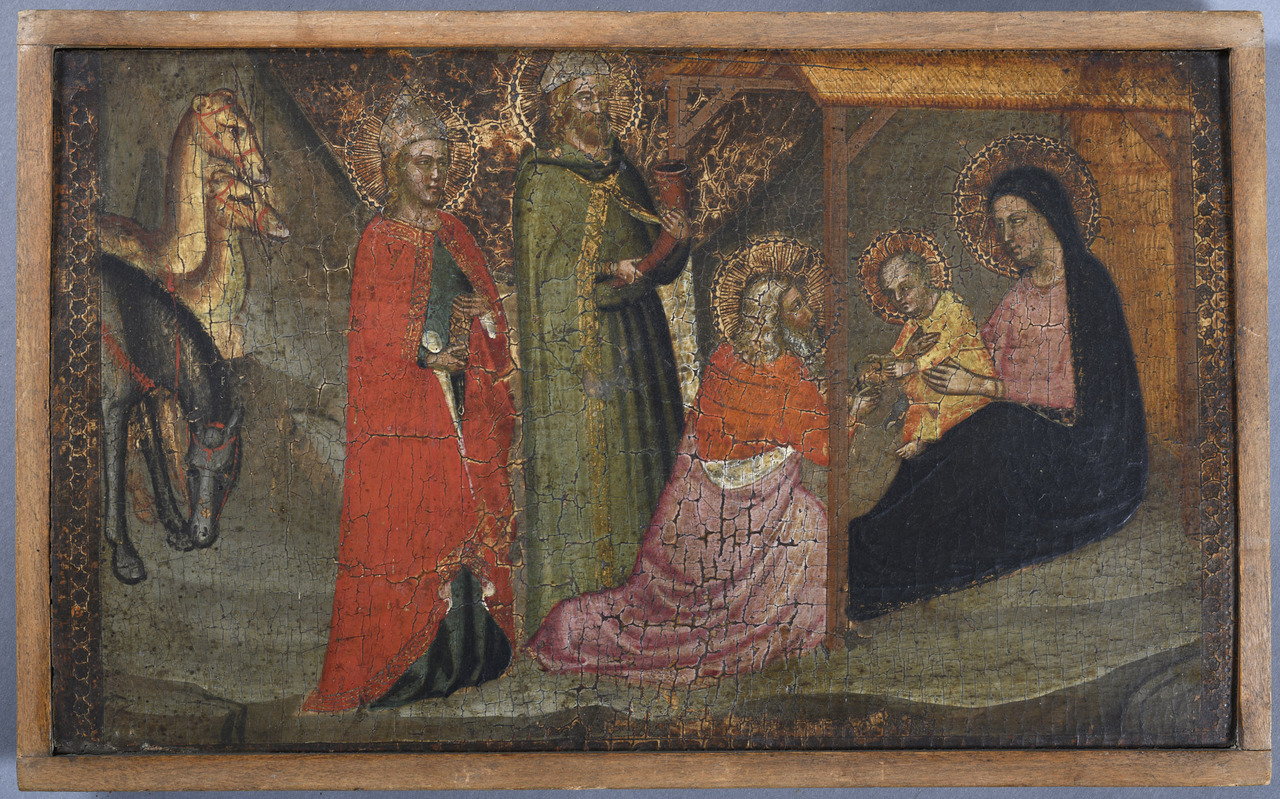
Adoration of the Magi
active c. 1280 - 1348
width: 36 cm
Description and further information
At the centre of the painting stand the kings, who approach from the left to adore the Child. The Madonna is seated on the ground at the right edge of the picture, in an open stable with a thatched roof. She wears a red, long-sleeved dress and a blue mantle, the colour of which has now darkened. With both hands she holds her Child, dressed in a long golden-yellow garment, who is leaning forward towards the gift of the kneeling aged king: a golden vessel. The second king stands slightly farther back, wearing a green robe and mantle and holding in his hand the horn-shaped cup filled with myrrh. To his right stands the young king, dressed in blue with a vermilion-red mantle over it, holding with both hands the golden vessel containing frankincense. On his head is a golden-yellow, cap-like crown. The central king must have worn a similar head ornament, but as a result of the painting’s mutilation it is no longer visible today. The faces of all three kings are emphasized by radiant haloes, appropriate to saints. The two standing kings are further accentuated by the wedge-shaped field of gold projecting into the upper part of the painting. At the left edge of the scene, before the rocky background, two yellow camels and a grey horse are waiting. The painter places the encounter between the Child and the aged king along the diagonal axis of the picture. The two other kings stand in a plane parallel to this axis. The depth of space is suggested by arranging the figures one behind another.
In this work by a follower of Bernardo Daddi, Jesus is not shown as an infant, as in Giotto and his pupils, and also in Daddi’s London triptych, but—following the apocryphal writings (Pseudo-Matthew 16)—as a child of about one year old, as seen in early fourteenth-century painting in Siena and Assisi. In the painting, the vivid colour and immediacy characteristic of Sienese Trecento painting are combined with solemn simplicity. (Prokopp Mária, 1993)
Provenance
Ipolyi collection
Bibliography
- Cséfalvay Pál, szerk.: Keresztény Múzeum, Esztergom. Budapest, 1993. Corvina, 215, kat.sz. 72. "Bernardo Daddi követője" (Prokopp Mária)
- Boskovits Miklós: Korai olasz táblaképek, Budapest, 1966. 12. "Bernardo Daddi követője, 1330-as évek"
- Boskovits Miklós-Mojzer Miklós-Mucsi András: Az esztergomi Keresztény Múzeum képtára. Budapest, 1964. Akadémiai Kiadó, 29. "Bernardo Daddi követője, 1340-es évek"
- Magyarország műemléki topográfiája I. Esztergom 1. Esztergom műemlékei (összeállította: Genthon István; Budapest 1948) "romagnai 14. századi festő"
- Gerevich Tibor: Esztergomi Műkincsek, in Prímás Album, Budapest 1928,179-263. "romagnai 14. századi festő"