

Italian renaissace and baroque painting (permanent exhibition)
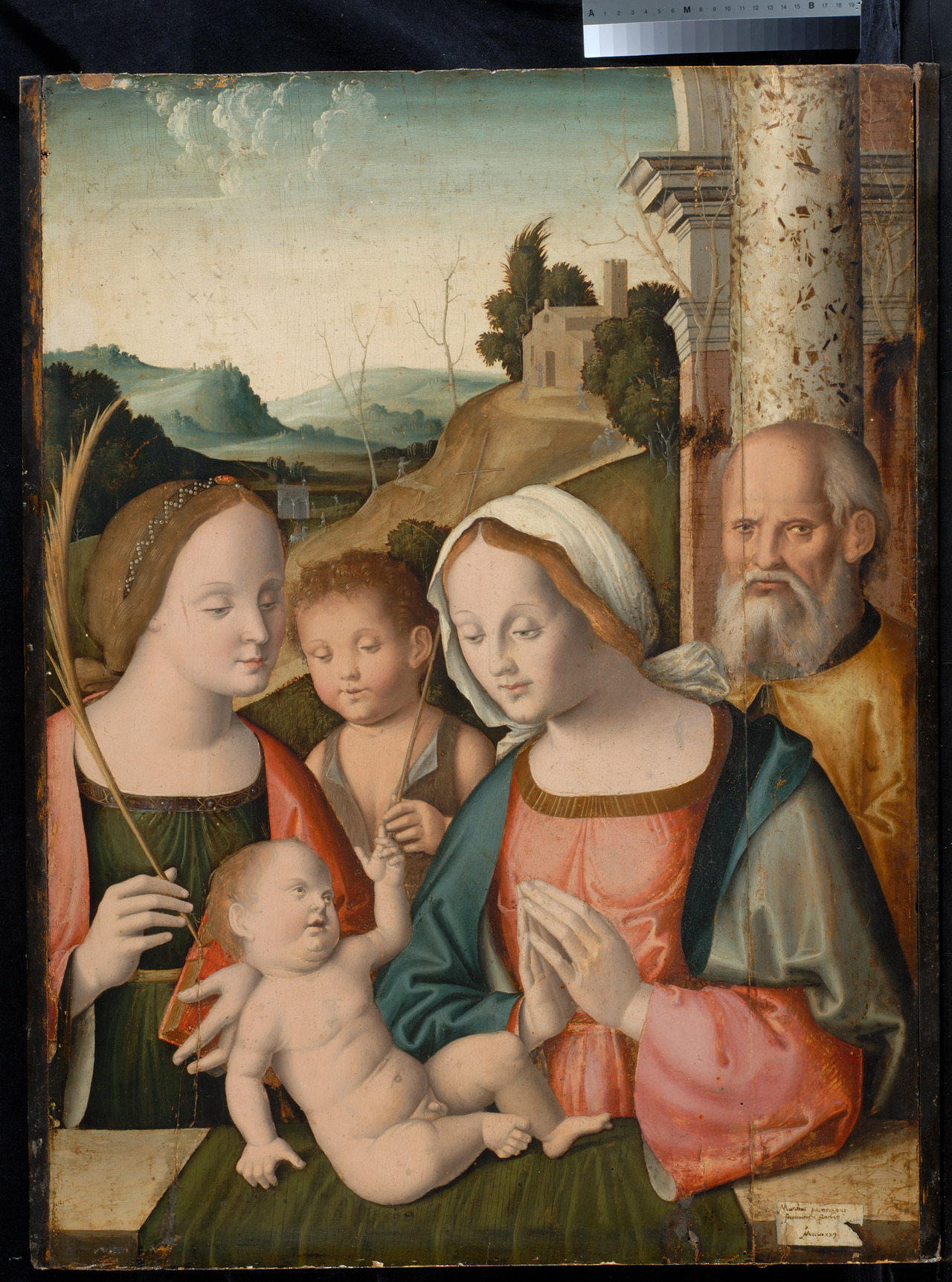
The Holy Family with Saint Catherine of Alexandria and Saint John the Baptist
Forlì, 1458/63 – Forlì, 1539
width: 65 cm
Description and further information
A fragmentary surviving version of the same composition is preserved in the storeroom of the Museum of Fine Arts, Budapest, while another variant — in which Saint Sebastian appears with Saint Catherine — is likewise a treasure of the Christian Museum. The dates are no longer legible on these two variants, and so we do not know how much earlier or later they were painted than the 1529 version reproduced here. It may be assumed that Palmezzano and his workshop continued to use the same compositional schemes for several years whenever these proved successful among patrons.
Marco Palmezzano’s finest works date from the few years immediately before and after the turn of the century. At that time, the lessons he had learned from Melozzo da Forlì were still fresh in his mind, and his paintings attained a high artistic level through their clear spatial construction, brilliant colours, and plastic force. In later years the painter, who worked mostly in Forlì, no longer reached the standard represented, for example, by the Coronation of the Virgin in the Brera, Milan. The structural rigour of his compositions loosened; he often fell into mannered self-repetition, and his art assumed a somewhat provincial character. Without being touched by the innovations of the Cinquecento, he remained throughout his career a continuator of the Paduan, Venetian, and Ferrarese Quattrocento traditions.
In this late work, before the adoring Virgin, the Christ Child sits on a parapet covered with green drapery, pointing towards heaven. On the left stands Saint Catherine, holding a book and a palm branch; on the right, emphasized by the motif of the corniced pier and the coloured marble column, and set apart from the other figures, Saint Joseph looks out at us with a grave, prophetic gaze. Between Mary and Saint Catherine appears the figure of the infant John the Baptist. Despite the interrelation of gestures and glances, the five figures do not form a true group; rather, they seem like busts placed beside and behind one another. The landscape in the background is drawn with somewhat greater liveliness, with curving hills and an evocative detail of a church emerging among trees with dense foliage.
Vilmos Tátrai, 1993.
Provenance
Simor collection. Purchased from the Bertinelli estate in Rome in 1878.
Bibliography
- Cséfalvay Pál, szerk.: Keresztény Múzeum, Esztergom. Budapest, 1993. kat. sz.129. (Tátrai Vilmos)
- Sallay Dóra: Raffaele Bertinelli és reneszánsz képtára. Egy műgyűjtemény útja Rómától Esztergomig. Esztergom, 2009
- Togneri Dowd szerk. KATALÓGUS 9
- Mravik 1975, 55, 168 (ua.)
- Berenson 1968, I, 314 (ua.)
- Boskovits–Mojzer Mucsi 1964, 99, korábbi irodalommal (ua.)
- Grigioni 1956, 103–104, 354, 529 (ua.)
- Gerevich szerk. 1948, 86 (ua.)
- Berenson 1932, 414 (ua.)– Berenson 1936, 356 (ua.)
- Berti Toesca 1932, 958 (ua.)
- Gerevich 1928, 236 (ua., késôi mû)
- Colasanti 1910a, 407 és 1910b, iii (ua., a mester egyik legszebb mûve)
- Rényi 1879, 17 (ua.)
- Maszlaghy 1878 és 1891, 107. sz. (Marco Palmesano)