

Italian renaissace and baroque painting (permanent exhibition)
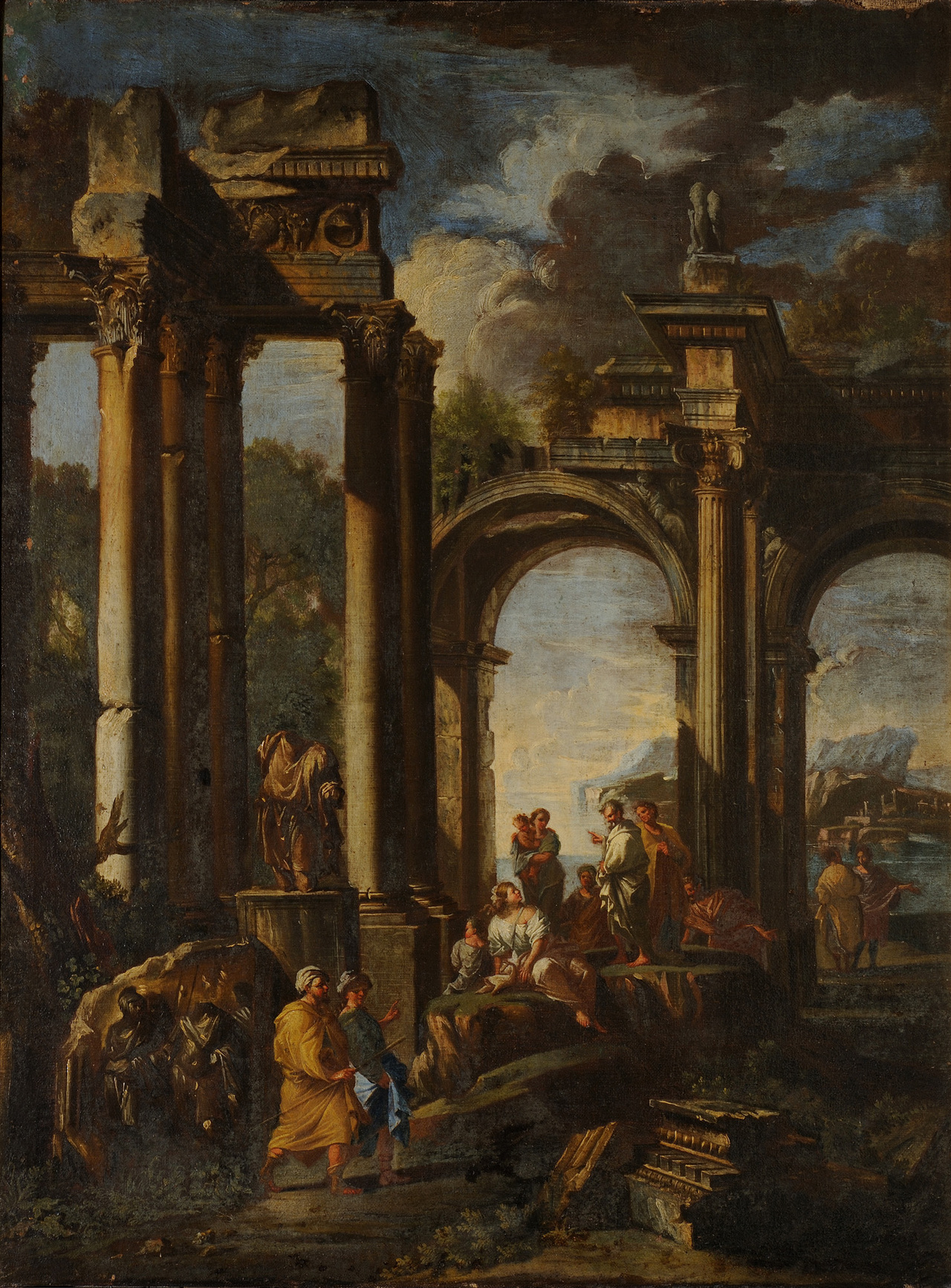
Ancient Ruins with Figures
The Preaching of an Apostle (?)
Piacenza, 1691 - Rome, 1765
width: 73,5 cm
Description and further information
The relationship of seventeenth- and eighteenth-century painters to antiquity was more complex than that of their Renaissance predecessors. In the artistic remains of the classical age, they no longer saw only a living cultural heritage. For them, ancient ruins were documents of both past and present; antiquity was also an existing reality that shaped artistic imagination, a romantic and picturesque element of the everyday environment.
The remains of ancient Rome and its famous buildings already appear in the works of Seicento veduta painters as settings of daily life, even in city views and street scenes that record the view with topographical intent. Unlike landscape painters who sought to represent reality faithfully, Panini — who was also an architect, and a designer and decorator of large-scale festivities and public ceremonies — could approach the monuments of ancient and more recent architecture as a painter in only one way: he regarded their characteristic motifs as painterly scenery, from which he created spectacular “stage sets” populated with staffage figures. With a few exceptions — such as the Arch of Titus, the Pyramid of Cestius, the Pantheon and Other Buildings in the Musée Fabre, Montpellier; the View of the Forum and the Colosseum in the Gemäldegalerie, Berlin; and the Views of Ancient Rome and Views of Modern Rome in the Metropolitan Museum of Art, New York — his works contain more painterly fantasy than concern for historicity or factual reality. His paintings are often antiquizing capricci without a basis in a specific landscape experience, in which formal inventiveness and freedom are combined with a light, sketch-like manner of painting, usually bright colours, and shimmering effects of light.
Panini’s monographer, Ferdinando Arisi (1961), places the painting among the artist’s earliest works, around 1709–1710, in his initial Piacenza period. Enikő Buzási, 1993.
Bibliography
- Cséfalvay Pál, szerk.: Keresztény Múzeum, Esztergom. Budapest, 1993.
- Ragghianti, C. L.: Giovanni Paolo Panini. Sele d'Arte X (1962) 53; Mucsi 1975 , 56
- Fabretti, G.: Giovanni Paolo Panini. Emporium, 1962. 44-45;
- Arisi, F.: Gian Paolo Panini. Piacenza, 1961. 32, 36-37, 109;
- Boskovits-Mojzer-Mucsi 1964, 108;
- David R. Marshall. in: Artibus et Historiae Vol. 18, No. 36 (1997), pp. 137-199
- Early Panini Reconsidered: The Esztergom "Preaching of an Apostle" and the Relationship between Panini and Ghisolfi