

Medieval Netherlandish Painting (Permanent Exhibition)
Landscape with Saint Anthony the Hermit, Saint Roch and Saint Christoph
width: 84 cm
Description and further information
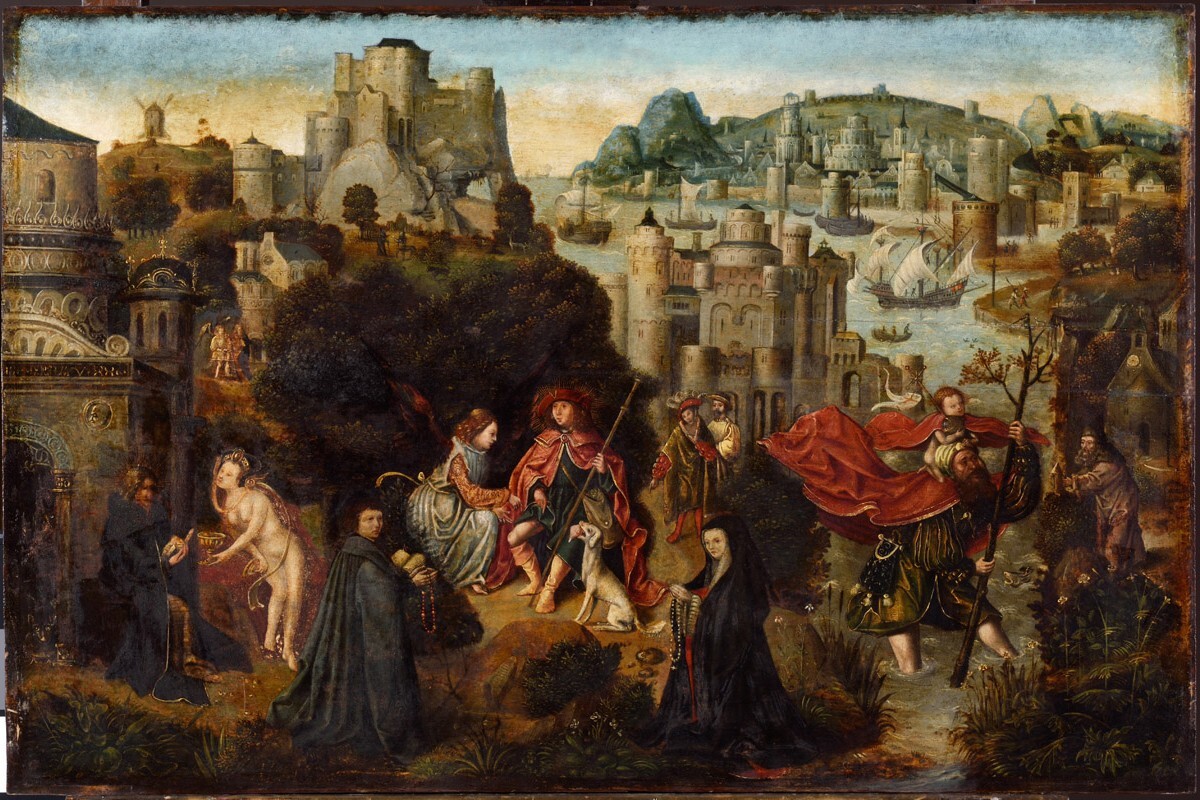
The painting belongs to the genre of the so-called Weltlandschaft, or “world landscape”, which became fashionable from the early sixteenth century onwards. In such works, the landscape is viewed from an elevated perspective, combining features associated with different parts of the world—mountains, rivers, forests and seas—within an imagined panoramic setting. In the Esztergom painting, the small figures are of only secondary importance compared with the crowded background, which is enlivened by waterfront towns and sailing vessels. The figures represent episodes from the lives of three saints, together with a donor couple in the foreground. At the left edge of the painting is the Temptation of Saint Anthony. Seated before an ornate Renaissance stone gateway and dressed in a black habit, the saint is approached by the tempter in the form of a voluptuous naked woman. At the centre of the composition, in a prominent position and flanked by the donors, stands the elegantly dressed Saint Roch. He wears a red cloak over a blue tunic and a red hat, and is shown revealing the plague wound on his thigh to the angel who is healing him. At his left foot sits the hunting dog that, according to legend, brought food to the saint.
At the right edge of the painting is Saint Christopher, represented in a manner familiar from earlier depictions. Leaning on a massive staff, he crosses the river carrying on his shoulder the Christ Child, who bears the sins of humanity. On the opposite bank, in keeping with pictorial tradition, a hermit awaits him with a lantern. According to the legend, it was this hermit who guided Christopher towards the Christian faith through his counsel.
Further episodes from the saints’ legends and additional narrative details can be discovered in the background landscape. This type of simultaneous representation was already known in Gothic painting and remained common in sixteenth-century Netherlandish art. The three principal scenes, however, are entirely independent of one another and are integrated into the surrounding landscape so awkwardly that their compositions were evidently not invented by the painter, but derived from clearly identifiable visual sources.
The combination of the three saints within a single imaginary landscape may have reflected the wishes of the patron or patrons. The donor couple, dressed in simple bourgeois clothing, kneel in the foreground with their hands clasped in prayer and rosaries held between their fingers. Their depiction likewise follows Gothic tradition, yet no evidence survives that would allow their identity or origin to be established.
Nor do we know how the three saints represented in the painting were connected with the donors’ lives. They may have appealed to their patron saints, or perhaps sought the aid of these widely venerated holy figures in times of illness or before undertaking a long journey.
The panel was painted by an as yet unidentified master who was familiar with contemporary Netherlandish painting while continuing to follow earlier artistic traditions.
(Emese Sarkadi Nagy, 2015)
Provenance
Provenance
Purchased by Arnold Ipolyi from the J. Fromm collection.
Exhibitions
- 2015 Sankt Pöten, Diözesanmuseum, Meisterwerke aus dem Keresztény Múzeum
Bibliography
- Wolfgang Huber (szerk.): Meisterwerke aus dem Keresztény Múzeum; kiáll.kat; Sankt Pölten 2015. 140 (Sarkadi Nagy Emese)
- Ágota Varga: Acquisitions by Arnold Ipolyi from the Johann Friedrich Fromm Collection in Cologne. In: Geest en Gratie. Essays presented to Ildikó Ember on her Seventieth Birthday. Budapest, 2012, 162-171, 170.
- Ágota Varga: Saints in a Landscape by a follower of Jacob Cornelisz van Oostsanen in Esztergom, MA thesis, Pázmány Péter Catholic University, 2005, publikálatlan
- Cséfalvay Pál, szerk.: Keresztény Múzeum, Esztergom. Budapest, 1993, 209 (János Végh)
- Ipolyi Arnold Emlékkönyve. Halálának századik évfordulója alkalmából az Esztergomi Keresztény Múzeumban 1986. december 12-én rendezett emlékülés anyaga. Szent István Társulat, Budapest 1989, 109.
- Mucsi András: Az esztergomi Keresztény Múzeum Régi Képtárának katalógusa. Budapest, 1975, 30.
- Friedlander, Max J. Early Netherlandish Painting XII Leyden-Brussels, 1975, Kat. Nr. 280.
- Mojzer Miklós: Tanulmányok a Keresztény Múzeumban. I. Művészettörténeti Értesítő 1964/3, 225.
- Boskovits Miklós-Mojzer Miklós-Mucsi András: Az esztergomi Keresztény Múzeum képtára. Budapest, 1964, 194.
- Magyarország műemléki topográfiája I. Esztergom 1. Esztergom műemlékei. összeállította: Genthon István, Budapest, 1948, 102.