

19th–21st-Century Painting (Permanent Exhibition)
Last Supper
Battonya, 1894 - Budapest, 1981
width: 146 cm
Description and further information
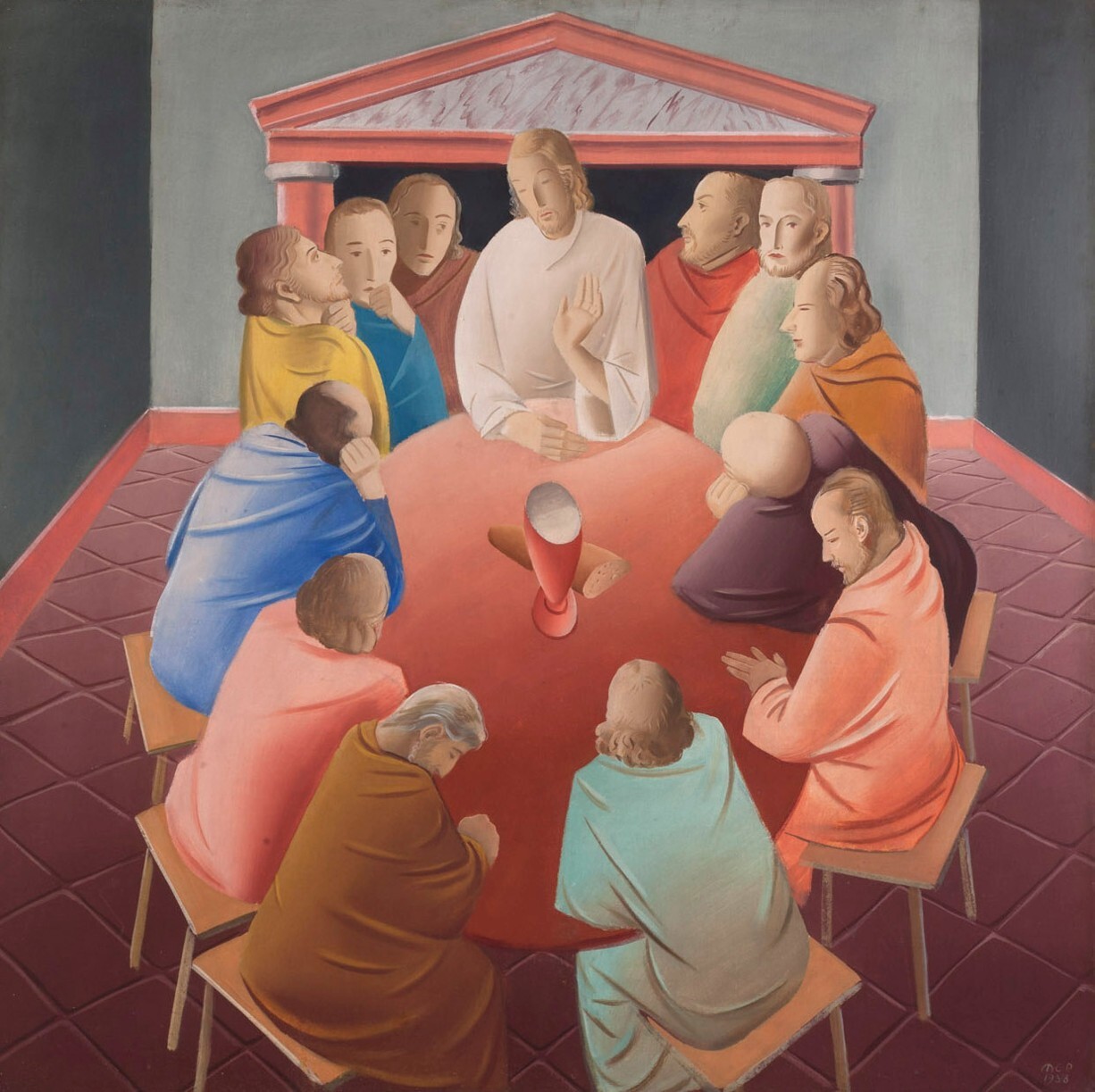
During the period between the two World Wars, artists were supported by state scholarships that enabled them to spend extended periods of study in Rome. One of the openly acknowledged aims of this support was the renewal of ecclesiastical art. In this way, creative artists were trained who, equipped with art-historical knowledge, were able to fulfil church commissions at a contemporary artistic standard. Pál Molnár C. lived in Rome between 1928 and 1931. After his return, he painted altarpieces and murals in several churches. Following the Communist takeover, however, he received hardly any further commissions. The distinctive optics of this Last Supper scene, viewed from above, presents the apostles seated around Jesus as if seen through the viewing aperture of a peep-box. The concentric circles of the interior arrangement narrow inward, culminating in the Host of the Eucharist. The essential, matter-of-fact mode of representation associated with the “New Objectivity” directs attention to the very core of the depicted story.
Ildikó Kontsek
Provenance
Gift of the artist’s heirs
Exhibitions
- 1983. Római Iskola. Keresztény Múzeum, Esztergom
- 2015. "Meisterwerke ..." Diözesanmuseum, St. Pölten
- 2019. "Agnus Dei" Pesti Vigadó, Budapest
Bibliography
- Rákossy Anna, Kontsek Ildikó (szerk.), Agnus Dei - Az Oltáriszentség tisztelete Magyarországon. Időszaki kiállítás a Pesti Vigadóban. Katalógus bevezető tanulmányokkal. Keresztény Múzeum, Esztergom, 2019. 1. kép, 11, kat. sz. 2.4
- Wolfgang Huber (szerk.): Meisterwerke aus dem Keresztény Múzeum; kiáll.kat; Sankt Pölten 2015., 168. (Kontsek Ildikó)
- P. Szűcs Julianna: Római iskola I.. Keresztény Múzeum, Esztergom, 1983, kat. 85.