

Medieval Hungarian, Austrian and German Painting and Sculpture
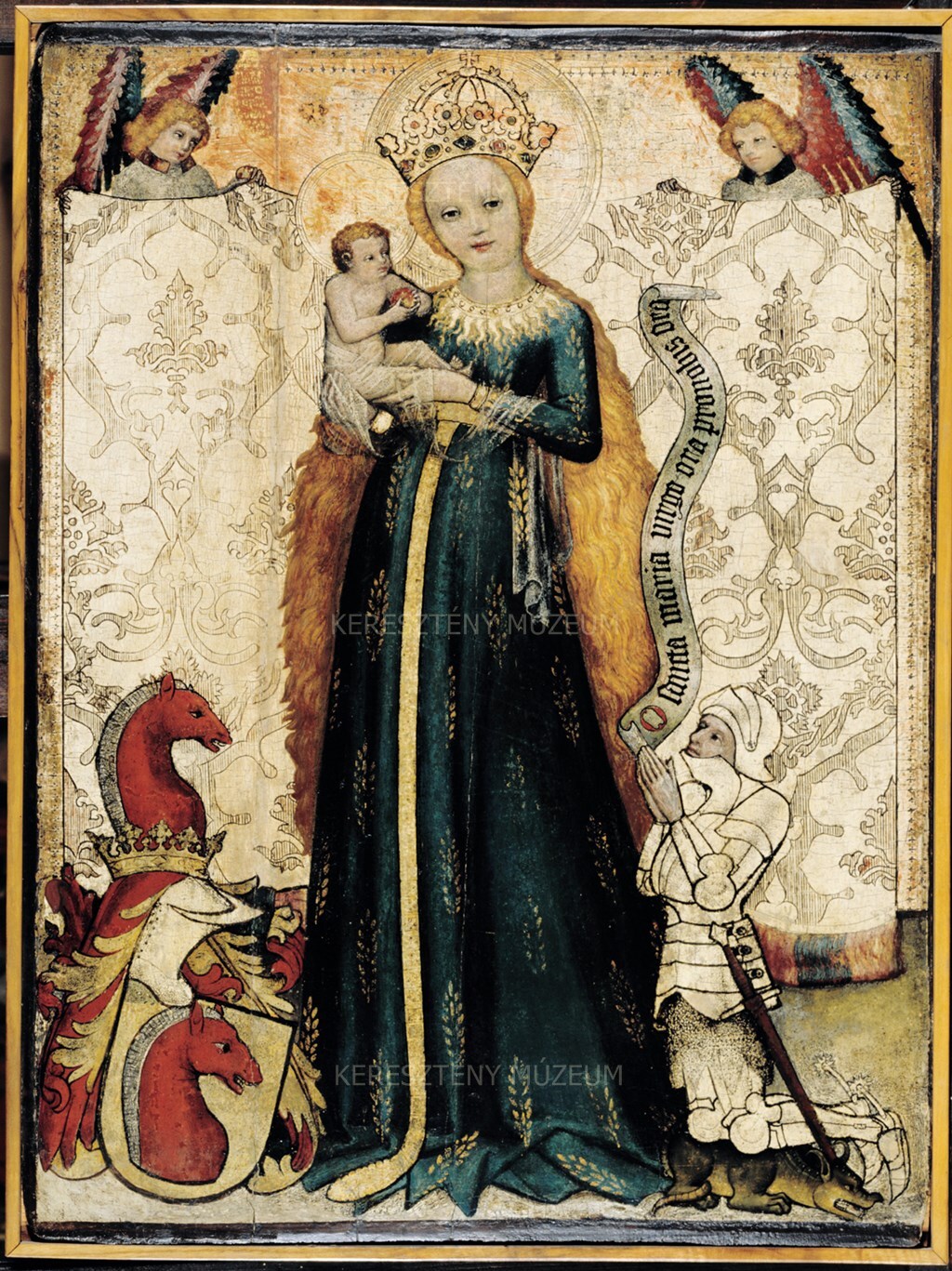
Madonna with Ears of Wheat, with a depiction of the donor
width: 45 cm
Description and further information
In the 15th century, north of the Alps, the image of the Madonna with ears of wheat, originating from Milan, was very widespread. Mary is shown in a robe decorated with wheat, referring to her miraculous fertility. The known depictions show the Virgin Mother with her hands clasped in prayer, or, less frequently, holding the Child; her blue attire is decorated with gold ears of wheat and, around the neck, rays of light and is secured at the waist with a long cincture that drapes to the floor; her hair is long, thick, golden and flowing. In the Esztergom image, a donor is shown as an armoured knight kneeling on a dragon, to the right of Mary’s feet: rising from his hands, clasped in prayer, is a banderol with the inscription: "O sancta Maria virgo ora pro nobis ora". On the opposite side of Mary is the donor’s coat of arms, which identifies him as a member of the Praun family. The coat of arms, accompanied by a large mantling, displays a red horse’s head turning left against a silver background.
The brocade curtain held by two angels in the background was at one time silver lustred, which, like the gilded surface above it, had become strongly abraded and later was almost completely destroyed as a result of an early restoration project. The silver gilding on the knight’s armour and the heraldic helmet probably suffered a similar fate.
The exact place of origin of the panel is unknown. It was among the objects purchased perhaps in the area of Wiener Neustadt by the painter and copper engraver Blasius Höfel. This piece of information and the coat of arms led Richerd Perger to identify the donor as Bernhard Praun, the servant, or Diener, of Albert II and later Frederick II. Mentioned several times in the sources, Praun, who lived in Vienna and Wiener Neustadt, was from Salzburg and almost certainly decided to order the painting from the master’s Salzburg workshop because of his family’s origins in Salzkammergut.
The master named for the Altar of Hallein represented the style characteristic of Salzburg painting of the mid-15th century. His works displayed elements of the waning Soft Style, such as the entirely translucent cloth covering the Child’s groin, with the end of the cloth lifted by Mary’s left lower arm. At the same time, certain figure types and faces created by the painter reveal a shift toward the succeeding stylistic period, influenced by Netherlandish painting.
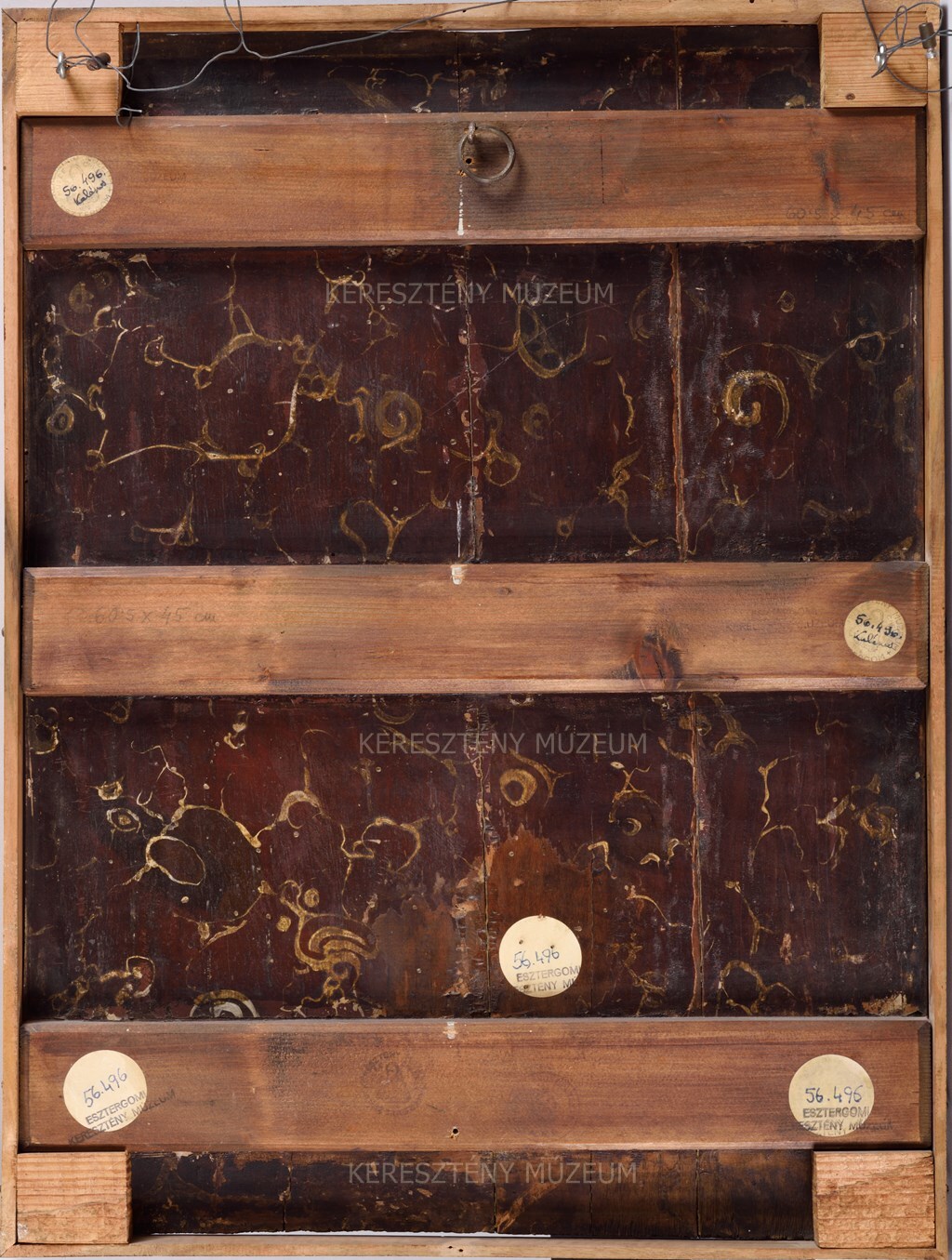
The decorative painting on the reverse imitates red-white marble.
Provenance:
Initially in the collection of Blasius Höfel in Wiener Neustadt, before being acquired by Karl Lemann and then Arnold Ipolyi. “29. Madonna egész alakban, ezüstalapon, előtte térdelő pánczélos lovag czímerrel. Halottas kép deszkán, XV. sz. Német. Rongált. 3 részre hasadva.” (Lakatos-Balla-2012 280)/‘29. Full-length figure of the Madonna, on a silver ground, with an armed knight with coat of arms kneeling before her. Image of the deceased on a panel, 15th c. German. Damaged. Split into 3 parts.’/
Restoration:
Restored at an unknown time, perhaps in the 19th century
Bibliography:
Verzeichniss-1839, 30. sz. – Stiassny, Robert: Altsalzburger Tafelbilder. In: Jahrbuch der Kunsthistorischen Sammlungen des Allerhöchsten Kaiserhauses 24 (1903), 50, 79, 85. – Frimmel-1914, 179. – Gerevich-1930, 87. – Pigler Andor: La vierge aux épis. In: Gazette des Beaux-Arts 74/2 (1932), 136. – Pigler-1934, 134. – Éber László: Könyvismertetés az Archaeologiai Értesítő új kötetéről (review). In: Magyar Művészet 10 (1934), 255. – Pigler Andor: Pótlások az «Evagationes Spiritus» című cikkhez. In: Archaeologiai Értesítő 47 (1934), 169. – Genthon-1948, 127. – Czobor-1955, 13. – Mojzer-1958, 14. – Stange 1960 X. 17-18. – Boskovits-Mojzer-Mucsi-1964, 155-156. – Végh János: XV. századi német és cseh táblaképek, Budapest 1967, 19-20. sz. – Beate Rukschcio: Maria im Ährenkleid mit Stifter (Kat. no. 28.). In: Spätgotik in Salzburg. Die Malerei 1400-1530 (Kat. Salzburg: Museum Carolino Augusteum, 1972. május 26 – október 1), Salzburg 1972, 63-64. (Beate Rukschcio) – Mucsi András: Az esztergomi Keresztény Múzeum régi képtárának katalógusa, Budapest 1975, 24. – Perger, Richard: Der Stifter der Maria im Ährenkleid im Christlichen Museum in Esztergom. In: Österreichische Zeitschrift für Kunst und Denkmalpflege 33 (1979), 16-18. – Schiller, Gertrud: Ikonographie der christlichen Kunst, II., Gütersloh 1980, 165-169. – Englisch, Ernst – Vocelka, Karl: Madonna im Ährenkleid (VII. No. 5.). In: Die Ritter. Burgenländische Landesausstellung ( Kat. Burg Güssing, 1990. május 4 – október 28), Eisenstadt 1990, 259-260. – Cséfalvay-1993, 186 (Végh János). – Koppensteiner, Erhard: Madonna im Ährenkleid. In: Ars Sacra. Kunstschätze des Mittelalters aus dem Salzburg Museum, red. Peter Husty – Peter Laub, Salzburg 2010, 164-165. – Töll László: A harci vértezetek története. (A nyugat-európai hadviselésben alkalmazott testvédelmi rendszerek fejlődéstörténete a 10. századtól a 16. század közepéig.) Doctoral Dissertation, ELTE University 2010; 214. – Sankt Pölten 2015,131.
Provenance
Blasius Höfel gyűjteményéből Karl Lemannhoz, innen pedig Ipolyi Arnold gyűjteményébe került. “29. Madonna egész alakban, ezüstalapon, előtte térdelő pánczélos lovag czímerrel. Halottas kép deszkán, XV. sz. Német. Rongált. 3 részre hasadva.” (Lakatos-Balla 2012, 280)
Restauration
Ismeretlen időpontban, talán még 19. században történt beavatkozás
Exhibitions
- 1990 Burg Güssing
- 2015 St. Pölten
- 2023 Leogang (A), Bergbau- und Gotikmuseum
Bibliography
- Wolfgang Huber (szerk.): Meisterwerke aus dem Keresztény Múzeum; kiáll.kat; Sankt Pölten 2015.,131.
- Töll László: A harci vértezetek története. (A nyugat-európai hadviselésben alkalmazott testvédelmi rendszerek fejlődéstörténete a 10. századtól a 16. század közepéig.) Doktori Értekezés ELTE 2010; 214.
- Peter Laub, Salzburg 2010, 164-165.
- Koppensteiner, Erhard: Madonna im Ährenkleid. In: Ars Sacra. Kunstschätze des Mittelalters aus dem Salzburg Museum, red. Peter Husty
- Cséfalvay Pál, szerk.: Keresztény Múzeum, Esztergom. Budapest, 1993. Corvina, 186 (Végh János).
- október 28), Eisenstadt 1990, 259-260.
- Vocelka, Karl: Madonna im Ährenkleid (VII. No. 5.). In: Die Ritter. Burgenländische Landesausstellung ( Kat. Burg Güssing, 1990. május 4
- Englisch, Ernst
- Schiller, Gertrud: Ikonographie der christlichen Kunst, II., Gütersloh 1980, 165-169.
- Perger, Richard: Der Stifter der Maria im Ährenkleid im Christlichen Museum in Esztergom. In: Österreichische Zeitschrift für Kunst und Denkmalpflege 33 (1979), 16-18.
- Mucsi András: Az esztergomi Keresztény Múzeum régi képtárának katalógusa, Budapest 1975, 24.
- október 1), Salzburg 1972, 63-64. (Beate Rukschcio)
- Beate Rukschcio: Maria im Ährenkleid mit Stifter (Kat. no. 28.). In: Spätgotik in Salzburg. Die Malerei 1400-1530 (Kat. Salzburg: Museum Carolino Augusteum, 1972. május 26
- Végh János: XV. századi német és cseh táblaképek, Budapest 1967, 19-20. sz.
- Boskovits Miklós-Mojzer Miklós-Mucsi András: Az esztergomi Keresztény Múzeum képtára (Budapest, 1964. Akadémiai Kiadó), 155-156.
- Stange 1960 X. 17-18.
- Mojzer Miklós: Az esztergomi Keresztény Múzeum képtárának útmutatója, Budapest, 1958,, 14.
- Czobor Ágnes: Az esztergomi Keresztény Múzeum kiállításának vezetője. Esztergom 1955., 13.
- Magyarország műemléki topográfiája I. Esztergom 1. Esztergom műemlékei (összeállította: Genthon István; Budapest 1948), 127.
- Pigler Andor: Pótlások az «Evagationes Spiritus» című cikkhez. In: Archaeologiai Értesítő 47 (1934), 169.
- Éber László: Könyvismertetés az Archaeologiai Értesítő új kötetéről (recenzió). In: Magyar Művészet 10 (1934), 255.
- Archaeologiai Értesítő ÚF. XLVI. 1932-1933 (1934). 121-136. 207-208., 134.
- esztergomi Keresztény Múzeum festményeinek történetéhez)
- Pigler Andor: „Evagationes spiritus” (Egy képmagyarázat és adatok az
- Pigler Andor: La vierge aux épis. In: Gazette des Beaux-Arts 74/2 (1932), 136.
- Évkönyve Bp. 1930, 87.
- Gerevich T. Az Ipolyi Gyűjtemény. Az Országos Magyar Képzőművészeti Társulat
- Theodor Frimmel: Lexikon der Wiener Gemäldesammlungen, II. München 1914, 179.
- Stiassny, Robert: Altsalzburger Tafelbilder. In: Jahrbuch der Kunsthistorischen Sammlungen des Allerhöchsten Kaiserhauses 24 (1903), 50, 79, 85.
- Verzeichniss einer Sammlung altdeutscher Gemählde...Wien 1839., 30. sz.