

Italian renaissace and baroque painting (permanent exhibition)
The Holy Family
Siena, 1570/71 – Rome, 1626
width: 142 cm
Description and further information
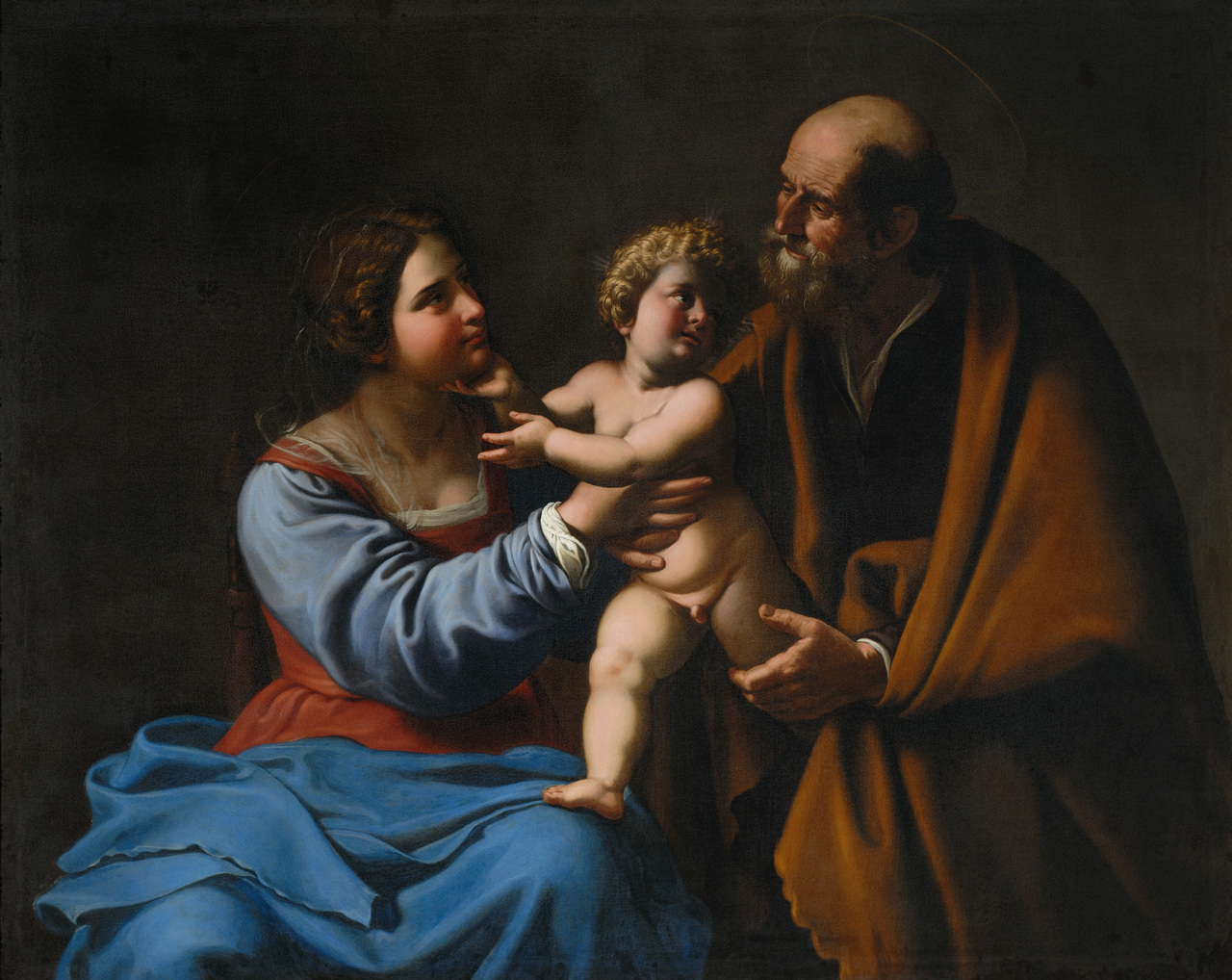
The Esztergom Holy Family may be understood as a symbol of the earthly Trinity: the Christ Child reaches towards Mary, yet looks at Saint Joseph. The two monumental figures, conceived as a unified group, are perfectly linked by the movement of the stepping Child and by the hands that hold him. In the blessing, stepping figure of Jesus in the Karlsruhe painting, the blessing Christ of the Resurrection is evoked.
In the earliest publications, the work was attributed to the Neapolitan painter Andrea Vaccaro. Antiveduto della Grammatica was a contemporary of Caravaggio, and his art occupies an important place among the Roman followers of the great Lombard master. Although he worked in Rome, this painting, which comes from a former Neapolitan collection and was recorded in the 1715 inventory of the Capece de Zurlo princely family as an “overdoor depicting the Flight of the Holy Family”, suggests that he may also have been active in Naples (R. Ruotolo, in Napoli nobilissima XII, 1973, pp. 119, 145–153).
The Virgin is seated before a deep reddish-brown background; the Christ Child steps onto her lap and turns towards Saint Joseph, who embraces him from the right. The painting is dominated by tones of blue, red, ochre and brown. A sharp chiaroscuro effect, reminiscent of the Lombard master, prevails in this work. The classically regular features of Mary can be recognised in several paintings by Antiveduto, including the Holy Family with Saint Anne in the Staatliche Kunsthalle, Karlsruhe, painted around the same time, circa 1618–1620.
Éva Nyerges, 2015.
Provenance
San Marco collection
Restauration
1993 Varga Dezső
Exhibitions
- 2015 St. Pölten, Diözesanmuseum, "Meisterwerke aus dem Keresztény Múzeum"
- 2019 Veszprém Érseki Palota, "Nápolytól Velencéig"
Bibliography
- Cséfalvay Pál, szerk.: Keresztény Múzeum, Esztergom. Budapest, 1993. 247-248, kat. sz. 143. (Buzás Enikő)
- https://www.magyarkurir.hu/hirek/napolytol-velenceig-kiallitas-veszpremben-az-italiai-barokk-festeszetet-remekeibol
- Wolfgang Huber (szerk.): Meisterwerke aus dem Keresztény Múzeum; kiáll.kat; Sankt Pölten 2015. 152-153. (Nyerges Éva)
- Riedl, H.Ph.: Antiveduto della Grammatica (1570/71-1626) Leben und Werk, München 1998, no. 39
- Szigethi, Á.: „Un dipinto sconosciuto di Antiveduto Gramatica e altri dati sulla sua opera1 in Acta Historiae Artium XXXIV (1989), 107-110.
- Papi, G.: „Note al Garamatica e al suo ambiente” in Paradigma 9, 1990, 107-127
- Papi, G.: Antiveduto Gramatica, Soncino 1995, no.70
- Nyerges in Milano 1993, no. 27 (Antiveduto Gramatica nápolyi alkotása )
- Szigethi in Acta Historiae Artium, 34 ( 1989), pp. 109-110, (Antiveduto Gramatica)
- Perez Sánchez, Alfonso E.: Caravaggio y el naturalismo español. Sevilla, 1973. Katalógus (az analógiákhoz 1, 26, 27, 28. kat. tételek); Dizionario Enciclopédico Bolaffi, VI. 130-132; L'Europa della pittura nel XVII. secolo (kiállítási katalógus). Milano, 1993
- Lcmghi, R.: Ultimi studi su Caravaggio e la sua cerchia. Proporzioni 1943. 32,54-55; Katalog Alte Meister bis 1800. Staatliche Kunsthalle, Karlsruhe. Szerk.: Lauts,Jan. Karlsruhe, 1966. Bd. I. 130;
- Szigethi BMH 1984 , 63, 157 Vö. Longhi, R.: Quesiti caravaggeschi. Pinacotheca, 1928/29. 19-20;
- Szigethi AH A 1978, 287-289;
- Mucsi András: Az esztergomi Keresztény Múzeum Régi Képtárának katalógusa. Budapest, 1975, 55;
- Mojzer ME 1964, 221 (Vaccaroként);
- Boskovits Miklós-Mojzer Miklós-Mucsi András: Az esztergomi Keresztény Múzeum képtára. Budapest, 1964. , 106. (Vaccaroként);